Delhi: Wife sedates husband with sleeping pills, lover electrocutes him to death

New Delhi, Jul 19 (PTI): A woman and her lover were arrested for allegedly killing her husband in Delhi's Dwarka, an official said on Saturday.
The incident came to light on July 13, when a call was made to the PCR from the Mata Rooprani Maggo Hospital in Uttam Nagar, reporting the death of Karan Dev (36).
Karan and his wife, Sushmita, have a six-year-old son, the official added.
Sushmita and her alleged lover Rahul Dev (24), who is the son of Karan's uncle, were arrested, a senior police officer said, adding that a relative found chats between the two on a social media platform planning to kill Karan.
Karan had slapped Sushmita on the festival of Karwachauth, which added to her emotional distress, police sources stated.
According to a preliminary investigation, Sushmita first allegedly drugged Karan by giving him sleeping pills, following which Rahul electrocuted him using the wire of an extension board, the officer added.
Sushmita allegedly mixed over 10 sleeping pills in Karan's food on the night of July 12, after which Rahul came to their residence in the morning and electrocuted him, he added.
Subsequently, Sushmita rushed to her in-laws' house nearby, telling them that Karan had collapsed, which prompted them to take him to the hospital.
He was brought to the hospital in an unresponsive state and declared dead with the medico-legal case (MLC) citing electrocution as the cause of death, sources said.
"Initially, the deceased's family did not raise any allegations and even wished to waive the post-mortem examination. However, considering Karan's relatively young age and to rule out any foul play, the post-mortem was conducted at Deen Dayal Upadhyay (DDU) Hospital," Deputy Commissioner of Police (Dwarka) Ankit Singh said.
On July 16, Karan's younger brother, Kunal Dev, approached the police, expressing suspicions about the circumstances of his brother's death.
Kunal discovered messages between Sushmita and her lover, in which they allegedly planned to kill Karan by administering sleeping pills and electrocuting him.
A case under Sections 103 (punishment for murder) and 61 (criminal conspiracy) of the Bharatiya Nyaya Sanhita (BNS) has been registered, and an investigation is underway.
Let the Truth be known. If you read VB and like VB, please be a VB Supporter and Help us deliver the Truth to one and all.
Ladakh a living land of dharma for centuries: Amit Shah
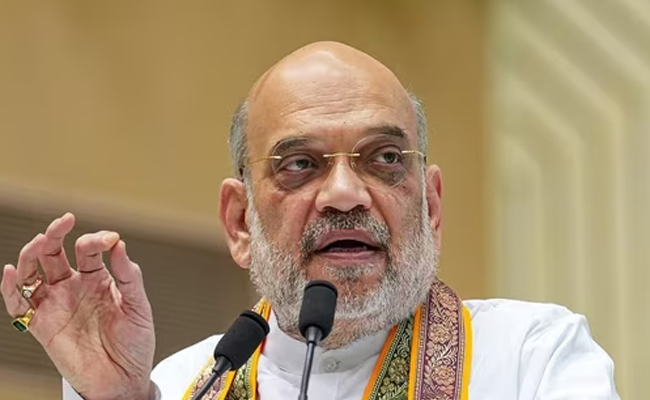
Leh/Jammu (PTI): Union Home Minister Amit Shah on Friday described the return of sacred relics of Lord Buddha to Ladakh after 75 years as a "historic reunion" and said that the Union Territory has remained a "living land of dharma", preserving and nurturing Buddhist knowledge for centuries.
Stressing the relevance of Buddha's teachings in modern times, Shah said the message of peace, compassion and the middle path was even more important today than it was 2,500 years ago.
"Ladakh has been a living land of dharma for centuries. When the Dalai Lama comes here, he says this land is not merely a geographical land but a living laboratory of Buddhist culture and compassion," Shah said, speaking after the inauguration of the sacred holy relics exposition of Tathagata Buddha and the 2569th Buddha Purnima celebrations at Jivetsal in Leh during his two-day visit to Ladakh.
Calling Ladakh a land of compassion, he said this land has preserved and nurtured knowledge. "Whenever Buddhism faced crises, this land worked to protect the teachings of Buddha. And when peace returned, it helped to expand and carry forward that preserved wisdom," he added.
"Unless one internalises knowledge and makes it a part of oneself, liberation is not possible. Knowledge is incomplete without spiritual practice, while spiritual practice without knowledge is blind. Therefore, the union of spiritual practice and knowledge is the right path. Even after all this, if there is no moral discipline, one cannot lead a truly wise life. The basis of a life of wisdom is moral discipline," he said.
Shah said it was through Ladakh and adjoining routes that the teachings of Tathagata Buddha, which originated in India, spread to China and several other countries.
"The message that emerged from the land of Ladakh has become a guiding force for many people around the world to take their lives forward. The presence of these sacred relics in Ladakh reminds us that India's civilisation has, for thousands of years, given the message of peace and coexistence," he said.
He said that in a diverse region like Ladakh and Kargil, this message becomes even more relevant. "This heritage still tells us today that amidst conflict and unrest, only the path of peace and compassion can provide solutions."
He said the return of the relics on Buddha Purnima had enhanced the significance of the festival for the people of Ladakh.
"These sacred relics have come to Ladakh after 75 years. It is as if Buddha himself is present here today," Shah said, adding that followers of Buddhism and people of other faiths in Ladakh and Kargil would draw spiritual energy from the relics.
Highlighting Ladakh's role in the spread of Buddhism, Shah said Kashmir was once an ancient centre of Buddhist studies, Mahayana philosophy and Buddhist art, from where Ladakh first came into close contact with Buddhism.
He said Emperor Ashoka's envoys laid the foundation of Buddhist influence in Ladakh through Kashmir and Gandhara, while Mahayana Buddhism expanded in the region during the Kushan period between the first and third centuries CE.
The Silk Route linking Kashmir, Leh, Yarkand, Khotan and Tibet became a channel not only for trade but also for ideas, monks, manuscripts and artistic traditions, Shah said.
He added that later, Tibetan influence between the seventh and tenth centuries further enriched Ladakh through Mahayana and Vajrayana traditions.
Stressing the relevance of Buddha's teachings in modern times, Shah said the message of peace, compassion and the middle path was even more important today than it was 2,500 years ago.
"Amid conflict and unrest, only the path of peace and compassion can provide solutions," he said.
Shah also appealed to the Ladakh administration to ensure complete arrangements so that followers of all faiths, especially Buddhists, could visit and pay obeisance to the relics.
#WATCH लेह, लद्दाख: केंद्रीय गृह मंत्री अमित शाह ने कहा, "जब दलाई लामा यहां आते हैं तो वे कहते हैं कि यह भूमि केवल भौगोलिक भूमि नहीं है। यह भूमि बौद्ध संस्कृति और करुणा की जीवंत प्रयोगशाला है। इस भूमि पर ज्ञान का संरक्षण हुआ है... भारत की सभ्यता हजारों वर्षों से शांति का संदेश… https://t.co/2nwG0w2CE6 pic.twitter.com/W13itRBqeX
— ANI_HindiNews (@AHindinews) May 1, 2026