Delhi's air quality recorded in 'very poor' category, authorities warn of deterioration
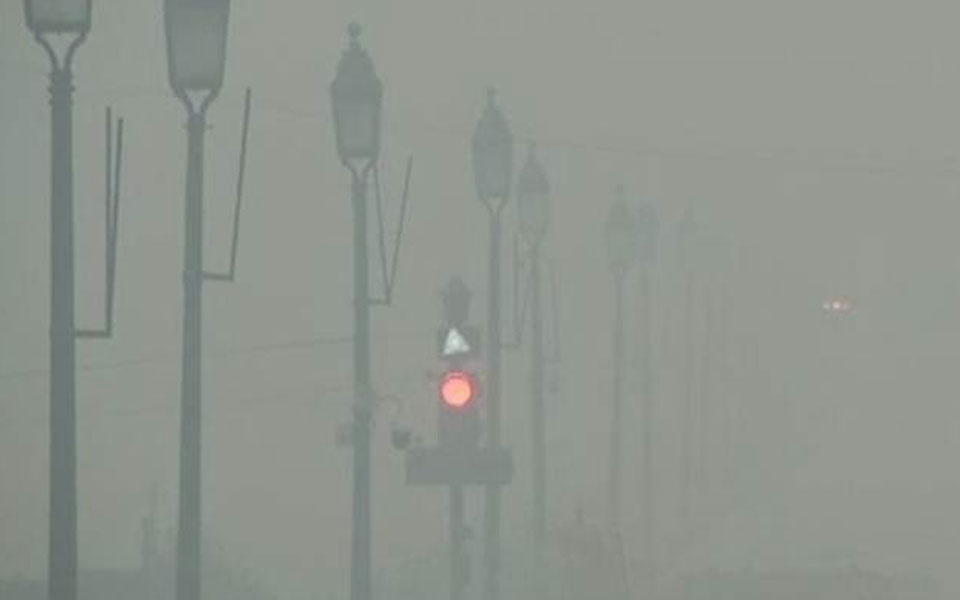
New Delhi, Nov 6 : Delhi's air quality was recorded in 'very poor' category on Tuesday as wind continued to blow from regions where there is rampant stubble burning, authorities said, warning of severe spike in pollution levels after Diwali even if "partial toxic crackers" are burnt compared to last year.
The overall Air Quality Index (AQI) was recorded at 394, which falls in the 'very poor' category, according to data by the Central Pollution Control Board.
On Monday, the AQI was recorded at severe category of 434, the highest of the season, it said.
On Tuesday, the PM2.5 (particles in the air with a diameter of less than 2.5 micrometres) level was recorded at 243 while the PM10 (particles in the air with a diameter of less than 10 micrometres) was recorded at 372 in Delhi.
In Delhi NCR, the PM2.5 was recorded 237 and PM10 was recorded at 366, the CPCB data said.
An AQI between 0 and 50 is considered 'good', 51 and 100 'satisfactory', 101 and 200 'moderate', 201 and 300 'poor', 301 and 400 'very poor', and 401 and 500 'severe'.
Twenty areas in Delhi recorded 'severe' air quality, while 13 areas recorded 'very poor' air quality.
Authorities attribute the continuous pollution to the change in wind direction, which is now blowing from the direction of stubble burning areas of Punjab and Haryana.
About 14 per cent of the PM2.5 pollution in Delhi was caused due to stubble burning, while 33 per cent of the PM2.5 pollution in Delhi on Monday was caused due to stubble burning, authorities said.
Winds coming from North-westerly direction is bringing influence of biomass burning pollutants in Delhi-NCR which may continue up to Wednesday morning, the Indian Institute of Tropical Meteorology said.
Delhi's air quality is expected to deteriorate to 'severe plus emergency' category after Diwali, the Centre-run System of Air Quality Forecasting and Research (SAFAR) said.
"Even if 50 per cent of the total load of toxic fire crackers as compared to Diwali-2017 is added, the prevailing weather conditions will aggravate the high smoke level and make air quality to persist in severe range for at least two day on November 8 and November 9," the SAFAR said in a report.
The PM10 is expected to reach 575 and PM2.5 is expected to reach 378 a day after Diwali, recording the worst air quality of the year, it said.
Let the Truth be known. If you read VB and like VB, please be a VB Supporter and Help us deliver the Truth to one and all.
CM Siddaramaiah alleges ‘criminal conspiracy’ in Sringeri recount, vows legal action
Bengaluru (PTI): Alleging a “criminal conspiracy” by BJP candidate D N Jeevaraj in the Sringeri Assembly poll recounting, Karnataka CM Siddaramaiah on Tuesday said the outcome was manipulated after valid postal ballot votes in favour of Congress leader T D Raje Gowda were tampered with during the recounting process.
Following a Karnataka High Court order on an election petition filed by Jeevaraj, challenging Raje Gowda’s election, the reverification and recounting were conducted on Saturday.
After the reverification and recount of postal ballots for the Sringeri Assembly constituency, votes polled in favour of Raje Gowda were reduced by 255, the returning officer said.
A report on the matter has been submitted to the Election Commission of India for further action, the officer added.
Congress leader Raje Gowda had won the 2023 Assembly polls from Sringeri by 201 votes, defeating his nearest rival Jeevaraj.
Addressing a press conference in Bengaluru, Siddaramaiah said the High Court had directed the recounting of postal ballots and that irregularities were noticed during the exercise conducted on May 2.
“This is a clear case of criminal conspiracy,” Siddaramaiah said, alleging that valid votes cast in favour of Raje Gowda were altered after being accepted by counting agents of all parties, including Congress, BJP, and JD(S).
He claimed that during the recounting of postal ballots, 255 votes were initially accepted as valid by all agents but were later tampered with by subordinate officials.
“There is a second mark on the votes polled in favour of Raje Gowda. They had accepted these as valid votes. Subsequently, another mark was made by officials. This is a clear case of criminal conspiracy,” he said.
When asked who was behind the alleged conspiracy, the CM replied, “It was hatched by Jeevaraj and others. It is planned.”
Siddaramaiah further alleged that the returning officer acted improperly by declaring the result despite the presence of an Election Commission observer during the recounting.
“Immediately after the counting, the returning officer announced the result. He should not have done so; this is against the law,” he said.
He pointed out that Raje Gowda had originally won by 201 votes, but after the recounting, the BJP candidate was declared the winner by 52 votes.
“The BJP has committed a criminal act of conspiracy. This is not vote chori but vote dacoity,” he alleged.
The CM said a police complaint had already been filed by Raje Gowda’s election agent, Sudhir Kumar, and emphasised the need for electoral integrity.
“We want transparency and free and fair elections. That is what our Constitution mandates,” he added.
Stating that the government would pursue legal remedies, Siddaramaiah said, “We are preparing an appeal challenging the returning officer’s announcement in a court of law.”
Responding to a separate query on elections in other states, the CM said there appeared to be an anti-incumbency factor in West Bengal, while results in Tamil Nadu were “surprising,” adding that Vijay’s party was emerging as the largest there.
Following the victory of party candidates in Bagalkote and Davanagere South, Siddaramaiah expressed confidence about future electoral prospects in Karnataka.
“Even in 2028, we will win the Assembly elections. We will come back,” the CM said.
Siddaramaiah added that he would order a forensic examination into the alleged tampering of postal ballots.