Delhi's air quality remains 'very poor'; light rain, haze likely on Tuesday
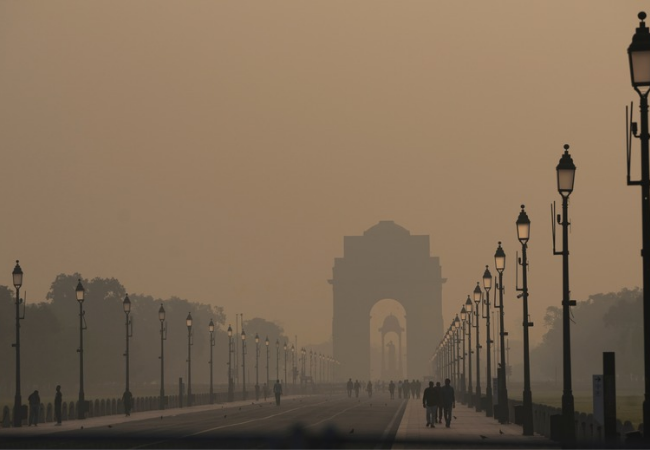
New Delhi (PTI): The air quality in the national capital remained in the 'very poor' category on Monday. A blanket of haze lingered over the city through the morning and afternoon hours, reducing visibility.
According to the Central Pollution Control Board (CPCB), Delhi's 24-hour average Air Quality Index (AQI) stood at 301 at 4 pm.
Data from the CPCB's Sameer app -- a mobile application that provides hourly updates on AQI -- showed that at 6 pm, 22 out of the 38 monitoring stations across the city recorded 'very poor' air quality. Anand Vihar was the most polluted area with an AQI of 395, followed by Wazirpur at 385. However, no station reported a 'severe' level of pollution.
Meanwhile, the maximum temperature in the city settled at 29.5 degrees Celsius, 1.3 degrees above the seasonal average, according to the India Meteorological Department (IMD). THe minimum temperature was recorded at 17.3 degrees Celsius, 0.1 degrees above normal.
Humidity levels fluctuated between 94 per cent and 58 per cent during the day.
According to the Indian Institute of Tropical Meteorology's Decision Support System for Air Quality Management, transport accounted for 13.7 per cent of the city's pollution, while neighbouring NCR regions such as Ghaziabad contributed 10.6 per cent, Meerut 4.8 per cent, and Delhi's local emissions 3.6 per cent. Other sources contributed nearly 20 per cent to the pollution load.
Satellite data from October 26 showed 122 stubble-burning incidents in Punjab, eight in Haryana, and 186 in Uttar Pradesh.
For Tuesday, the IMD has forecast a generally cloudy sky with mist or haze in the morning and the possibility of one or two spells of very light rain or drizzle. The maximum and minimum temperatures are expected to hover around 29 and 18 degrees Celsius, respectively.
Health experts have urged residents to minimise outdoor exposure during high pollution hours, particularly early mornings and late evenings.
"Winter air becomes denser, trapping pollutants that irritate the respiratory tract and worsen conditions like asthma and allergies," said Dr Hinal Shah, Consultant Biochemist at Agilus Diagnostics. He recommended the use of N95 masks and HEPA air purifiers to reduce health risks.
Let the Truth be known. If you read VB and like VB, please be a VB Supporter and Help us deliver the Truth to one and all.
Man booked for duping 7 persons of Rs 91 lakh on promise of awarding govt works

Mumbai (PTI): The Mumbai police have registered a case against a man for allegedly duping seven persons of Rs 91 lakhs on the promise of awarding them works of different government departments, an official said on Tuesday.
The accused was identified as Satish Kadam, a resident of Nanded in Marathwada region, an official said.
A complaint was filed by Hanumant Vadje, who alleged that the accused cheated him and six others of around Rs 91 lakh by promising to give them various works of Urban Development and Social Justice Department, he said.
The fraud occurred between 2024 and 2026, with Kadam collecting money in cash and into his accounts, police said, adding he had returned some amount to them partially.
Multiple cheques issued by the accused bounced, prompting the victim to lodge a complaint at the Marine Drive police station. Based on the complaint, a case of cheating and criminal breach of trust was registered against him.
The case is under further investigation, the official said.