Delhi's air quality turns 'severe'
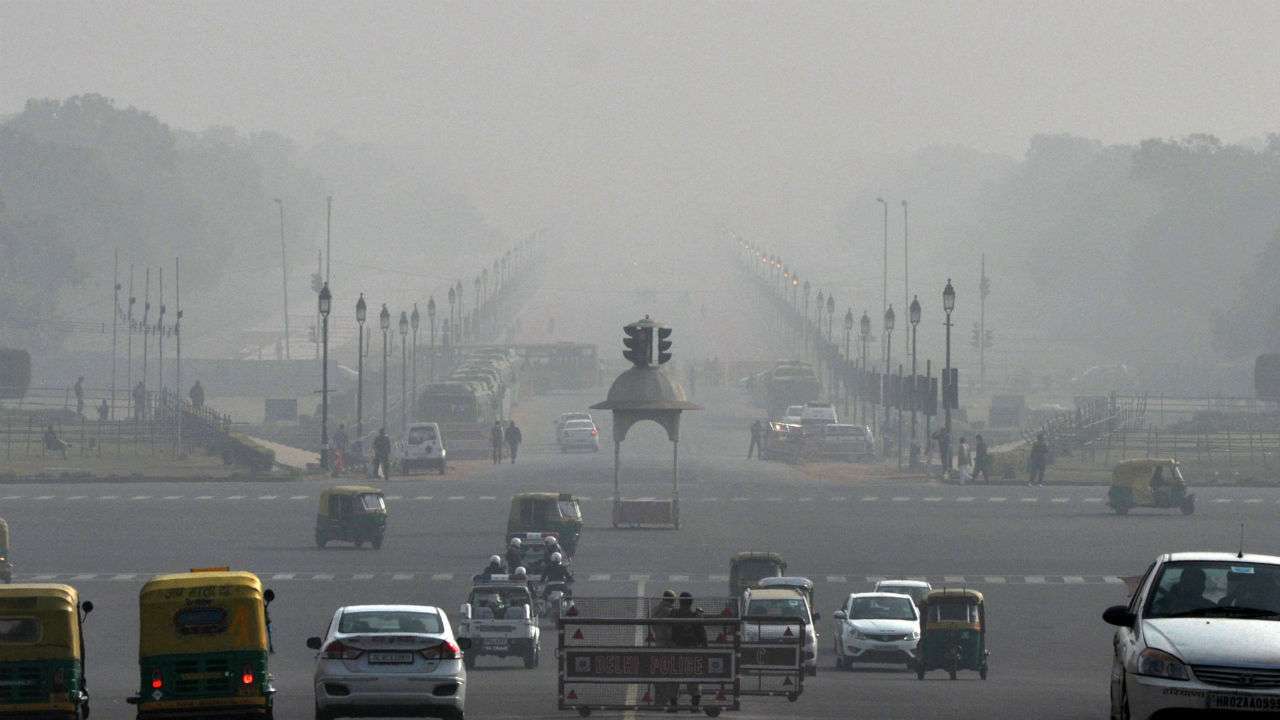
New Delhi: Delhi's air quality turned "severe" on Saturday with slow wind speed allowing the accumulation of "locally generated" pollutants, according to India Meteorological Department (IMD) officials.
However, it is expected to improve by Monday as the wind speed is likely to pick up.
At 10 am, the city's air quality index (AQI) was 401, which falls in the "severe" category.
The 24-hour average AQI was 382 on Friday, 341 on Thursday, 373 on Wednesday, 367 on Tuesday, 318 on Monday, and 268 on Sunday.
Air pollution in the neighboring cities of Ghaziabad (AQI 446), Greater Noida (401), and Noida (406) also entered the "severe" zone.
An AQI between zero and 50 is considered "good", 51 and 100 "satisfactory", 101 and 200 "moderate", 201 and 300 "poor", 301 and 400 "very poor", and 401 and 500 "severe".
The wind speed remained slow allowing the accumulation of pollutants generated locally, V K Soni, head of the IMD's environment research centre said.
"Easterly winds carrying moisture also led to the formation of secondary particulate matter. All these factors together pushed the air quality in the 'severe' zone," he said.
However, Soni said, the air quality is likely to improve to the "poor" category by Monday as the wind speed is expected to pick up.
According to the IMD, the maximum wind speed is likely to be 8 kmph on Saturday, 10 kmph on Sunday and 15 kmph on Monday.
The minimum temperature in Delhi was 11 degrees Celsius on Saturday and the maximum is expected to settle around 28 degrees Celsius, the weather department said.
However, the minimum temperature is likely to dip again with the wind direction changing to northwesterly by Monday, according to IMD officials.
Westerly and northwesterly winds blow from snow-laden western Himalayas towards the plains.
Shallow to moderate fog is also predicted over the next two days, the IMD said.
The minimum temperature this season has remained 2-3 notches below normal in the absence of a cloud cover on most days, according to IMD officials.
Calm winds and low temperatures trap pollutants close to the ground, while favorable wind speed helps in their dispersion.
The central government's Air Quality Early Warning System for Delhi said the city's ventilation index -- a product of mixing depth and average wind speed -- is likely to be 2,500 m2/s on Friday.
Mixing depth is the vertical height at which pollutants are suspended in the air. It reduces on cold days with calm wind speed.
A ventilation index lower than 6,000 sqm/second, with an average wind speed of less than 10 kmph, is unfavorable for the dispersal of pollutants.
Let the Truth be known. If you read VB and like VB, please be a VB Supporter and Help us deliver the Truth to one and all.
Emotional tributes paid to cops killed in blast at gunpowder dump of Maoists in Chhattisgarh

Narayanpur (Chhattisgarh) (PTI): Emotional scenes were witnessed on Sunday as wreaths were laid on the mortal remains of three of the four police personnel killed in an explosion in a gunpowder dump of Maoists in Chhattisgarh's Kanker district.
The grieving family members were inconsolable, while security personnel tried to comfort them.
Amid chants of "Bharat Mata ki Jai" and "Vande Mataram," public representatives, along with senior police and administrative officials, paid tributes to the deceased personnel.
The wreath-laying ceremony to pay homage to Inspector Sukhram Vatti (40), constables Krishna Komra (35) and Sanjay Gadhpale (29), killed in the explosion on Saturday, was held at the Police Lines in Narayanpur district, neighbouring Kanker.
The mortal remains of constable Parmanand Komra (29), who succumbed to injuries during treatment in Raipur, will be shifted to Kanker, where a separate wreath-laying ceremony will be held, police said.
Inspector General of Police, Bastar Range, Sundarraj Pattilingam, after paying homage, told reporters that the four police personnel made the supreme sacrifice while protecting the region.
"I pay my homage to them," he added.
The four personnel were killed while they were attempting to dispose of a gunpowder dump hidden earlier by Maoists in a forest near Aadnar village under Chhotebethiya police station limits in Kanker district, according to police.
It was the first explosion linked to Naxalites in the state since it was declared free from armed Maoists on March 31, and also the first instance this year in which security personnel engaged in anti-Naxal operations lost their lives.
District Reserve Guard (DRG) official Vatti, who was leading the team, hailed from Bijapur district. Constable Krishna Komra of the district force and constables Gadhpale and Parmanand Komra of the Bastar Fighters were residents of different villages in Kanker.