Delhi's air quality turns 'very poor'; Gopal Rai calls meeting with depts
New Delhi (PTI): Delhi Environment Minister Gopal Rai will on Monday chair a meeting with departments concerned on the implementation of mitigating measures under the central government's pollution control plan, officials said.
Delhi's air quality dipped to "very poor" levels on Sunday, the first time this season, due to unfavourable meteorological conditions.
The capital's 24-hour average air quality index (AQI) dropped to 313 (very poor) on Sunday from 248 on Saturday.
The Commission for Air Quality Management (CAQM), a statutory body responsible for proactively implementing the pollution control plan known as the Graded Response Action Plan (GRAP), had on Saturday directed authorities in the NCR to increase parking fees to discourage private transport and enhance the services of CNG or electric buses and metro trains amid a likely increase in pollution levels.
GRAP categorises actions into four stages: Stage I 'Poor' (AQI 201-300); Stage II 'Very Poor' (AQI 301-400); Stage III 'Severe' (AQI 401-450); and Stage IV 'Severe Plus' (AQI >450).
Stage I mandates the suspension of work at private construction and demolition projects with a plot size equal to or exceeding 500 square metres that are not registered on the state government's portal for remote monitoring of dust mitigation measures.
Authorities are also tasked with enforcing a complete ban on the use of coal and firewood in 'tandoors' at hotels, restaurants and open eateries, along with taking punitive action against polluting industrial units and thermal power plants within 300 km of Delhi.
Ensuring the proper implementation of guidelines for dust mitigation at construction and demolition project sites and sound environmental management of resulting waste is also part of Stage I.
Stage II measures involve increasing parking fees to discourage private transport and enhancing CNG or electric bus and metro services by introducing additional fleets and increasing service frequency.
Under Stage III, BS-III petrol and BS-IV diesel four-wheelers are prohibited from operating in Delhi, Gurugram, Faridabad, Ghaziabad, and Gautam Buddh Nagar.
Stage III involves a complete halt on construction and demolition work, except for essential government projects, besides mining and stone crushing. It also includes a ban on the entry of light commercial vehicles registered outside Delhi and diesel-guzzling trucks, and medium and heavy goods vehicles (except those involved in essential services).
Stage IV includes banning all types of construction and demolition work. State governments are authorised to decide on online classes for school students and work-from-home arrangements for government and private offices during such situations.
Let the Truth be known. If you read VB and like VB, please be a VB Supporter and Help us deliver the Truth to one and all.
Hospital wall collapse: CM orders suspension of executive engineer; kin of victims get solatium
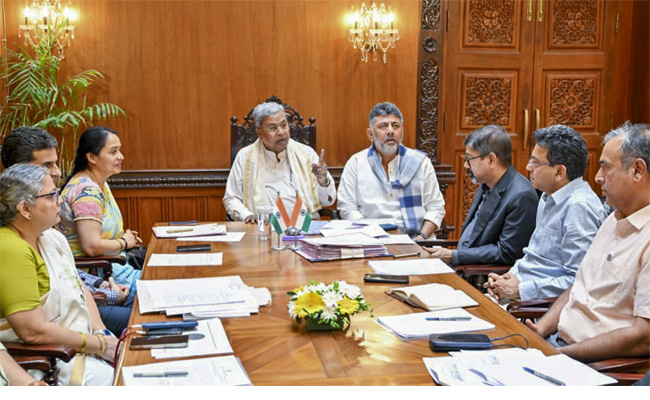
Bengaluru (PTI): Karnataka Chief Minister Siddaramaiah on Thursday ordered the immediate suspension of an executive engineer for the Bowring and Lady Curzon Hospital wall collapse that claimed the lives of seven people, during a high-level review meeting at Vidhana Soudha.
A compensation of Rs 5 lakh, as announced by the CM Siddaramaiah, was distributed to the families of seven victims who lost their lives in the tragedy on Wednesday evening, which occurred due to heavy downpour with gusty winds and hailstorm.
The meeting of municipal commissioners of the five corporations, chaired by the chief minister and attended by Deputy Chief Minister D K Shivakumar, focused on fixing accountability and examining lapses that led to the tragedy.
"Why was soil dumped in a way that damaged the wall? Why did you not monitor this?" Siddaramaiah asked, pulling up hospital authorities during the meeting.
A statement from the chief minister's office said that the CM ordered the immediate suspension of the executive engineer of the Karnataka Health Systems Development Project (KHSDP).
ALSO READ: Three arrested for running fake Aadhaar racket in UP's Badaun
He also questioned the hospital authorities, asking why they failed to monitor the dumping of soil that weakened the structure.
The chief minister directed that a notice be issued to the head of the Hospital.
During the meeting, Siddaramaiah said the rains had caused extensive damage in the city, with over 250 trees uprooted.
The Chief Minister instructed officials to take necessary measures before the onset of the monsoon to avoid untoward incidents.
Commissioners of all five municipal zones in Bengaluru have been asked to take precautionary steps, including trimming dry and dangerous tree branches, the CMO said.
Siddaramaiah also directed them to get the silt cleared from stormwater drains to prevent flooding, and that immediate action be taken to remove debris and fallen branches from roads.
Further, he instructed that barricades be placed at underpasses where water stagnates and restricts public movement.
The Greater Bengaluru Authority (GBA) Chief Commissioner M Maheshwar Rao said in a statement that Shivajinagar MLA Rizwan Arshad distributed compensation cheques of Rs 5 lakh each to the families of the deceased on Thursday.
Seven people, including a six-year-old girl, were killed and seven others injured when the compound wall collapsed amid heavy rain, strong winds and a hailstorm on Wednesday evening.
Police said the victims, comprising three from Bengaluru, two from Kerala on a study tour and one each from Uttar Pradesh and Assam, had taken shelter near the wall when it suddenly gave way, trapping them under the debris.
The chief minister questioned officials over the dumping of soil near the wall despite knowing it could weaken the structure, and directed that a notice be issued to the head of Bowring Hospital.
Siddaramaiah, who had visited the spot soon after the incident along with senior officials, reviewed the situation and ordered a detailed probe into the collapse.