DMK MP sparks row by referring to Hindi heartland states as 'gaumutra states' in Lok Sabha
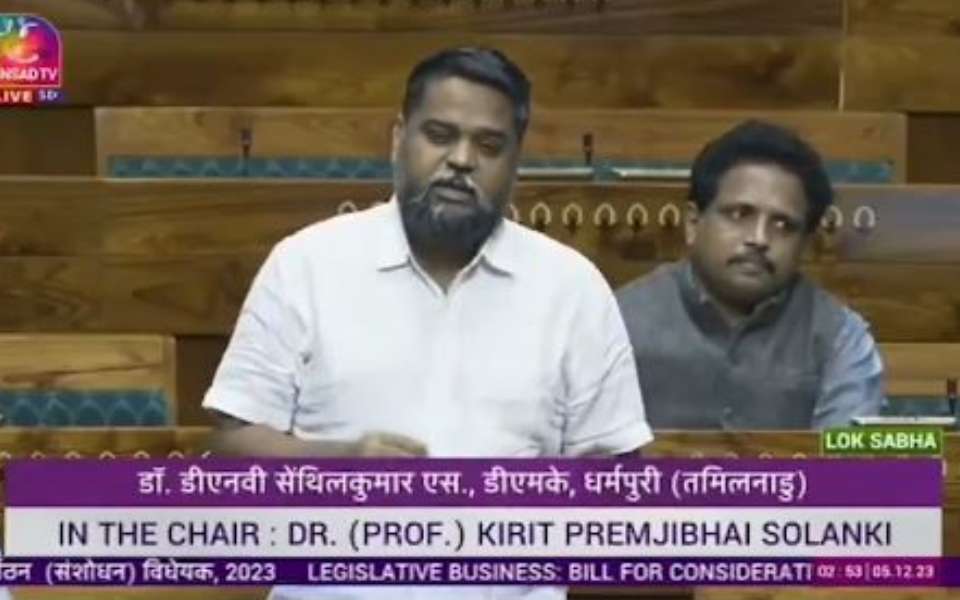
New Delhi, Dec 5: A DMK MP in Lok Sabha sparked a controversy on Tuesday by describing Hindi heartland states as "gaumutra states", and said the BJP can win elections only there and not in south India.
BJP leaders hit back at the DMK and asked Congress leader Rahul Gandhi if he agreed with the insulting remarks of its INDIA bloc partner against the north Indians.
Participating in a debate in the Lower House on two bills related to Jammu and Kashmir, D N V Senthilkumar said people of this country should think that the power of the BJP is only winning elections "in the heartland states of Hindi and what we generally called as gaumutra states".
The comments come in the backdrop of some referring to the recent assembly election results as a 'North-South divide' after the BJP trounced the Congress in Rajasthan, Madhya Pradesh and Chhattisgarh, and the Congress won in Telangana.
During the elections, the row over some DMK leaders' remarks against Sanatan Dharma had been latched on by the BJP to target the Congress.
Earlier this year, Congress had wrested Karnataka from the BJP, while other southern states are ruled by non-BJP parties including Tamil Nadu where Congress ally DMK is in power.
Speaking in Lok Sabha, Senthilkumar said, "You (BJP) cannot come to South India. You see all the results of what happens in Kerala, Tamil Nadu, Telangana, Andhra Pradesh and Karnataka ... we are very strong over there."
He went on to say, "We will not be surprised if you have an option of converting all these states into Union territories so that you can come into indirect power because you can never dream of setting foot over there and taking control of all the southern states."
In Tamil Nadu, state BJP chief K Annamalai condemned the "insensitive" remarks of the MP, saying the level of the party's discourse is "sinking" like Chennai and the "arrogance" of DMK will be the prime reason for its downfall.
"After calling our North Indian friends Pani Puri sellers, toilet constructors, etc., I.N.D.I. Alliance DMK MP, makes Gaumutra Jibes," he said on X.
"Chennai is sinking due to the misgovernance of DMK & and so is their level of discourse on the floor of the Parliament," Annamalai said, referring to the flood-like situation in the state capital.
The BJP "highly condemns this insensitive remark," he said.
Annamalai said the DMK MP has possibly forgotten that the NDA Alliance is in power in Puducherry and was in power in Karnataka until recently.
"The arrogance of DMK will be the prime reason for their downfall!," he posted.
Former Karnataka minister C T Ravi asked if Congress leader Rahul Gandhi endorses such insulting remarks.
"Will I.N.D.I. Alliance leader Rahul Gandhi agree with this DMK man who has insulted Bharatiyas of the Heartland States?
"How long will CONgress and its allies insult Bharatiyas? (sic)," he said on X.
Meanwhile, BJP Rajya Sabha member GVL Narasimha Rao on Tuesday demanded that the Tamil Nadu government register a case against state minister for making "hate speeches" against Sanatan Dharma and sack them from their posts.
Chennai is sinking due to the misgovernance of DMK & and so is their level of discourse on the floor of the Parliament.
— K.Annamalai (@annamalai_k) December 5, 2023
After calling our North Indian friends Pani Puri sellers, toilet constructors, etc., I.N.D.I. Alliance DMK MP, makes Gaumutra Jibes. @BJP4TamilNadu highly… pic.twitter.com/S13YzvDfsb
Let the Truth be known. If you read VB and like VB, please be a VB Supporter and Help us deliver the Truth to one and all.
4 held for sexually assaulting woman, girl on moving bus after social media alert in UP's Agra

Agra (UP) (PTI): Four people were arrested, after a prompt response by police following a social media alert, for allegedly sexually assaulting a woman and a girl inside a moving bus here, officials said on Tuesday.
According to an official police statement, at 12:27 am on April 27, information was received on the social media platform X about an incident of sexual assault on a bus travelling from Kanpur to Ahmedabad, which was approaching Namner crossing in Agra.
Acting under the direction of Police Commissioner Deepak Kumar, the Agra Police social media team immediately alerted the Rakabganj police station within minutes and coordinated with the victims to confirm the incident and obtain the exact location, it stated.
Police teams launched intensive checking at Namner crossing and intercepted the bus as it reached the spot. The four accused involved in the incident were apprehended on the spot, and legal action was initiated against them, the statement said.
The police said the swift response and coordination between the social media team and field units ensured timely action, bringing relief to the victims and other passengers, who expressed gratitude towards the police, it added.