Doordarshan sparks row with ‘Gaddar’ poster featuring Kharge, Imran Masood, Arshad Madani
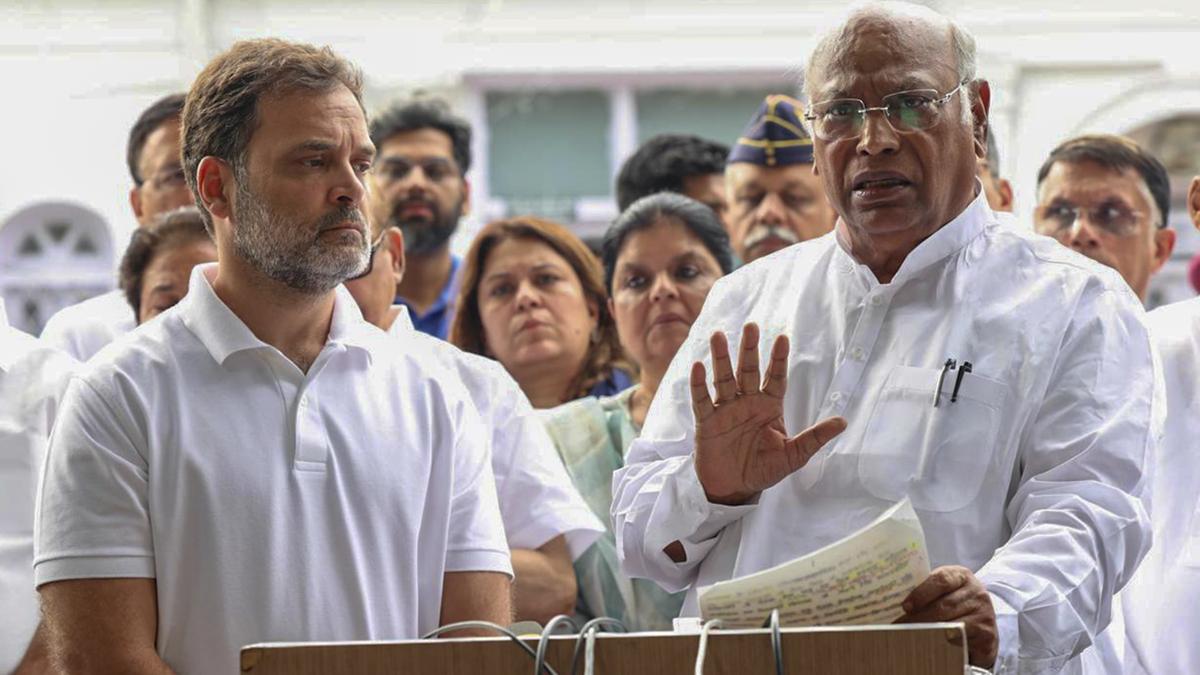
New Delhi, May 8: The Congress party has launched a sharp attack against public broadcaster Doordarshan for promoting a prime-time debate programme using a controversial poster that labelled several prominent figures—including Congress president Mallikarjun Kharge, Lok Sabha MP Imran Masood, and Islamic scholar Arshad Madani—as “gaddar” (traitors). The party called the move insulting, divisive, and unacceptable during a time of national crisis, demanding an immediate apology from Information and Broadcasting Minister Ashwini Vaishnaw.
The outrage began after Doordarshan anchor Ashok Shrivastava shared a promotional poster on social media platform X (formerly Twitter) on May 6. The graphic included the faces of Kharge, Masood, and Madani with the caption: “India is ready but how many traitors are in the House?” This was in reference to Shrivastava’s debate show aired on Doordarshan, a government-funded broadcaster that is expected to maintain neutrality and uphold public service broadcasting standards.
Congress leaders strongly objected to the tone and content of the promotion, questioning how a national broadcaster could resort to such provocative and polarising messaging, especially when the country is facing security challenges.
“Unacceptable and Dangerous,” Says Congress
Reacting strongly, Congress general secretary (organisation) K.C. Venugopal said, “The kind of pathetic, insulting and dangerous narrative being run by Doordarshan is unacceptable. Labelling Kharge-ji and MP Imran Masood-ji as ‘gaddar’ is extremely divisive and completely out of place as we face a national crisis.”
Venugopal also pointed out that the Congress president has been working closely with the government and security forces since the Pahalgam terror attack. “We are together with the government at this critical juncture. It should ensure no such scurrilous message is sent out from its official or unofficial channels. Minister @AshwiniVaishnaw must extend an unconditional apology immediately,” he said in a post on X.
Targeting of Muslim Leaders Raises Concerns
What has further raised eyebrows is the inclusion of Islamic scholar Arshad Madani in the same graphic. Madani is the principal of the prestigious Darul Uloom Deoband and is a respected religious figure. Critics have asked how a public service broadcaster could justify grouping opposition political leaders and religious scholars under a label that questions their loyalty to the country.
Several users on social media, along with opposition leaders, highlighted that the visuals and captions used in the promotion were not only inflammatory but also carried communal undertones.
Manickam Tagore Also Demands Apology
Echoing Venugopal’s concerns, Lok Sabha MP from Tamil Nadu Manickam Tagore said, “Calling Leader of Opposition @kharge ji and Lok Sabha colleague @ImranMasood ‘Gaddar’ on Doordarshan is disgraceful & divisive. Congress stands with the nation in this crisis. Reel minister @AshwiniVaishnaw must apologise unconditionally.”
Criticism Over Use of Public Platform for Political Gimmicks
Political observers and media experts have also raised concerns over the editorial independence of Doordarshan. “This is not just about one show or one anchor,” said a senior media analyst. “The question is whether a taxpayer-funded broadcaster can be allowed to run such political propaganda. When opposition leaders and respected religious figures are openly vilified on government platforms, it’s a serious blow to democratic discourse.”
There has been no official response yet from the Ministry of Information and Broadcasting or from Doordarshan regarding the controversy.
As the outrage grows, many have demanded clarity on who approved the visuals and messaging for the programme. Opposition parties say this episode reflects a growing trend of weaponising state media to discredit dissenting voices and minority communities, even during times of national security concerns.
Let the Truth be known. If you read VB and like VB, please be a VB Supporter and Help us deliver the Truth to one and all.
Maharashtra sets up state vaccination task force to strengthen immunisation programme

Mumbai (PTI): The Maharashtra government has set up a State Vaccination Task Force to strengthen the regular immunisation programme and review the progress of related campaigns, a health department official said on Monday.
The State Vaccination Task Force will comprise at least 29 members and will be headed by the administrative head of the health department, he informed.
The government has also constituted separate district-level and municipal vaccination task forces to improve implementation and address challenges at the grassroots level, he said.
Municipal task forces, chaired by respective civic commissioners, have been constituted in view of the vast urban population in Maharashtra and the role of civic bodies in implementing different health programmes.
The district-level task forces will function under the chairmanship of collectors.
"Complete immunisation of children at the appropriate age is an extremely simple, cost-effective and highly effective measure to reduce child mortality and the prevalence of diseases among kids. Immunisation is a powerful tool for reducing illness in children," maintained the official.
To ensure full vaccination of all children, the state government implements various campaigns from time to time as per the central government guidelines, he pointed out.
"Active participation and cooperation of other relevant government departments are essential (in making these campaigns successful)," according to the official.
The state-level body will review the regular immunisation programme, associated campaigns and vaccine-preventable diseases in detail. It will also conduct focused assessments of high-risk districts and municipal corporations, including vacancies at district, municipal and sub-district levels, availability of cold chain equipment, resource gaps and training requirements, he noted.
The state task force will review allocation and utilisation of funds for immunisation and ensure timely action by officers concerned based on reports from district and municipal task forces and state-level monitoring mechanisms, the official said.
It will also ensure active coordination and participation of other government departments in immunisation drives, while district and municipal task forces will carry out similar functions at their respective levels, the official added.