Drop one-child norm from draft population policy, will lead to imbalance, VHP tells UP govt
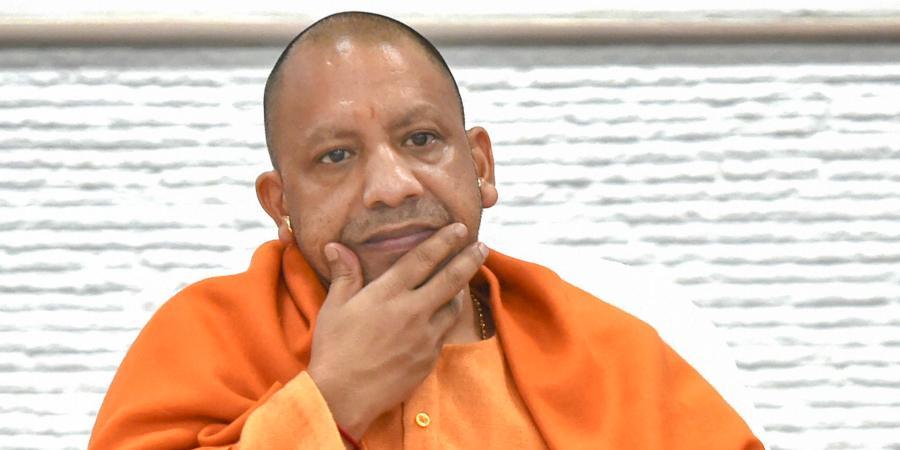
New Delhi, Jul 12: The Vishva Hindu Parishad (VHP) has suggested to the Uttar Pradesh government to remove the one-child policy norm from its draft population control bill, saying it is likely to lead to furthering of the imbalance between different communities and contraction of the population as well.
The saffron outfit has also asked the Yogi Adityanath government to remove "the anomaly" of rewarding or punishing the child, instead of the parents, from the Uttar Pradesh Population (Control, Stabilisation and Welfare) Bill, 2021.
"The preamble of the bill states that this is a bill, inter alia, to stabilise the population and promote the two-child norm. The Vishva Hindu Parishad agrees with both objects," the organisation's working president, Alok Kumar, said in a letter to the Uttar Pradesh State Law Commission (UPSCL) on Monday.
However, sections 5, 6(2) and 7 of the bill, which incentivise public servants and others to have only one child in the family, go "well beyond the said objects", he said.
"Therefore, we suggest the deletion of section 5, and the consequential sections 6(2) and 7 to avoid the contraction of the population as also the undesirable social and economic consequences of a one-child policy, and also the removal of the anomaly of rewarding or punishing the child instead of the parents," Kumar added.
He also suggested to the UPSCL to reconsider the objective of the bill that seeks to bring down the total fertility rate (TFR) in Uttar Pradesh to 1.7 within a certain time frame.
Placing the draft bill in the public domain recently, the UPSCL has invited suggestions from people.
In his suggestions, the VHP working president said a two-child policy is considered desirable for achieving population stability.
The population in a society stabilises when the average number of children born to a woman in her reproductive life is marginally above two, he said.
"This happens when the TFR is 2.1. At this level of TFR, on an average, there are two children born to replace the two parents and the additional 0.1 child provides for the possibility of some children dying before reaching the reproductive age and similar other wastage," Kumar added.
In a contracting population, he said the ratio between the working-age population and the dependent population gets disrupted.
In an extreme case, the one-child policy would lead to a situation where there is only one working-age adult to look after two parents and four grandparents, he said.
China had adopted the one-child policy in 1980, but had to withdraw it within three decades to get over such a situation, the VHP leader said.
He added that the imbalance between different communities has been "growing" in several states.
"It is becoming alarming in states like Assam and Kerala, where the overall growth of population has declined. In both these states, the TFR of Hindus has declined far below the replacement rate of 2.1, but that of Muslims is 3.16 in Assam and 2.33 in Kerala," Kumar said.
In these two states, one of the communities has thus entered the contraction phase while the other is "still expanding", he added.
"Uttar Pradesh should avoid getting into that situation," the VHP leader said, adding that the one-child policy in the state "is likely to lead to furthering of the imbalance between different communities because they are known to respond differently to the incentives and disincentives related to family planning and contraception".
Let the Truth be known. If you read VB and like VB, please be a VB Supporter and Help us deliver the Truth to one and all.
TN Governor should invite Vijay to form govt, then prove majority: Former MP Prakash Ambedkar
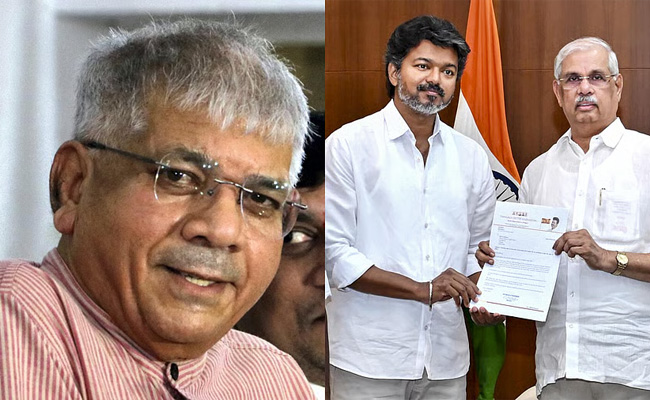
Mumbai: Senior politician and constitutional expert Prakash Ambedkar has opined that Tamil Nadu Governor Rajendra Arlekar should invite the Tamilaga Vettri Kazhagam President Vijay to form the government as his party emerged as the single largest party in the Assembly elections.
Ambedkar, who is a Mumbai-based advocate, activist and also the grandson of Dr. BR Ambedkar, is a former Parliamentarian.
Citing articles from the Constitution and similar incidents in the political history of the nation, Prakash Ambedkar has explained why Vijay cannot be stopped from forming the government in Tamil Nadu, reports Deccan Herald.
“Merely doubt over whether the TVK has the necessary number cannot suffice to withhold the invitation to the party to form the government. The Governor should invite Vijay, President of TVK, the single-largest party, to form the government and assume office as the next Chief Minister. After taking charge, as per the Article 164 (2) of the Constitution, Vijay will have to prove that his government has a majority in the House,” Ambedkar explained.
He also gave examples from India’s political history supporting his argument.
Ambedkar cited the example of the 1989 Lok Sabha elections and said that, although the Congress (I) emerged the single-largest party with 194 seats, Rajiv Gandhi declined the invitation by President R Venkataraman to form the government. “My friend Vishwanath Pratap Singh, leader of the National Front, was then invited and sworn in as Prime Minister on December 2, 1989,” he added.
He then recalled the 1996 elections to the Lower House of the Parliament, when the BJP emerged the single-largest party, but the Parliament was hung as the BJP lacked a majority. “Atal Bihari Vajpayee was invited by President Shankar Dayal Sharma to form the government and was sworn in as Prime Minister. Vajpayee resigned 13 days later on May 28, 1996, after failing to secure majority support in the Lok Sabha,” Ambedkar explained.