DU replaces paper on Gandhi with one on Savarkar in BA (hons) political science syllabus
teachers oppose
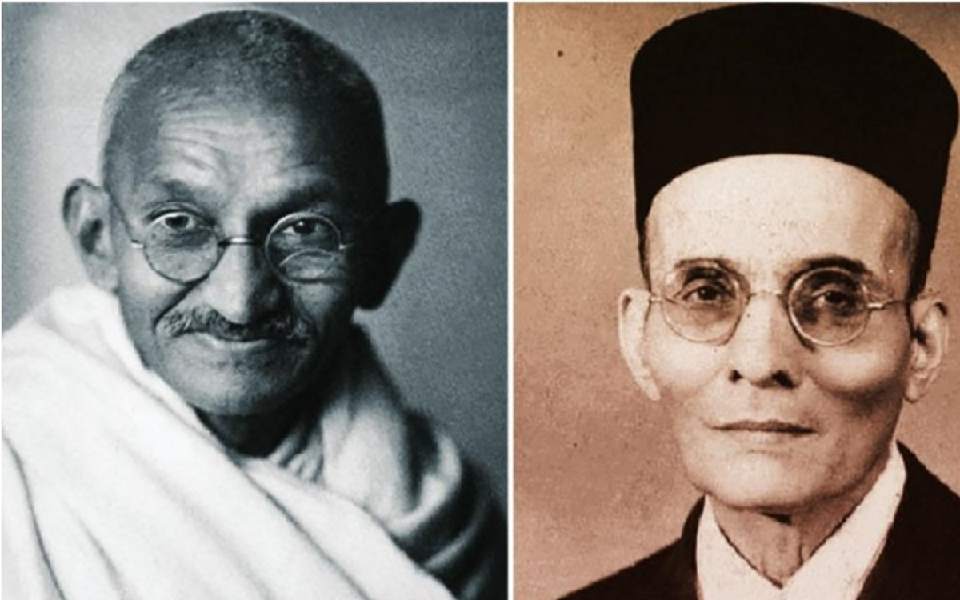
New Delhi, May 27: Delhi University has replaced a paper on Mahatma Gandhi in semester V of BA (hons) political science syllabus with one on Hindutva ideologue V D Savarkar, teachers claimed on Saturday.
The paper on Mahatma Gandhi will now be taught in semester VII, they said, adding this would mean students opting for a three-year graduation course instead of a four-year programme will not study Gandhi.
A motion in this regard was passed at the Academic Council meeting on Friday.
The move has drawn sharp flak from a section of teachers, who termed it a saffronisation of education and an attempt to compare Gandhi and Savarkar.
Now, the final call will be taken by the Executive Council, the highest decision making body of DU.
DU Vice Chancellor Yogesh Singh did not respond to PTI calls seeking a comment on the issue.
Alok Pandey, an Academic Council member who attended Friday's meeting, said: "Earlier, a paper on Gandhi was there in semester V and in semester VI a paper on Ambedkar. Now, they have introduced a paper on Savarkar. We have no problem with the introduction of Savarkar but they have done it at the cost of Gandhi. They have moved the paper on Gandhi from semester V to VII."
"It seems they are planning to remove the paper on Gandhi from studies as students who will opt for a three-year programme will not study this paper," Pandey said.
Pandey, who was also a part of the standing committee where the proposal was discussed, said he agreed that they will teach about Gandhi in semester V, Savarkar in VI and Ambedkar in VII as per their age chronology.
"I opposed the proposal in the standing committee and they agreed that the paper on Gandhi will not be removed from semester V...but now in the Academic Council, they brought the resolution which was not agreed in the standing committee meeting," he said.
Opposing the move, Rajesh Jha, a former member of the Executive Council, said students should be exposed to Gandhi in initial semesters in order to develop critical thinking.
"Gandhian ideas are inclusive and reflect the collective consciousness of our freedom struggle. His philosophy stands for good politics as well as good individuals. Hence, the students should be exposed to Gandhi in initial semesters in order to develop critical thinking," Jha said.
"Teaching Gandhi earlier than Savarkar would have prepared students to understand the latter's thought in broader and more balanced perspective," he added.
As per the syllabus reviewed by PTI, 'Understanding Gandhi' was a paper in semester V. The course aims to acquaint the students with the social and political thought of Gandhi.
"The course seeks to meet two essential objectives: one, to acquaint the students with the art of reading texts, to enable them to grasp its conceptual and argumentative structure and to help them acquire the skills to locate the texts in a broader intellectual and socio-historical context," the course objective said.
The themes in Gandhian thought that are chosen for close reading are "particularly relevant to our times", it said.
The university has adopted a four-year programme as part of the National Education Policy and students have the choice to either opt for a three-year undergraduate degree or a four-year undergraduate programme.
The university is preparing syllabi for four-year programmes for several subjects.
Let the Truth be known. If you read VB and like VB, please be a VB Supporter and Help us deliver the Truth to one and all.
KKR defeat LSG via Super Over

Lucknow (PTI): Kolkata Knight Riders edged Lucknow Super Giants via Super Overs in a battle between two bottom-placed teams in the IPL, here on Sunday.
Chasing a modest 156, LSG suffered a batting collapse and managed to tie the contest and take it to Super Over with No. 9 Mohammed Shami striking a last-ball six against a wayward Kartik Tyagi, who leaked 16 runs in the final over.
But Sunil Narine bowled a stunning Super Over conceding just one run and taking two wickets to give KKR an easy target.
Rinku Singh then finished the chase with a boundary off first ball from Prince Yadav.
Earlier the KKR were in deep trouble with 93/7 in 15 overs but Rinku smashed a sensational 83 not out from 51 balls including four sixes in a row in the final over to lift them to 155/7.
Cameron Green (34) was the only other batter to reach double-digit scores as KKR suffered a familiar batting meltdown with Mohsin taking his maiden fifer.
In reply, LSG continued their dismal show with the bat to succumb to their fifth loss in a row.
Brief Scores:
Kolkata Knight Riders 155/7; 20 overs (Rinku Singh 83 not out, Cameron Green 34; Mohsin Khan 5/23). Lucknow Super Giants 155/8; 20 overs (Rishabh Pant 42). KKR won via Super Over.