ED failed to give direct evidence linking Kejriwal to proceeds of crime, says court
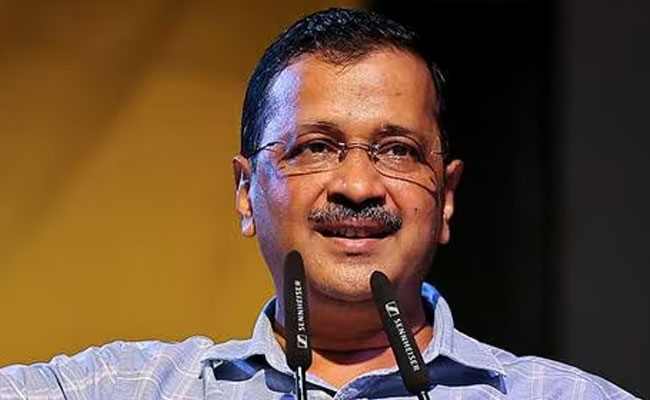
New Delhi (PTI): The Enforcement Directorate (ED) failed to furnish direct evidence linking Delhi Chief Minister Arvind Kejriwal to the proceeds of crime in the money laundering case against him, a Delhi court has said while ordering his release on bail.
The order passed on Thursday has, however, been stayed by the Delhi High Court on an appeal by the ED. The trial court order was made available to the media on Friday.
In the order granting relief to Kejriwal, Special Judge Niyay Bindu held that prima facie his guilt was yet to be established.
"It may be possible that some persons known to the applicant are having involvement in an offence....but ED has failed to give any direct evidence against the applicant in respect of the proceeds of crime," the judge said.
She also questioned the ED's silence on Kejriwal's assertion that he was arrested in the money laundering case related to the alleged excise scam without having been named in the CBI FIR or the ECIR registered by the anti-money laundering agency. Enforcement Case Informaton Report (ECIR) is ED's version of an FIR.
"This is also noticeable that ED is silent about the facts as to how the proceeds of crime have been utilized in Assembly Elections in Goa by AAP as, admittedly, after about two years, the bigger portion of the alleged amount remains to be traced out," the judge said.
Kejriwal and his Aam Aadmi Party (AAP) has been accused of receiving kickbacks of Rs 100 crore from the South Group, a cartel of politicians, businessmen and others to rig the Delhi liquor policy in favour of licencees. The money was allegedly used in the 2022 Goa assembly poll campaign.
The judge said the ED has failed to clarify as to how much time it required to trace the complete money trail.
"Meaning thereby that until and unless this exercise of tracing out the remaining amount gets completed by ED, accused is supposed to remain behind bars that too without proper evidence against him. This is also not an acceptable submission of ED," the judge said.
The maxim of law that every person must be presumed innocent until proven guilty seems to be not applicable in the given case in respect of the present accused, she said.
The judge quoted Benjamin Franklin, one of the founding fathers of the US, to say "It is better that 100 guilty persons should escape than an innocent person should suffer".
"This principle imposes a duty upon the court not only to prevent guilty individuals from escaping justice but also to ensure that no innocent should be punished. There have been thousands of cases where the accused underwent a long lasting trial and agony resulting from the same till the date they were acquitted by the court for being innocent.
"Unfortunately, the mental and physical agony of such person cannot be compensated in any manner whatsoever," she said.
If an accused undergoes the atrocities of the system till his innocence is discovered, he would never be able to conceive that justice has actually been done to him, she said.
The judge said there are certain undisputed facts, as specified on behalf of the applicant, that in the month of July 2022 the material now with the ED was already available with it but he was called only in August 2023 which shows the malafide on the part of the central agency. "The probe agency has failed to answer this objection of the applicant," the judge said.
She also dismissed the ED's argument that "investigation is an art and sometimes one accused is given lollypop of bail and pardon and induced with some assurance to make them tell the story behind the offence".
"If it is so, then any person can be implicated and kept behind the bars by artistically procuring the material against him after artistically avoiding/ withdrawing exculpatory material from the record. This very scenario constrains the court to draw an inference against the investigating agency that it is not acting without bias," the judge said.
The judge noted that the Additional Solicitor General (ASG), appearing for the ED, talked about inducement to extract the truth against other accused involved in the matter.
"But the effect of this submission goes to the conception that the complete truth cannot be revealed through the persons who have resiled from their previous statements.
"Rather, the complete truth shall be established on the basis of the incriminating material, if available on record which the investigating agency is under an obligation to procure in a legal manner by following the procedural aspects as well," the judge said.
The judge said the allegations against Kejriwal surfaced during subsequent statements of certain co-accused. She said it is also an admitted fact that he has not been summoned by the court after his arrest and is "lying in judicial custody at the instance of ED on the pretext of the investigation being still on."
"On the prima facie basis, the guilt of the accused is yet to be established. In respect of the condition that he shall not involve in the offence after his release on bail, it is already undertaken so by the applicant in his application. Moreover, if bail is granted, the same shall be conditional which shall put the applicant under an obligation in this regard," the judge said.
She said it is also noticeable that in the cases under PMLA bail becomes an impossible task to obtain as on one pretext or the other the investigating agency gives its own reasons which puts the accused in a situation almost akin to a convict without any hope to be released from the gloomy atmosphere of jail.
The judge had on Thursday ordered Kejriwal's release on bail on a personal bond of Rs 1 lakh. It, however, imposed certain conditions on the AAP leader before granting him the relief, including that he will not try to hamper the investigation or influence the witnesses.
The judge had also directed Kejriwal to appear before the court whenever required and to cooperate with the investigation.
The ED had arrested Kejriwal on March 21, shortly after Delhi High Court refused to grant him protection from arrest on his petition challenging summonses issued to him.
On May 10, the Supreme Court had granted interim bail to Kejriwal till June 1 to campaign in Lok Sabha elections, saying he will have to surrender and go back to jail on June 2. He is in jail ever since.
Let the Truth be known. If you read VB and like VB, please be a VB Supporter and Help us deliver the Truth to one and all.
Man arrested with Rs 2.54-crore heroin in Mumbai

Mumbai (PTI): Police have arrested a man and seized over 500 grams of heroin worth Rs 2.54 crore in the illicit market from him in Mumbai, officials said on Friday.
The police's Anti-Narcotics Cell (ANC) made the drug seizure in Santacruz in the western suburbs. The operation was conducted by the Kandivali unit of the ANC on Thursday as part of a special crackdown against drug trafficking in the area, they said.
Acting on specific inputs, an ANC team conducted a raid in Santacruz (East) and intercepted a man. During a search, the team recovered 508 grams of high-grade heroin from his possession, an official said.
The seized contraband, a highly addictive, opioid drug derived from morphine, is estimated to be worth Rs 2.54 crore in the international market, he informed.
Following the seizure, a case was registered against the man under relevant sections of the Narcotic Drugs and Psychotropic Substances (NDPS) Act, 1985, and he was formally placed under arrest in the early hours of Friday.
The police are currently investigating the source of the drug and trying to identify the intended recipients of the consignment, he said.