Efforts being made to undermine federal structure, says Thomas Isaac
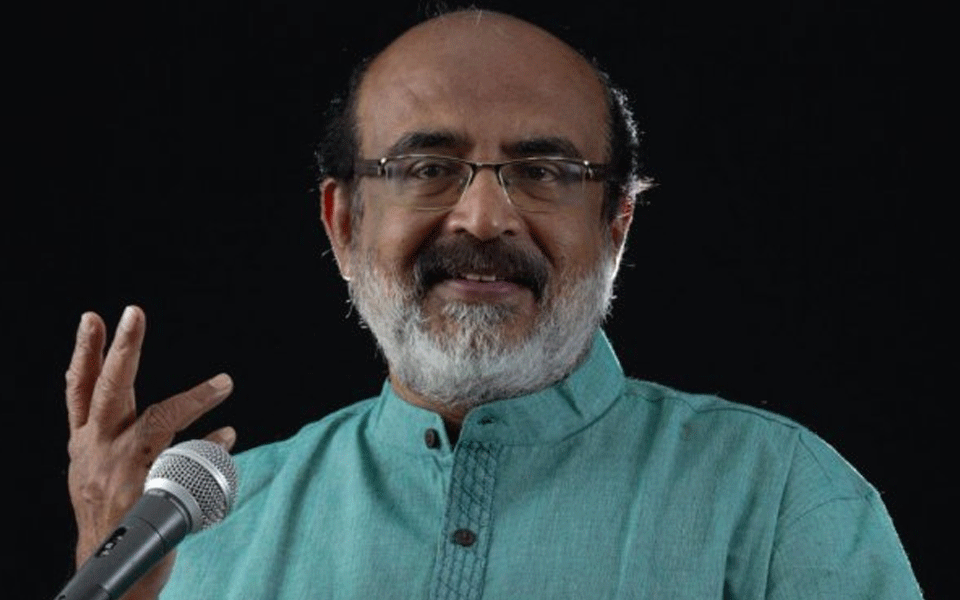
New Delhi (PTI): Former Kerala Finance Minister Thomas Isaac on Saturday said efforts are being made to undermine the country's federal structure and pitched for making federalism a major issue of national discourse, amid a tussle between the governor and the government in the state.
A senior leader of the ruling CPI(M)-led front in the state, Isaac also said the central government does not believe in the country's diversity and was trying to homogenise things.
Criticising the Centre about its views on freebies, he said the central government was trying to discipline states whereas it has reduced corporate tax rate and through Production Linked Incentives (PLIs), freebies are given for production.
He was delivering the fifth LC Jain Memorial Lecture on 'The Challenges of Federalism: Negotiating Centre State Tensions' in the national capital. LC Jain was a Gandhian activist and writer.
Referring to the tensions between Kerala Governor Arif Mohammed Khan and the state government, Isaac said in a parliamentary system, the power is with the Cabinet which is accountable to the elected representatives. "It is a well settled matter."
On Saturday, the state government sent an ordinance to remove the Governor from the post of chancellor of universities in the state, to the Raj Bhavan for approval, days after the cabinet had taken a decision in this connection.
Sources said it was unlikely for the Governor to promulgate the ordinance soon as the tussle between him and the state government over the issue is yet to die down.
"Constitution does not say that Governor is the Chancellor. That status is given through the legislation in the assembly... Never has this happened. There is some decorum in dealing with each other... there was a civility in discourse," Isaac noted.
Further, he said the whole scenario is changing. "Why? because for the first time in the history of the country, we are having a government that does not believe in the diversity of the country... you want to homogenise the nation, one nation, one culture, one nation, one law, one nation, one election...
"Once you have that ideology itself, then every opportunity is made to undermine the federal system that exists. This is a terrible situation," he said.
While noting that there must be a political response to address the situation, Isaac said federalism has to become a major issue of national discourse.
"At the state level... you develop alternatives within the federal system that is possible. The nation must reflect regional aspirations... and a lot of action is possible at the local level," he said.
Isaac also pitched for some federal flexibility in the Goods and Services Tax (GST) regime.
The function was organised by the LC Jain family and the Association for Democratic Reforms (ADR).
Let the Truth be known. If you read VB and like VB, please be a VB Supporter and Help us deliver the Truth to one and all.
Maharashtra sets up state vaccination task force to strengthen immunisation programme

Mumbai (PTI): The Maharashtra government has set up a State Vaccination Task Force to strengthen the regular immunisation programme and review the progress of related campaigns, a health department official said on Monday.
The State Vaccination Task Force will comprise at least 29 members and will be headed by the administrative head of the health department, he informed.
The government has also constituted separate district-level and municipal vaccination task forces to improve implementation and address challenges at the grassroots level, he said.
Municipal task forces, chaired by respective civic commissioners, have been constituted in view of the vast urban population in Maharashtra and the role of civic bodies in implementing different health programmes.
The district-level task forces will function under the chairmanship of collectors.
"Complete immunisation of children at the appropriate age is an extremely simple, cost-effective and highly effective measure to reduce child mortality and the prevalence of diseases among kids. Immunisation is a powerful tool for reducing illness in children," maintained the official.
To ensure full vaccination of all children, the state government implements various campaigns from time to time as per the central government guidelines, he pointed out.
"Active participation and cooperation of other relevant government departments are essential (in making these campaigns successful)," according to the official.
The state-level body will review the regular immunisation programme, associated campaigns and vaccine-preventable diseases in detail. It will also conduct focused assessments of high-risk districts and municipal corporations, including vacancies at district, municipal and sub-district levels, availability of cold chain equipment, resource gaps and training requirements, he noted.
The state task force will review allocation and utilisation of funds for immunisation and ensure timely action by officers concerned based on reports from district and municipal task forces and state-level monitoring mechanisms, the official said.
It will also ensure active coordination and participation of other government departments in immunisation drives, while district and municipal task forces will carry out similar functions at their respective levels, the official added.