Ex-servicemen express mixed reactions on merger of Amar Jawan Jyoti with NWM's eternal fame
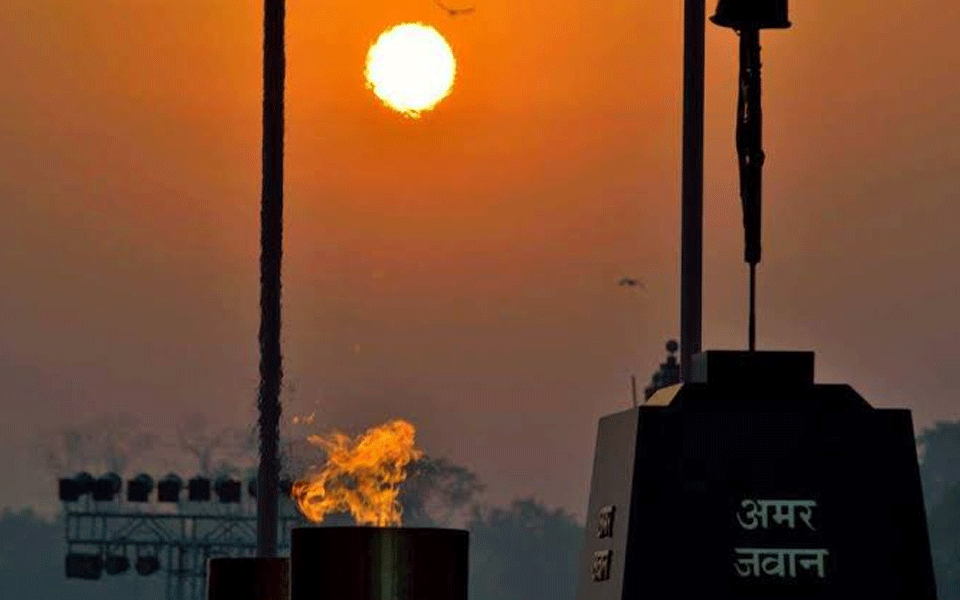
New Delhi(PTI): Ex-servicemen expressed mixed reactions on the Centre's decision to extinguish and merge the Amar Jawan Jyoti at India Gate with the eternal flame at the National War Memorial (NWM) here on Friday.
Former Air Vice Marshal Manmohan Bahadur tagged Prime Minister Narendra Modi on Twitter and requested him to rescind the decision.
"Sir, the eternal flame at India Gate is part of India's psyche. You, I and our generation grew up saluting our brave jawans there," he stated.
While National War Memorial is great, the memories of Amar Jawan Jyoti are indelible, Bahadur noted.
However, Former Lieutenant General Satish Dua expressed "great satisfaction" on merging the Amar Jawan Jyoti with the NWM's eternal flame.
"As someone who had steered the design selection and construction of the NWM, I had been of this view all along that India Gate is a memorial to the fallen heroes of First World War," Dua stated.
The Amar Jawan Jyoti was added in 1972 as we did not have another memorial, he mentioned.
The NWM pays homage to the soldiers who were killed in action after the country's independence and all homage ceremonies have been shifted to the new memorial already, he noted.
Prime Minister Narendra Modi had on February 25, 2019, inaugurated the NWM, where names of 25,942 soldiers have been inscribed in golden letters on granite tablets.
Former Army Chief General Ved Malik also supported the Centre's decision to merge the flames.
He said on Twitter that it is "a natural thing" to merge flames now as the NWM has been established and all ceremonials related to remembrance and honouring soldiers killed in action are being held there.
Former Colonel Rajendra Bhaduri said the Amar Jawan Jyoti is sacred and need not be extinguished.
"India Gate has names of Indian soldiers who died in wars. It is immaterial who constructed it," Bhaduri said on Twitter.
The Amar Jawan Jyoti was constructed as a memorial for Indian soldiers who were killed in action in the 1971 Indo-Pak war, which India won, leading to the creation of Bangladesh.
It was inaugurated by the then prime minister, Indira Gandhi, on January 26, 1972. Former Lieutenant General Kamal Jit Singh said on Friday that after the NWM's inauguration, it is logical to unify both the flames.
"Rationalise multiple memorials in penny packets," he said on Twitter.
Former Lieutenant Colonel Anil Duhoon said on Twitter that "If one can't make it then break it" is the BJP's mantra for new India.
He said the Amar Jawan Jyoti is too sacred to be touched or relocated. "Why can't they have two of them? Can't understand their functioning," Duhoon added.
Government sources said it was an odd thing to see that the flame at Amar Jawan Jyoti paid homage to the martyrs of the 1971 and other wars but none of their names are present there.
The names inscribed on the India Gate are of only some martyrs who fought for the British in the World War-1 and the Anglo Afghan War and thus is a symbol of our colonial past, the government sources said.
They said the names of all Indian martyrs from all the wars, including 1971 and wars before and after it are housed at the National War Memorial.
Hence it is a true homage to have the flame paying tribute to martyrs there, they added.
Let the Truth be known. If you read VB and like VB, please be a VB Supporter and Help us deliver the Truth to one and all.
India and Netherlands ink 17 pacts, elevate ties to strategic partnership
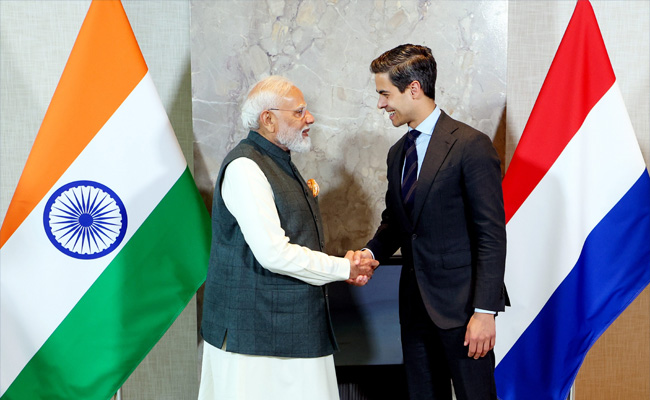
The Hague (PTI): Driven by shifting global geopolitics, India and the Netherlands elevated their ties to a strategic partnership and inked 17 agreements to boost cooperation in defence, critical minerals and other key sectors during talks between Prime Minister Narendra Modi and his Dutch counterpart Rob Jetten.
In their meeting on Saturday evening, the two prime ministers expressed deep concern over the situation in West Asia, especially its serious implications for the region and the wider world in view of disruptions caused to the global energy supplies and trade networks.
Modi and Jetten also called for freedom of navigation and global flow of commerce through the Strait of Hormuz, while opposing any "restrictive" measures, and reaffirmed their support for ongoing initiatives in this regard, according to a joint statement.
Roughly one-fifth of global energy supplies pass through this narrow waterway, where shipping has been severely disrupted since February 28, after the US and Israel launched a joint attack on Iran, triggering retaliatory strikes.
The two leaders also discussed the situation in Ukraine - marked by the ongoing conflict with Russia and regional security developments.
They agreed to continue supporting efforts towards the achievement of a comprehensive, just, and lasting peace in Ukraine through dialogue and diplomacy, based on the principles of the UN Charter and international law, it added.
Modi landed in The Hague on Friday on a two-day visit as part of a four-nation trip to Europe that is aimed at ramping up bilateral ties in a range of key areas.
Following the Modi-Jetten talks, India and the Netherlands unveiled a "strategic partnership roadmap" to boost ties in trade and investment, defence and security, critical and emerging technologies including semiconductors, space, AI and quantum computing.
The two leaders also launched an ambitious "India-Netherlands roadmap on the development of green hydrogen".
Modi and Jetten also agreed to explore possibilities of establishing a defence industrial roadmap to ensure joint manufacturing of defence equipment, systems, components and other key capabilities through transfer of technology and setting up of joint ventures.
The Netherlands is one of India's largest trading destinations in Europe, with bilateral trade touching USD 27.8 billion in 2024-25. The European nation is India's fourth largest investor with cumulative foreign direct investment of USD 55.6 billion.
The Netherlands, with its world class logistics network also serves as a strategic gateway to Europe for Indian exporters, mainly through the Port of Rotterdam.
In the talks, the two sides also agreed to enhance cooperation in science and innovation, sustainability, health, agriculture, water management, climate change and energy transition, maritime development and people-to-people ties.
The agreements inked between the two sides will provide for boosting cooperation in areas of semiconductors, critical minerals, health, water, renewable energy, agriculture and culture among others, according to the Ministry of External Affairs (MEA).
A key pact signed following the Modi-Jetten meeting was one on migration and mobility, which is expected to facilitate greater movement of Indians to the European nation for jobs and education.
While deliberating on geopolitical developments, the two leaders called for a free, open and peaceful lndo-Pacific, based on respect for international law, sovereignty and territorial integrity, freedom of navigation, and "absence of coercion and conflicts", according to the joint statement.
The remarks came against the backdrop of growing global concerns over China's increasingly assertive behaviour in the region.
Recognising the strategic importance of critical minerals for continued innovation, the two prime ministers expressed their mutual interest in strengthening cooperation across the critical minerals value chain, including exploration and integration of value chains.
Both leaders also welcomed an initiative to connect the Dutch Semicon Competence Centre to the Indian Semiconductor Mission, which aims to support and strengthen the semiconductor sector, according to the joint statement.
On enhancing overall two-way trade, Modi and Jetten emphasised the immense potential for further growth particularly in light of opportunities arising from the India-EU Free Trade Agreement, which was signed earlier this year.
In the meeting, PM Modi thanked Jetten for the continued Dutch support to India’s permanent membership of a reformed and expanded UN Security Council.
According to the joint statement, Jetten strongly condemned the “heinous and abhorrent” Pahalgam terrorist attack in April 2025 - in which 26 people were killed - and extended his country's unwavering support to India in its fight against terrorism, including cross-border terrorism.
The two prime ministers unequivocally condemned terrorism in all its forms and manifestations and called for a "zero tolerance" approach to combat terrorism and rejected double standards in countering the menace, it said.
"There has been significant progress in India-Netherlands ties in the last one decade," Modi said in his televised opening remarks during the meeting with Jetten.
The prime minister said India considers the Netherlands among its most important partners as the historical and people to people relations between the two sides are "deep" rooted.
"Democratic values, market economy and responsible behavior are part of our common approach. Our cooperation in areas of Water, healthcare and education has been making the lives of our people better," he said.
Modi also highlighted India's economic growth.
The prime minister suggested that there should be convergence of the Netherlands' expertise and India's "speed and skill" in every sector.
"We need to take our cooperation in areas of innovation, investment, sustainability and defence to new heights. Under this common vision, we are taking India-Netherlands relations to the level of strategic partnership," Modi said.
List of outcomes (17 in total) : PM @narendramodi’s visit to the Netherlands ⬇️
— Randhir Jaiswal (@MEAIndia) May 16, 2026
🇮🇳 🇳🇱 pic.twitter.com/dcAiscX5vO