Extended neighbourhood in Southeast Asia a priority for India: Modi
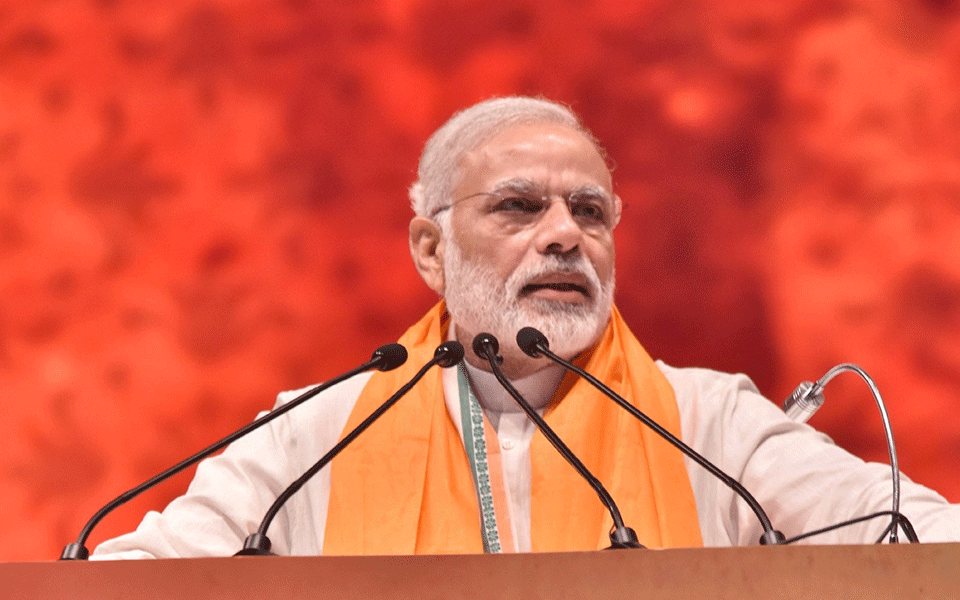
New Delhi, Aug 29 : Ahead of his departure for Nepal to attend in the Fourth Bimstec Summit on Kathmandu on August 30-31, Prime Minister Narendra Modi on Wednesday said that his participation in the event symbolises the priority India accords to deepening ties with India's extended neighbourhood in Southeast Asia.
"My participation in the Summit symbolises India's highest priority to our neighbourhood and our strong commitment to continue deepening our relationship with the extended neighbourhood in Southeast Asia," Modi said in a pre-departure statement here.
"During the Summit, I will have interactions with all the leaders of Bimstec ( Bay of Bengal Initiative for Multi-Sectoral Technical and Economic Cooperation) to further enrich our regional cooperation, enhance our trade ties and advance our collective efforts to build a peaceful and prosperous Bay of Bengal region," he said.
"The Summit theme, 'Towards a Peaceful, Prosperous and Sustainable Bay of Bengal Region' will enable us to shape a collective response to our common aspirations and challenges."
Bimstec came into existence on June 6, 1997, through the Bangkok Declaration.
It comprises seven countries lying in the littoral and adjacent areas of the Bay of Bengal -- Bangladesh, Bhutan, India, Myanmar, Nepal, Sri Lanka and Thailand.
The bloc brings together 1.5 billion people, or 21 per cent of the world's population, and has a combined GDP of $2.5 trillion.
The main objective of Bimstec is technical and economic cooperation among South Asian and Southeast Asian countries along the rim of the Bay of Bengal.
With the South Asian Association for Regional Cooperation (Saarc) virtually rendered ineffective as a bloc, largely due to non-cooperation on the part of Pakistan on issues like connectivity and counter-terrorism, India has been giving more importance to Bimstec in recent times.
India is the lead country for cooperation in four priority areas: counter-terrorism and transnational crime, transport and communication, tourism and environment, and disaster management.
In his statement, Modi expressed confidence that the Kathmandu Summit will further consolidate the progress made thus far under Bimstec , and will chart the course for building a peaceful and prosperous Bay of Bengal Region.
"On the margins of the Bimstec Summit, I will have the opportunity to interact with the leaders of Bangladesh, Bhutan, Myanmar, Sri Lanka and Thailand," he said.
"I also look forward to meeting Prime Minister of Nepal K.P. Sharma Oli and reviewing the progress we have made in our bilateral ties since my last visit to Nepal in May 2018."
Modi said that he and Oli will also inaugurate the Nepal Bharat Maitri Dharmashala at the Pashupatinath temple complex.
At a media briefing here last week, Preeti Saran, Secretary (East) in the External Affairs Ministry said that significant progress has been made in cooperation within the regional bloc since the Bimstec Outreach Summit held on the sidelines of the BRICS (Brazil, Russia, India, China, South Africa) Summit in Goa in 2016 in the areas of security, counter-terrorism, transport and connectivity, tourism, environment and disaster management, and people-to-people contacts.
"Bimstec is growing economically and strategically," she said.
"The strength of the group is in responding collectively in the face of adversity."
Saran said that Bimstec is important for India in terms of New Delhi's Act East Policy and Neighbourhood First Policy, with northeastern India acting as a bridge between South Asia and Southeast Asia.
A Bimstec free trade agreement (FTA) is under negotiation as also a customs cooperation agreement and a motor vehicles agreement.
Let the Truth be known. If you read VB and like VB, please be a VB Supporter and Help us deliver the Truth to one and all.
EAM Jaishankar meets Jamaican PM, gifts over 10 BHISHM Cubes
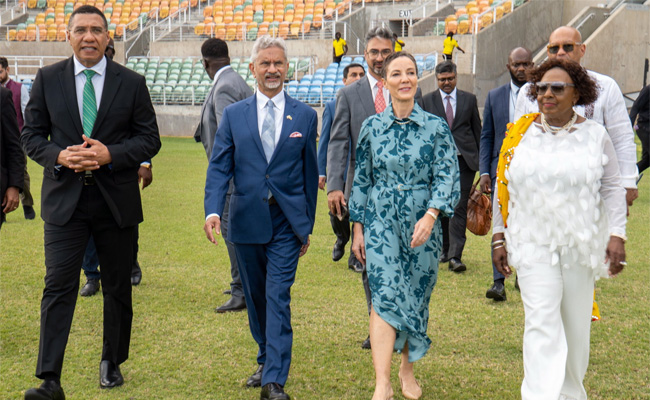
Kingston (PTI): External Affairs Minister S Jaishankar on Monday met Jamaican Prime Minister Andrew Holness and discussed ways to further deepen "political, economic and people-to-people cooperation."
Jaishankar also conveyed greetings from Prime Minister Narendra Modi to Holness.
"Pleased to call on Prime Minister @AndrewHolnessJM in Kingston. Conveyed the greetings of PM @narendramodi," Jaishankar posted on X.
"Discussed deepening our political, economic and people-to-people cooperation. Value his commitment towards further strengthening India-Jamaica relations," the post further read.
Also, the external affairs minister handed over 10 BHISHM (Bharat Health Initiative for Sahyog Hita & Maitri) Cubes as a gift to Jamaica.
"Formally handed over 10 BHISHM Cubes as a gift from India to Jamaica, in the presence of PM @AndrewHolnessJM, Health Minister @christufton and FM @kaminajsmith," Jaishankar posted on X.
"The BHISHM Cube mobile hospital system, designed for rapid deployment, will help Jamaica during disasters and emergencies. The gift of these cubes is a statement of friendship, a commitment to disaster preparedness, and an outcome of innovation," the post said.
Jaishankar arrived in Kingston on Saturday evening, marking the first leg of his nine-day tour of Jamaica, Suriname, and Trinidad and Tobago, aimed at further strengthening India's strategic and cultural ties with the Caribbean nations.
Earlier in the day, he interacted with the Indian diaspora and discussed India's ongoing transformation in infrastructure, human development and technology-driven governance and entrepreneurship with them.
He also highlighted the cricket bond between both countries as India gifted a scoreboard to Jamaica.
A scoreboard was dedicated at Sabina Park in Kingston. It is the home of the Jamaica cricket team and is the only Test cricket ground in the Caribbean island nation.
The minister expressed hope that the new scoreboard would witness many memorable innings, including those symbolising the enduring friendship between the two countries.
Cricket has long been a strong cultural bridge between India and Jamaica, which is part of the West Indies cricket team.
Jamaican players, including Chris Gayle, Courtney Walsh and Michael Holding, have played a major role in shaping the legacy of West Indies cricket in the international arena, contributing to its dominance in earlier decades and its continued global appeal.