Facebook removes Rahul Gandhi's post for policy violation
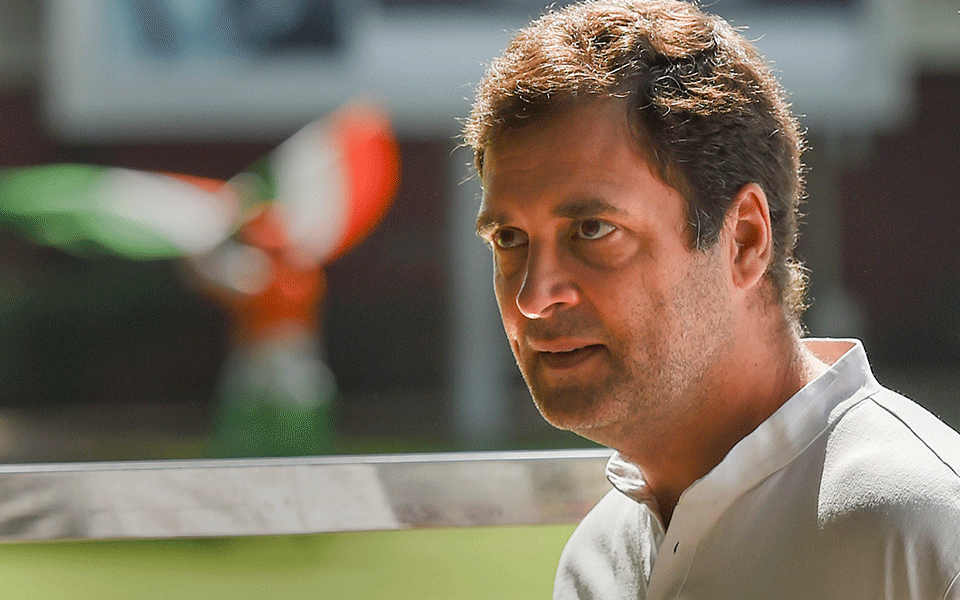
New Delhi(PTI) : After Twitter, Facebook has removed a content posted by Congress leader Rahul Gandhi that identified the family of a nine-year-old victim of alleged rape and murder in Northwest Delhi, saying it violated the social media platform's policies.
According to sources, Facebook has informed Gandhi and the National Commission for Protection of Child Rights (NCPCR) about the removal of the posts from Facebook and Instagram.
Earlier this week, Facebook had written to Gandhi asking him to remove the said post from Instagram -- Facebook's photosharing platform.
"We have taken action to remove the content as it was in violation of our policies," a Facebook spokesperson said in an emailed statement on Friday.
Facebook takes action against a content if it violates its Community Standards or upon receiving a valid legal request as per Indian laws.
Last week, NCPCR had asked Facebook to take appropriate action against Gandhi's Instagram profile over violation of provisions of the Juvenile Justice Act, 2015, the Protection of Children from Sexual Offences (POCSO) Act, 2012, and the Indian Penal Code, and demanded the removal of the video from the platform.
Following the communication from Facebook to Gandhi earlier week, NCPCR withdrew its direction to the company to appear before the commission with an explanation over non-action regarding Gandhi's post.
Earlier this month, Gandhi had met the family of the nine-year-old girl and asserted that he is with them on the path to justice and "will not back down even an inch". Later, he posted a picture of his meeting with the girl's parents on Instagram.
Similar posts were also shared on Twitter. The microblogging platform had locked accounts of Gandhi as well as many other Congress leaders who tweeted the controversial post. On August 14, Twitter restored Gandhi's account after the Congress leader submitted a consent letter from the family of the victim.
Twitter, however, continues to withhold the tweets that contain the images saying they violate India's laws.
"As part of the appeal process, @RahulGandhi (the official Twitter handle of Rahul Gandhi) has submitted a copy of the formal consent/authorisation letter to use the referenced image via our India Grievance Channel," Twitter spokesperson had said.
The law provides that identity of a juvenile victim of sexual assault cannot be disclosed. Tweeting pictures of the family violated that and so the accounts were locked. During the period the accounts were locked, the owner could access the account but not allowed to send out new tweets. This was to allow them to delete the contentious tweets.
But neither Gandhi nor Congress and its leaders did that. Instead, they submitted a consent letter from the family of the alleged rape victim for use of their images.
"We have followed the necessary due diligence process to review the appeal in order to protect the safety and privacy of the affected individuals. We have updated our enforcement action based on the consent provided by the people depicted in the image," the Twitter spokesperson had said.
Let the Truth be known. If you read VB and like VB, please be a VB Supporter and Help us deliver the Truth to one and all.
Tamil Nadu: Cong stages statewide protests against guv over govt formation
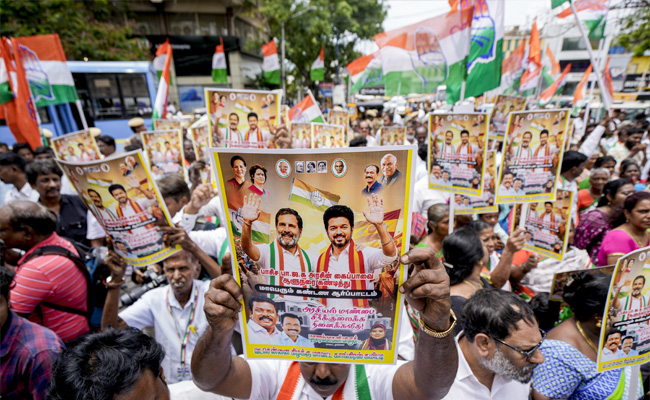
Chennai (PTI): TNCC on Friday launched a statewide protest against Governor Rajendra Vishwanath Arlekar for his refusal to invite the TVK to form the government despite it emerging as the single largest party in the recently concluded Assembly elections.
Leading a spirited demonstration at Anna Salai in Chennai, AICC in-charge for Tamil Nadu, Girish Chodankar, and TNCC President K Selvaperunthagai accused the Raj Bhavan of acting as a "puppet" of the BJP-led Centre and subverting democratic norms.
Speaking to reporters at the protest site, Chodankar launched a scathing attack on the Governor's delay in government formation.
"The Governor has a mission, but he is following (Union Home Minister) Amit Shah. That is his problem," Chodankar charged.
ALSO READ: UP govt sacks five doctors, orders action against 16 health officials for negligence
When asked about mounting speculation regarding a potential "outside support" arrangement between traditional rivals DMK and AIADMK to keep the TVK-Congress combine out of power, Chodankar said, "Let them come together. Let everyone get exposed before the people of Tamil Nadu.”
According to him, if that happens people will know who is really secular and who is ready to stand by them in this situation.
"I am confident that many secular parties are not ready to see BJP or RSS rule enter Tamil Nadu and will definitely oppose it," said Chodankar.
Addressing his party's recent exit from the DMK-led alliance to support actor-turned-politician Vijay's TVK, Chodankar dismissed allegations of "backstabbing" by his party's former ally.
"In a democracy, people are the masters. We have respected the people's mandate," he stated.
Selvaperunthagai demanded that the Governor immediately invite the single largest party to form the government.
"The Governor must implement the Constitution. That is our only demand, and that is why we are protesting today," Selvaperunthagai said.
The Congress, which recently snapped its long-standing ties with the DMK, has aligned itself with the TVK, which won 108 seats. The party cadres held demonstrations across all district headquarters, raising slogans against the Governor and the Union government, while demanding that the democratic mandate of the 2026 elections be respected without further delay.
The protests come amid a tense political climate in the state, as the DMK and AIADMK -- who both suffered significant losses to the TVK -- reportedly explore tactical manoeuvres to navigate the hung assembly.
TVK with 108 seats has the support of Congress' five MLAs but the party is still short of five legislators to form government.