Fact Check: New Ayodhya currency released with Ram Rajya Mudra? Here’s the truth
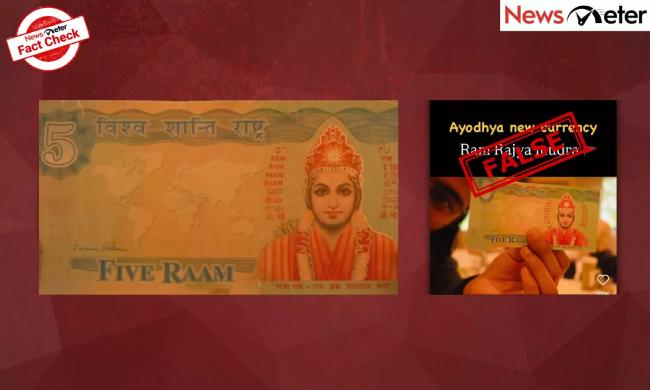
Claim: The video shows the new Ayodhya currency with a Ram Rajya seal on it.
Fact: The claim is false. The video shows ‘Raam’ currency, which is not legal tender. ‘Ayodhya’ currency does not exist.
Hyderabad: A video showing ‘Raam’ currency is going viral on social media with the claim that it shows Ayodhya’s new currency.
In the video shared on Instagram, we can see a person showing ‘Lord Raam’ currency, saying it is the official currency of Maharishi Vedic City. He also says that this currency is used for transactions and the value of ‘Five Raam’ denomination is equal to 50 US Dollars.
The text on the video reads, “Ayodhya new currency… Ram Rajya Mudra… Jai Shree Ram”. The video was uploaded with the caption, “Ayodhya new currency. Should the currency in the name of Lord Ram should come into Bharat as well? (Translated from Hindi) (Archive)

Fact Check
NewsMeter found that the viral claim is false. The video does not show the Ayodhya currency. Ayodhya currency does not exist.
Keyword searches yielded no reports or social media posts indicating that Ayodhya currency exists. There are no reports of any central bank announcing its intentions to introduce an ‘Ayodhya’ currency.
Using a reverse image search, we found an extended version of the viral clip uploaded to YouTube on June 14, 2024. The video was uploaded by a channel named Desi Tourist with the title ‘Found a Hindu country but 99% Indians don't know about it? Desi Tourist Vlog.’ (Translated from Hindi)
The description of the video stated that it’s a part of a travel video taken during a road trip through the United States of America. The viral clip started from the 25:23-minute mark in the YouTube video.
From the information in the YouTube channel, we found that the person talking about the ‘Raam’ currency in the viral video is Amit Singh, a travel vlogger who uploads his videos on the Desi Tourist YouTube channel. The video description stated, “In this episode, I will take you to the magical land of Ram Rajya in America. A Land of Sanskrit Speaking people, land of Vedas & Vastu Shashtra, land of Bhagwan Ram currency note. Let’s go to Maharishi Vedic City, Iowa - the most progressive city in America based on Ayurveda. (sic)”
From the video, we understand that the ‘Raam’ currency is used in the Maharishi Vedic City of Iowa.
Using keyword searches, we found a Zee News report dated March 6, 2025, with the title ‘Lord Ram On Currency Note: THIS US City Has Currency Stronger Than Dollar; It’s Located In....’ The report stated that the ‘Raam’ currency was introduced in 2001 by the Global Country of World Peace (GCWP) with the goal of fostering global peace, progress, and prosperity.
“While primarily used in Maharishi Vedic City, it has also seen limited circulation in some European countries, particularly in the Netherlands,” added the report.
Is ‘Raam currency’ legal tender?
The Raam currency is available in the denominations of 1, 5 and 10, with each ‘Raam’ valued at 10 US Dollars.
According to the Times of India report published on the same date with the title ‘This place in the US has the Ram Rajya Currency in Circulation’, ‘Raam’ currency is a bearer bond not legal tender.
TOI stated that the ‘Raam’ currency is more of an instrument of investment, rather than a regular transaction: “…bearer bonds are usually issued by corporate houses or governments to collect funds, hence it is basically a debt instrument. However, no record of the investor is kept by the bank, hence the currency holds no legal tender.”
NewsMeter spoke to Amit Singh, who confirmed that the ‘Raam’ currency is not related to Ayodhya or any place in India. He added, “It is a conceptual currency from a Vedic-based small town in America.”
Amit Singh informed NewsMeter that he wrote a comment in the viral video, “I asked them to delete it, as it was spreading fake information.” However, we were unable to find Amit Singh’s comment on the viral video, and it seems to be deleted.
‘Raam’ currency is not a legal tender, it’s a bearer bond introduced by GCWP in 2001. Its circulation is limited to some places in America and few European countries, particularly the Netherlands.
Therefore, NewsMeter concludes that the viral claim regarding an ‘Ayodhya’ currency is false.
(This story wa originally published by newsmeter.in, and repulished by english.varthabharati.in as part of Shakti Collective)
Let the Truth be known. If you read VB and like VB, please be a VB Supporter and Help us deliver the Truth to one and all.
Will win 226 seats; exit polls predictions made at BJP's behest to demoralise TMC workers: Mamata
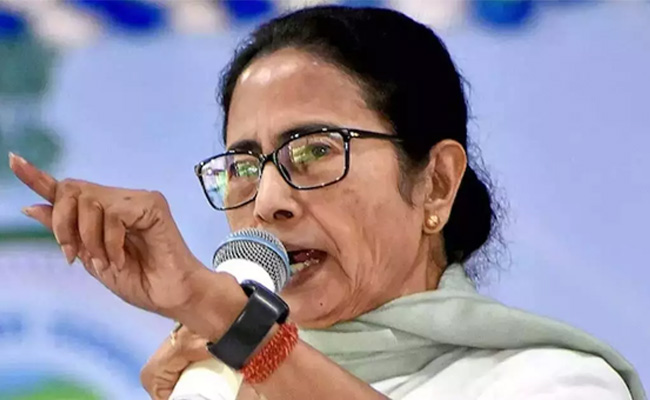
Kolkata (PTI): West Bengal Chief Minister Mamata Banerjee on Thursday dismissed exit poll projections, saying they were aired at the “instruction of the BJP” to demoralise her party and asserted that the Trinamool Congress (TMC) would win more than 226 seats in the assembly polls.
She also targeted Union Home Minister Amit Shah, alleging central forces acted as “agents of the BJP”, and took a dig at Prime Minister Narendra Modi for his remarks made on Wednesday that "the poll results will strengthen the resolve of a developed India", wondering how he can make such a comment when voting was on.
In a video message shared on social media ahead of counting on May 4, Banerjee claimed television channels ran projections circulated from the BJP office, alleging a coordinated attempt to shape public perception.
“I want to reassure you that what is being shown on TV, that circular was issued from the BJP office at 1.08 pm yesterday. Money was paid to show those figures. The media was forced to air it,” she said.
Her remarks came a day after most exit polls predicted a majority for the Bharatiya Janata Party in the 294-member Assembly, where the halfway mark is 148, with several projections giving it over 150 seats, a narrative the TMC chief sought to counter forcefully.
Exuding confidence about her party’s prospects, Banerjee said the TMC would comfortably cross the two-thirds mark.
“We will cross 226. We may even get 230. I have full faith in the way people have voted,” she said.
Thanking voters for their participation, she struck an emotional note, saying, “Even in such scorching heat, and despite so much oppression, the way you stood in queues to vote -- we are grateful. I am also grateful to my workers. They fought with everything they had. They endured a lot of oppression. Those who tried to subdue Bengal have themselves been subdued in the ballot box.”
Alleging widespread intimidation during polling, Banerjee said Trinamool workers faced “joint oppression” by central forces and sections of the police.
“The BJP intimidates everyone through ED, CBI. The conduct of the central forces yesterday, and some of the newly appointed police personnel who were not under my control - they beat women, they beat children,” she claimed.
The chief minister also trained her guns on Union Home Minister Amit Shah, alleging that central forces acted as “agents of the BJP” during the entire polling process.
“At direct instructions of Amit Shah, central forces have been working in West Bengal as agents of the BJP in the entire polling process,” she claimed.
He also took a swipe at Prime Minister Narendra Modi for his remarks on the last day of polling from Uttar Pradesh, where he had said voters are casting their vote in West Bengal this time in a "fearless atmosphere", which was unimaginable in the past six or seven decades."
He also asserted that the assembly poll results on May 4 will further strengthen the resolve of a developed India.
“How can he say Bengal is his during elections? Does he know Bengal? Does he know its soil? He knows no one here,” she said.
Referring to the reported death of a voter in Udaynarayanpur in a polling booth, she said, “I have no words to console the bereaved family of the gentleman who died while going to vote. We will stand by that family.”
The CM alleged that her party workers were “one-sidedly attacked” but did not retreat, and that many were deliberately arrested to prevent them from acting as polling agents. She cited incidents from areas such as Bhatpara, Noapara, Jagaddal and her own constituency, Bhabanipur.
“Our workers were beaten so that they could not function as agents. Even in Bhabanipur, raids were conducted throughout the night. I have not slept for two days,” she said.
Calling the exit poll predictions a “BJP conspiracy”, Banerjee further alleged that they were aired to influence economic sentiment and demoralise her cadre.
“I have information that this was done to comfort the share market. If the truth comes out, the market will crash. So the BJP used the media for this last game, to demoralise our workers,” she said, recalling discrepancies between exit poll projections and actual results in 2016 and 2021.
In a strong organisational directive, Banerjee asked party leaders, candidates and workers to remain on high alert during counting and guard strong rooms housing Electronic Voting Machines (EVMs).
“You must guard the counting centres. If needed, I will also go and guard my area. Candidates must guard themselves. Stay awake. If I can do it, so can you. There is a plan to change the machines while transporting EVMs. Do not take this lightly,” she said.
“Until I formally say so in a press conference, no one should leave the counting table,” Banerjee added.
The TMC supremo cautioned workers against leaving counting tables unattended even briefly.
“During counting, sit firmly at the centres. Even if someone needs to go to the toilet or eat, it should not be for more than two minutes. Leave someone trustworthy in your place, someone who cannot be bought with money,” she said.
Despite the sharp allegations, Banerjee appealed for restraint.
“Even if they attack you, do not retaliate immediately. There has been a lot of violence. Our workers were beaten and bloodied in Bhangar. They will be answered — but no one should take the law into their own hands. We will take action,” the CM said.
Banerjee said she was “100 per cent confident” of a win and urged all TMC candidates to remain vigilant till the final results are declared.
Meanwhile, BJP state president Samik Bhattacharya dismissed her allegations as a sign of nervousness.
“She is very well aware that she is losing the polls and that is why she is making such a statement to keep her party workers charged up,” he said, terming her remarks a “panic reaction” to an “imminent defeat”.
The sharp exchange underscores the high-stakes nature of the Bengal verdict, with both narrative and numbers under intense contest ahead of counting day.