Farmers badly hit by demonetisation, admits Agriculture Ministry
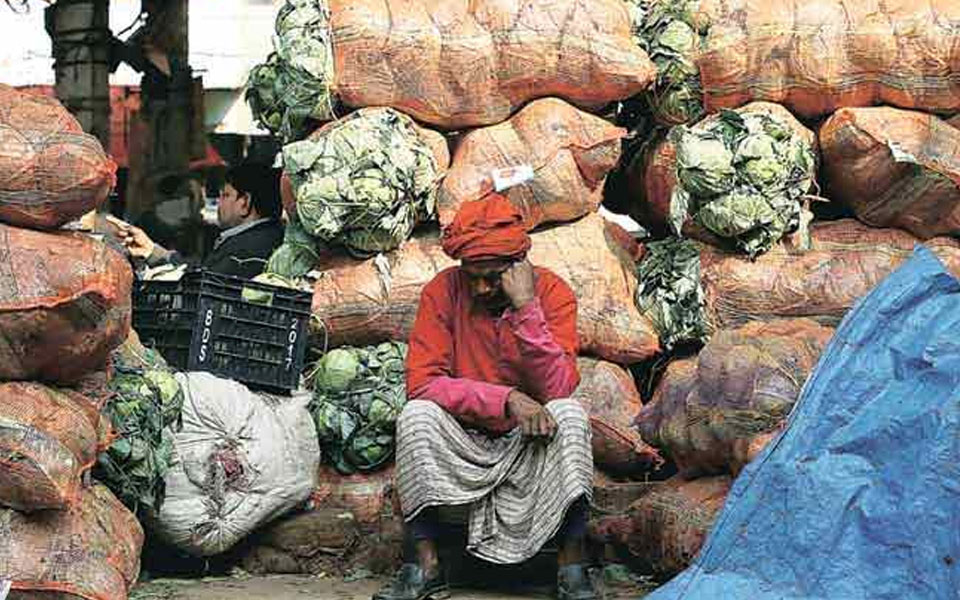
Millions of farmers in India were unable to buy seeds and fertilisers for their winter crops because of demonetisation, according to a report submitted by the Union Agriculture Ministry to the Parliamentary Standing Committee on Finance.
This official acknowledgement of the impact of demonetisation comes on a day when Prime Minister Narendra Modi, speaking at a rally in Jhabua, Madhya Pradesh, said that he used the “bitter medicine” of demonetisation to bring back money into the banking system and to give “proper treatment to deep-rooted corruption system” in the country.
The Parliamentary Standing Committee on Finance, headed by Congress MP Veerappa Moily, was on Tuesday briefed on the impact of demonetisation by the Ministries of Agriculture, Labour and Employment, and Micro, Small and Medium Enterprises.
‘Not enough cash’
The report submitted by the Ministry of Agriculture, reviewed by The Hindu, said that demonetisation came at a time when farmers were engaged in either selling their Kharif crops or sowing the Rabi crops. Both these operations needed huge amounts of cash, which demonetisation removed from the market. “India’s 263 million farmers live mostly in the cash economy,” the report said, adding, “millions of farmers were unable to get enough cash to buy seeds and fertilisers for their winter crops. Even bigger landlords faced a problem such as paying daily wages to the farmers and purchasing agriculture needs for growing crops.”
Failed to pick up
Even the National Seeds Corporation (NSC) failed to sell nearly 1.38 lakh quintals of wheat seeds because of the cash crunch. The sale failed to pick up even after the government, subsequently, allowed the use of old currency notes of ₹500 and ₹1,000 for wheat seed sales.
Sharp questions
According to sources, the Standing Committee sent the team of bureaucrats from the Agriculture Ministry packing because the Secretary, Agriculture, did not show up.
Many of the Opposition members raised sharp questions during the meeting. According to sources, All India Trinamool Congress’ Dinesh Trivedi asked if the government was aware of a report by the Centre for Monitoring Indian Economy (CMIE), which stated that 1.5 million jobs were lost during January-April 2017 post-demonetisation.
The Labour Ministry filed a laudatory report on demonetisation.
The Ministry said that comparisons of quarterly employment surveys (QES) for the periods just before and after demonetisation revealed an increase of 1.22 lakh and 1.85 lakh respectively in the fourth and fifth round of the QES, in the total employment for establishments with 10 or more workers.
Farmers’ distress is an important issue in three of the five States that are facing Assembly poll: Madhya Pradesh, Rajasthan and Chhattisgarh.
Courtesy: www.thehindu.com
Let the Truth be known. If you read VB and like VB, please be a VB Supporter and Help us deliver the Truth to one and all.
Vartha Bharati–Sankalp predictions align closely with Karnataka bypoll results
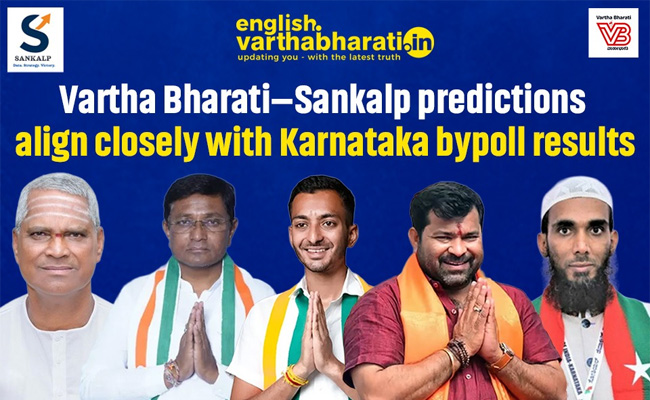
Bengaluru: The Vartha Bharati–Sankalp election analysis has shown a high level of accuracy in predicting the outcome of the recent Karnataka Assembly by-elections held in May 2026, correctly calling winners in both constituencies and closely estimating vote share trends.
The by-elections were held in Bagalkot and Davanagere South, drawing significant political attention as both seats were seen as key tests for the ruling Congress and opposition BJP.
According to the analysis, Vartha Bharati–Sankalp had made three major projections ahead of the results the winning party, vote share percentages, and margin of victory.
In both constituencies, the platform accurately predicted that the Congress would emerge victorious. The outcome matched the projections, with Congress candidates winning in Bagalkot and Davanagere South.
In terms of vote share, the predictions were largely in line with the final results. In Bagalkot, the BJP’s vote share was forecast in the range of 40 to 46 per cent, while the actual figure stood at 42.9 per cent. The Congress vote share, however, exceeded expectations, with the party securing 55.4 per cent against a projected range of 43 to 48 per cent.
The margin of victory in Bagalkot turned out to be significantly higher than anticipated. While the projection had placed the margin between 2,000 and 3,500 votes, the final margin was around 22,332 votes.
In Davanagere South, the predictions also remained largely accurate. The Congress vote share was projected between 43 and 51 per cent, and the final figure stood at 43.9 per cent. The BJP was expected to secure between 42 and 50 per cent but ended with 40.3 per cent.
The analysis had also identified the role of SDPI as a potential spoiler in the constituency. While its vote share was estimated around 6 per cent, the party eventually secured around 12 per cent of the vote.
The margin of victory in Davanagere South was predicted to be between 1,500 and 2,600 votes. The actual margin was higher at around 5,708 votes, though the contest remained relatively close as anticipated.
Overall, the performance of Vartha Bharati–Sankalp stood out for correctly identifying the winning parties in both seats and maintaining close accuracy in vote share estimates, with only limited deviations in specific cases.