Fire in East Delhi building; woman dead, 25 people rescued
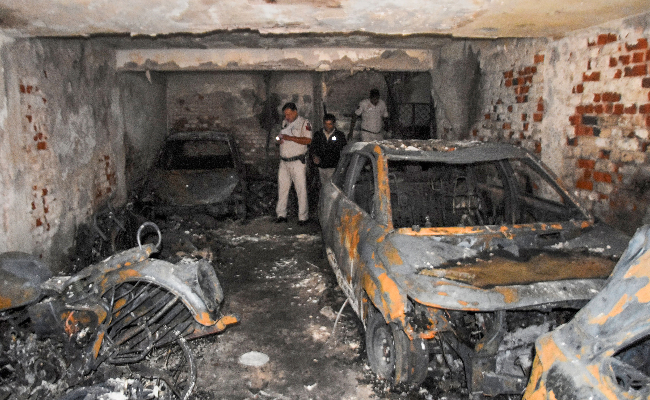
New Delhi (PTI): A 40-year-old woman died in a major fire at a building in East Delhi's Shakarpur on Tuesday while 25 people were rescued, officials said here.
They said the fire started in the building's parking area in the early hours of the day and soon engulfed the entire structure.
The woman, identified as Anita, died of burn injuries at a hospital, the officials said, adding that another person, Naresh Nagar, suffered a fracture in his leg after jumping off the first floor of the burning building.
A total of 25 people were rescued, along with two pets, by Delhi Fire Service (DFS) personnel, they said.
"We got a fire call at about 1.05 am... We immediately pressed three fire engines to service. Later, five more fire engines were rushed to the spot. The matter was informed to the police immediately," a DFS official said.
The fire department officials said the blaze was brought under control around 8.35 am.
They said 31 people were trapped inside the building when it was engulfed in flames. Five of them jumped off the balconies to save themselves and the rest were brought out of the building by firefighters, the officials said.
They added that 10 people were rushed to hospitals such as the Guru Teg Bahadur (GTB) Hospital, Lal Bahadur Shastri (LBS) Hospital and other medical facilities and one woman died during treatment.
"During the rescue operation, Samay Singh of the DFS suffered breathing problems and was immediately taken to a nearby hospital," an official said, adding that he was later discharged after first-aid.
Identities of the victims are being ascertained, DFS officials said.
Police have registered an FIR in connection with the incident and launched an investigation.
Around 1 am on the intervening night of Monday and Tuesday, information was received regarding a fire in a car in Ganesh Nagar II, Shakarpur, police.
A police team reached the spot and an inquiry revealed that a fire broke out in a five-storey building having a parking lot and eight flats with single entry and exit points, they said.
Police said the fire started on the left side of the building which has the parking lot on the ground floor and four flats.
A total of 17 fire tenders reached the spot to douse the flames, they said, adding that CAT ambulances, a BSES team and a crime and forensics team were also pressed into service.
"All those injured, including a fireman, were rushed to LBS, GTB and Hedgewar Hospital. Initial inquiry revealed that a fire broke out due to a short circuit in the parking area on the ground floor. The fire started from the parking area and soon engulfed the first floor. The residents of the floors above sustained injuries due to excessive heat and smoke," DCP Amrutha Guguloth said.
Of the five men and four women who received injuries, one Anita (40) died, police said, adding that another person jumped off the first floor and fractured his leg.
Four cars, 11 two-wheelers and three bicycles parked on the ground floor were gutted, they said.
"An FIR under sections 304-A (causing death by negligence) and 337 (causing hurt by act endangering life or personal safety of others) of the IPC has been registered and further investigation into the matter has been launched," Guguloth added.
Let the Truth be known. If you read VB and like VB, please be a VB Supporter and Help us deliver the Truth to one and all.
Several Gurugram schools receive hoax bomb threats

Gurugram (PTI): Several Gurugram schools received another hoax bomb threat emails on Wednesday morning, prompting police to launch searches on the premises.
Police said the email was sent by the 'Khalistan National Army', with threats issued to Haryana Chief Minister Nayab Singh Saini to declare April 29 as the "40th Khalistan Declaration Day". It also threatened to bomb the Red Fort in Delhi.
Police said it was a hoax as no suspicious items were found after an intensive search.
Several schools, including Shri Ram, Amity, and the HDFC school, received threatening emails at 8.33 am, when classes had already begun, police said.
The school administrations became aware of the threats around 9 am and immediately informed the police, a senior police officer said.
The schools immediately implemented emergency protocols, with many declaring a holiday and asking parents to take their children home safely, the officer said.
A large number of anxious parents gathered outside the schools, as police and bomb squad teams reached the spots and started checks.
"Around 10 schools have approached the police from morning until now over bomb threats. Police teams are alert, and searches are underway on all the premises", the officer said.
As soon as the information about this email was received, police in Gurugram and Delhi swung into action and started investigation.
Schools immediately implemented emergency protocols upon receiving the mail. Many schools declared a holiday and sent messages to parents, asking them to take their children home. Large crowds of parents gathered outside the schools.
The schools were sanitised by sending a bomb disposal squad as well as a dog squad.
A senior police officer said that police teams thoroughly searched the school premises, classrooms, buildings, and surrounding areas. No suspicious objects or explosive materials were found during the investigation.
"Police teams are seriously investigating the entire matter. Cyber experts are being consulted to determine the authenticity of the email, its source, and the identity of the sender", added the officer.
This is the third time since January that schools have received fake bomb threats.
In March, at least a dozen schools in the city received bomb threat emails, which later turned out to be hoaxes.
Similarly, on January 28, as many as 13 schools received hoax bomb threats via email, forcing authorities to evacuate campuses and suspend classes.
Last month, police arrested a Bangladeshi national whose email ID was allegedly used to make a bomb threat for some payment.