First time in history, says anguished Jagdeep Dhankhar on Kharge entering RS Well
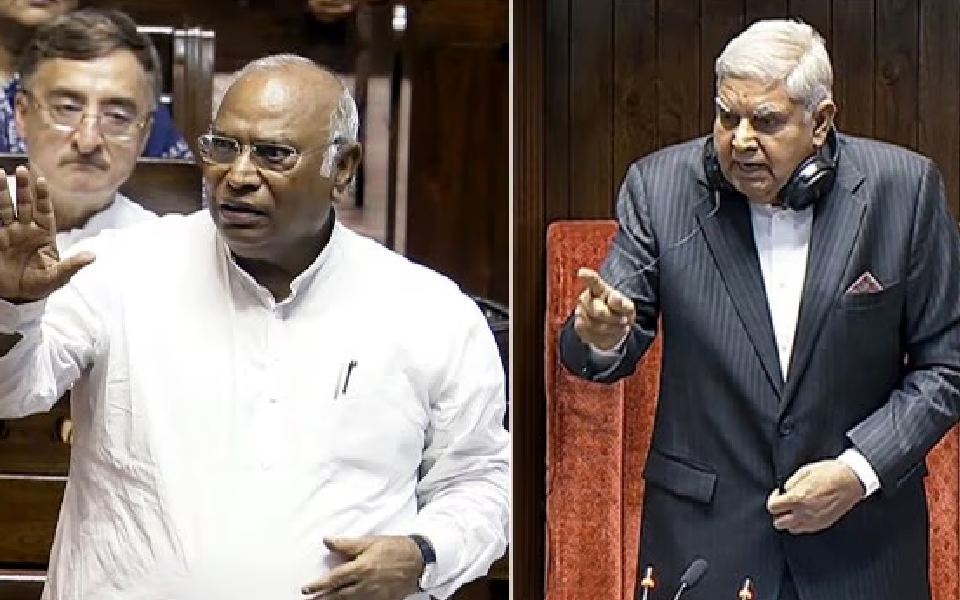
New Delhi, Jun 28: Rajya Sabha Chairman Jagdeep Dhankhar on Friday expressed anguish over Leader of the Opposition Mallikarjun Kharge trooping into the Well of the House during an opposition protest, saying it is for the first time that a person occupying the post has engaged in such conduct.
On Friday, the House witnessed three adjournments due to protests and sloganeering by the opposition.
Soon after laying of the listed papers on the table of the House during the morning session, Dhankhar informed that he has not accepted 22 notices by the opposition leaders to suspend the scheduled business of the day and take up discussion on the alleged irregularities in the NEET.
This led to protest by the MPs of the opposition parties. They started raising slogans and several of them entered into the Well, leading to adjournment of the proceedings.
Just before the adjournment, BJP leader Sudhanshu Trivedi had started speaking on the discussion on a motion to thank the President for her address to the joint sitting of Parliament.
When the House reassembled, there were almost similar scenes and the speech of Trivedi was disrupted.
At one point, Kharge too entered the Well of the House to join the opposition protest.
Dhankhar remarked that the act of coming into the Well by a leader of the opposition has happened for the first time in the history and become a "stain" for Parliament.
"I am pained and surprised that Indian parliamentary tradition will stoop to such low that the leader of the opposition will troop into the Well," he said, before adjourning the proceedings till 2 pm.
Later again, he referred to the incident.
"The kind of conduct, ignoble conduct, a conduct that will hurt every Indian, will put this institution to shame. We are here elected, get the prestige of being members of the upper house, the house of elders. If in this House we conduct ourselves in this unruly manner, it is most unfortunate," the chairman said.
The House later took up the discussions on the motion of the thanks before adjourning for the day around 6 pm.
Rajya Sabha will meet again at 11 am on Monday.
Let the Truth be known. If you read VB and like VB, please be a VB Supporter and Help us deliver the Truth to one and all.
NIA court to complete framing of charges against 2010 hand-chopping case accused on May 15

Kochi (PTI): A special court here will complete proceedings for framing charges against the prime accused in the 2010 hand-chopping case involving professor T J Joseph, in which PFI activists were accused of attacking him at Muvattupuzha.
Ernakulam Special Court for NIA cases judge P K Mohandas, on April 30, heard the arguments of counsel for accused Savad and Shafeer C and decided to proceed with framing charges against the duo.
A group chopped off Thodupuzha Newman College professor Joseph's right hand in July 2010, accusing him of religious blasphemy in a question paper he had prepared.
The case, later taken over by the National Investigation Agency (NIA), resulted in the conviction of 19 accused.
The first accused, Savad, who allegedly chopped off Joseph’s palm, was arrested in Berram in Mattannur, Kannur, in January 2024, where he had allegedly been hiding under the pseudonym Shajahan.
The NIA also arrested Shafeer, who allegedly arranged shelter and provided logistical support to Savad at Chakkad and Mattannur in Kannur since 2020.
On April 30, the court heard the counsel for the accused and the NIA prosecutor on framing charges against the duo.
"On going through the documents and evidence in the case and on hearing the counsel for the accused and the prosecutor, I am of the opinion that there are grounds for presuming that the first accused has committed offences punishable under provisions of the IPC, the Explosive Substances Act and the Unlawful Activities (Prevention) Act, and that the second accused has committed offences punishable under the IPC and the UAPA, and there are materials for framing charges under these provisions against the accused," the court said.
The court directed that Savad be produced and Shafeer, who is on bail, appear before it on May 15 for recording their pleas as part of the charge-framing process.
After framing the charges, the court will schedule the trial in the case.