Five IITs, DU, IISc among top 100 institutes in Asia: QS Rankings
_vb_53.jpeg)
New Delhi (PTI): Five Indian Institutes of Technology (IITs), Indian Institute of Science (IISc), Bengaluru and Delhi University figured in Asia’s top 100 institutes, according to the QS University Rankings announced on Tuesday.
IIT-Delhi, IIT-Madras, IIT-Bombay, IIT-Kanpur and IIT-Kharagpur were in the list of top 100 Asian institutes.
“Seven Indian institutions rank in the top 100 in QS World University Asia rankings, 20 in the top 200 and 66 in the top 500," London based QS said in a statement.
It said compared to last year, 36 Indian institutes went up in the list, 16 remained the same and 105 fell down the rankings. "The expansion of the rankings is associated with the greater volatility observed in this year’s results."
“Overall, 41 Indian institutions appear in the top 80th percentile of universities. India ranks best in Asia for staff with PhD,” it added.
IIT-Delhi, which ranked 59 this year, was declared the best Indian institute for the fifth consecutive year.
The QS World University Rankings: Asia assesses universities based on 11 indicators, which have been tailored to reflect the nuances of the region and differentiate it from the QS World University Rankings.
“India’s higher education transformation is now visible in the data. In just five years since the National Education Policy launched, India has built system-level capacity that is globally relevant and locally empowering. The entry of over 130 Indian universities into this year’s Asia Rankings is a strong signal of depth as well as breadth,” said Jessica Turner, CEO, Quacquarelli Symonds (QS).
“As research ecosystems mature and international partnerships scale, India is positioning itself not only as a study destination but as a global knowledge leader shaping innovation, inclusion and sustainable growth across Asia,” added Turner.
India dominates the 'Papers per Faculty' indicator, with five universities ranked among Asia’s top 10 and 28 among the top 50 — more than double the number achieved by its closest competitor, China (two in the top 10 and 14 in the top 50).
The country also has 46 universities in the top 100 for 'Papers per Faculty' and 45 in the top 100 for 'Staff with PhD', with South Korea a distant second (15).
Leading India’s research success, Maulana Abul Kalam Azad University of Technology, West Bengal ranks first for 'Papers per Faculty', followed by Bharathiar University (2nd), Indian Institute of Science (3rd), Anna University (5th), and Indian Institute of Technology Madras (7th).
In 'Staff with PhD', National Institute of Technology, Nagaland and Mother Teresa Women’s University share second place regionally, while nine institutions were -- Indian Institute of Science, IIT Madras, IIT Kanpur, IIT Kharagpur, IIT Bhubaneswar, IIT Patna, IIT Ropar, IISER Bhopal, and the Indian Institute of Information Technology Design and Manufacturing Kancheepuram -- joint fourth position in the category.
The results underscore India’s strong investment in faculty development and research-led teaching.
Let the Truth be known. If you read VB and like VB, please be a VB Supporter and Help us deliver the Truth to one and all.
A 99-run loss is unacceptable: Hayden blames batting horror
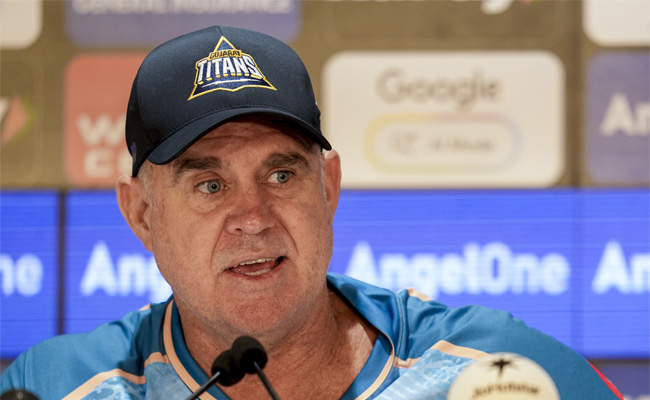
Ahmedabad (PTI): Gujarat Titans' batting coach Matthew Hayden was scathing about their 99-run defeat to Mumbai Indians, blaming a "horror" batting display and poor death bowling for the heavy loss in the IPL.
From being 44/3 in 5.5 overs, MI hammered 73 runs in the last four overs to post a challenging 199/5 here on Monday. In reply, GT were bundled out for 100.
"I expect our margins to be a lot smaller than 100 (99). That is an unacceptable scorecard for our batting unit," the legendary Australian opener told media in the post-match interaction.
"It was just a horrible day for us today. Truth be told, there was nothing good about this day, really, apart from Rabada's performance with the ball. so we've got some work to do, definitely."
GT boast a strong batting line-up in Sai Sudharsan (759 runs), Shubman Gill (717), and Jos Buttler (538). They have also added New Zealand’s explosive Glenn Phillips in the middle order alongside Shahrukh Khan and Rahul Tewatia.
"When you look down at our batting line-up, we've got wonderful players that have to be in a better mindset and better position to take their opportunities. That is our expectations and has been since the conception of this Gujarat Titans franchise...
"So you can't be sitting here and being happy about, a 100-run (99) margin game in a 20-over game. I mean, back in my day, 100 runs was almost a winning total in 50-over cricket!"
The 54-year-old said GT lost the game in the powerplay.
"Well, middle order was undoubtedly exposed today. When they're coming in with six overs, you know that you're in deep trouble. The thing about the power plays is that you can't win it from there, especially in a run chase, but you can definitely lose it, and we lost it in the power play," he said.
Shahrukh (35 off 25 balls) and Tewatia (49 off 42) have not fared well this season and Hayden feels the duo along with Phillips (67 off 54 balls) have been struggling because the top order has been below its best.
"The relevance behind balls faced when you look at, for example, someone like Glenn Phillips -- his record in T20 cricket is an impressive strike rate and you'll take that all day long in the majority of games," Hayden said.
"However, you need an upfront batting effort where you consistently taking the lion's share of the batting. We shouldn't be allowing, Tiwu (Tewatia) or Shahrukh or these guys lots of balls. That's not their role. That's not what they train for."
Hayden said GT has an aggressive and adaptable unit but their execution fell apart on the day.
"We are a very good thinking batting unit. We're not a conservative batting unit. You don't go out and get 200s as often as we do being conservative. But they're an adaptive batting unit. ...they've got their roles and they play them and today they simply didn't.
"So the worry isn't just today about the middle order. It'd be unfair to say that, they were going to go on and score 13 runs an over because by that stage, I felt like as a batting coach, I was on the mast and the boat was sinking."
It was poorly executed bowling effort
=======================
Hayden also pointed to poor execution in the death overs.
"I feel like one-dimensional is very unfair on a world-class bowling attack, but I will take on board it was a poorly executed bowling effort this evening.
"When you look back at those last four overs, that was just a 'horror story' -- 73 off the last four is unacceptable as world-class players. That bowling line-up has to reflect on that performance... It was purely an executional thing."
He added that GT were below par with the ball on a surface that didn’t fully justify the high total.
"We're very average with the ball, firstly, on a wicket that I really felt was probably a 175-type wicket.
"When you look historically at this black soil pitch on No. 5, it's a 200-wicket for the loss of five batters. That's been its winning first-inning score, and today it wasn't that wicket (199/5)... It was visible that it had cracks in it. It was visible that it was up and down.
"So credit also has to go to Tilak Varma, who put in a wonderful performance. It wasn't a cookie-cutter type performance. It was a dominant performance down the ground. He read the play nicely. He was able to pick up and play with power and precision."
Hayden said the chase was still within reach but poor shot selection proved costly.
"And when you reflect on our own batting, we had one side of the ground that was a little more inaccessible than the other, and we lost, what, three wickets into the bigger side of that boundary.
"And it wasn't an impossible total. 200 still is a total that I would back our three world-class players at the top of the order to etch into that a bit more and then allow our more sort of game players. An opportunity to set out their stalls and bat deep into the innings."