Former CJI Chandrachud opens up on Ayodhya Verdict, Modi meeting, in Lallantop interview
Speaks about delay in bail to Umar Khalid, Sharjeel Imam
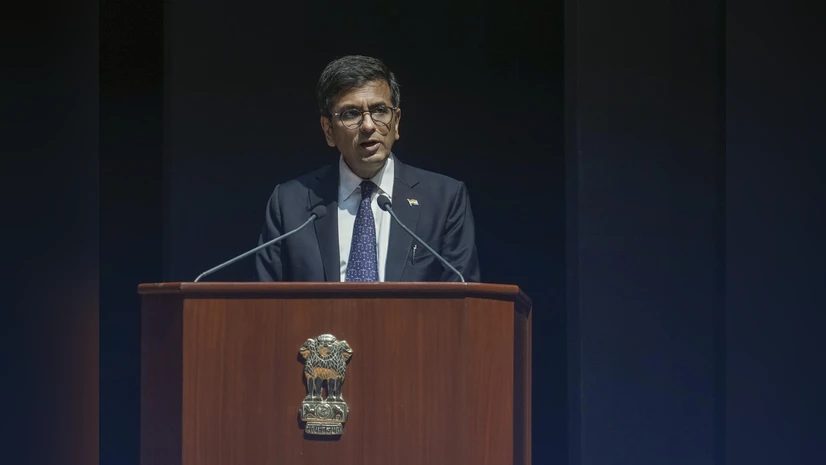
New Delhi: Former Chief Justice of India D.Y. Chandrachud has spoken at length on several contentious issues, from the Ayodhya title suit and mediation process to his meeting with Prime Minister Narendra Modi during Ganesh Utsav, the debate on bail in sensitive cases, and the challenges facing the judiciary. The remarks came during an interview with The Lallantop, excerpts of which have been shared ahead of the full video release.
The discussion touched on his judicial journey, his role in landmark verdicts, and his response to criticisms by fellow judges and political observers.
On the Ayodhya Verdict
Justice Chandrachud, who was part of the five-judge bench that delivered the 2019 Ayodhya land dispute judgment, addressed recent comments made by Odisha High Court Chief Justice S. Muralidhar. Justice Muralidhar had questioned why the decision was delivered in the name of “authorless judgment” and suggested that the ruling was rushed before then-CJI Ranjan Gogoi’s retirement.
Chandrachud countered this sharply. “Many judges become social reformers after retirement. Perhaps they want to be seen as such. But I do not agree with what he said. To say that this was an authorless judgment is wrong. This case was not an ordinary one. For over 100 years, society had witnessed tension before independence, during British rule, and after independence. The bench decided that whatever the verdict, it must be spoken in one voice. That is why it was delivered without attribution,” he explained.
He dismissed suggestions that the case was hurried to accommodate CJI Gogoi’s retirement. “Is this a joke? Mediation was given full opportunity. There were mediators like Sri Sri Ravi Shankar, former judge F.M.I. Kalifulla, and senior advocate Sriram Panchu. Their report made it clear no settlement acceptable to all sides had been reached. Should we have let 15–20 years pass in mediation? People would laugh at the Supreme Court,” he said.
On Criticism of Social Media Interpretations
Chandrachud also pointed out that Justice Muralidhar may have relied on incomplete information. “If he had seen the video clip, he would have realised that reading social media and giving opinions can be misleading. The truth is that mediation did not succeed, and the verdict had to come.”
On Ganesh Utsav Meeting with PM Modi
The CJI addressed criticism after photographs and videos emerged in September 2024 of Prime Minister Narendra Modi attending Ganesh Chaturthi celebrations at his official residence. The images had raised questions about the separation of the judiciary and executive.
“Yes, the Prime Minister came to my house. I have been CJI for two years. I often went to his office, his house, as part of official work—whether for selecting the CBI Director or Lokpal. After such meetings, he would often say, sit for five minutes, have tea, let us talk about digitisation or reforms. I have also invited him for official functions,” Chandrachud clarified.
He added that the Ganesh Utsav invitation was extended by him before retirement. “We were sitting together at an event, and I asked him will you come for Ganpati? He said yes. This was an exchange between constitutional authorities, not something that affects judicial work.”
On Bail and the Umar Khalid Case
Questions about prolonged custody of Delhi riots accused Umar Khalid and Sharjeel Imam also came up. Critics had raised concerns about why bail was denied despite the judiciary’s repeated emphasis that “bail is the rule, jail the exception.”
Chandrachud explained that Khalid’s lawyers themselves had withdrawn bail pleas on several occasions. He also addressed allegations that cases were selectively assigned to certain judges, including Justice Bela Trivedi, who had once been associated as counsel for Narendra Modi.
He rejected such claims. “In the Supreme Court, there are clear rules and conventions on allocation. Cases travel with judges after retirements or health reasons. For example, Justice Bopanna had to step back after heart surgery, and cases had to be reassigned. To say that cases are specifically allotted is wrong. If we start giving lawyers or political establishments the power to pick their judges, the entire system will collapse,” he said.
On the Sabarimala Verdict and Social Backlash
Reflecting on another landmark case, Chandrachud spoke about the Sabarimala judgment allowing women of menstruating age to enter the temple. “It was not an easy verdict. People troll us because they believe faith has been affected. But I am a judge, not God. I believe what I did was right. If society has another view, even harshly against us, let them speak. That is their right,” he said.
On Leaked Supreme Court Video
He also expressed concern about a controversial video clip that was uploaded on the Supreme Court’s website. “The in-house committee was supposed to decide whether the video was genuine or doctored. By uploading it directly on the website, the impression went out to the public that it must be genuine because it was on the Supreme Court’s site. Ordinary citizens do not know whether a video is real or doctored. That was a mistake,” he admitted.
On the Larger Judicial System
Chandrachud repeatedly stressed that criticisms must be seen in the broader context of protecting institutional integrity. “The danger lies in allowing individuals or parties to dictate before whom their cases should be heard. Today it is a matter of personal liberty, tomorrow it could be a matter of industrial disputes. If that line is crossed, the system itself is at risk,” he warned.
Let the Truth be known. If you read VB and like VB, please be a VB Supporter and Help us deliver the Truth to one and all.
Putin meets Iran's FM Araghchi, says Russia ready to do its best to help bring peace to West Asia
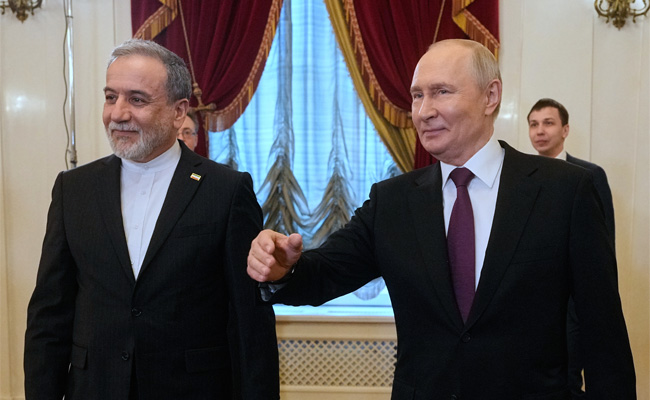
Moscow (PTI): Iran's Foreign Minister Abbas Araghchi on Monday met Russian President Vladimir Putin, who hailed the Iranian people for fighting bravely and heroically for their sovereignty and said Moscow is ready to do its best to help bring peace to West Asia as soon as possible.
Araghchi, who held talks with Omani and Pakistani leadership before arriving in Russia, met Putin in St. Petersburg and thanked him for supporting Iran, state-owned TASS news agency reported.
"Russia is ready to do everything in its power to ensure that peace in the Middle East is achieved as soon as possible," Putin said during his meeting with Araghchi, which was also attended by Russian Foreign Minister Sergey Lavrov.
Revealing that he received a message from Iranian Supreme Leader Mojtaba Khamenei last week, Putin asked Araghchi to convey his "gratitude for this message and best wishes for his health and well-being."
He praised the Iranian people for fighting "bravely and heroically" for their sovereignty, Iran's state-run PRESS TV reported.
"We really hope that, based on the courage and desire for independence, the Iranian people, under the guidance of the new leader, will weather this difficult period of trials and peace will come,” Putin said.
He also stressed that Russia “intends to maintain” its strategic relations with Iran.
Araghchi said that the world witnessed Iran’s strength in countering the US during the recent war, and that the Islamic Republic is a "stable and powerful establishment."
"With their courage, the Iranian people succeeded in resisting the US aggression and will be able to endure it,” he said.
He said that it became clear that Iran has “great friends and allies” like Russia, and conveyed “warmest greetings” from Supreme Leader Mojtaba Khamenei and President Masoud Pezeshkian to the Russian leader.
Araghchi said relations between Moscow and Tehran represent a “strategic partnership at the highest level” and will continue to develop "regardless of circumstances."
"We are grateful to you for the solid and strong positions in support of the Islamic Republic of Iran," he said.
Foreign Minister Lavrov said that the talks between President Putin and the Iranian Foreign Minister were "useful and constructive."
Kremlin Spokesman Dmitry Peskov later said that Russia is "ready to provide any good offices, any mediation services that are acceptable to the parties."
"We will be ready to do everything so that ultimately peace ensues, guaranteed peace, and that there is no return to hostilities," Peskov was quoted as saying by TASS.
He was asked how Moscow can assist in future negotiations on the Iranian settlement.
Araghchi arrived in Russia after his whirlwind trip to Islamabad, which, according to him, was “very productive” and involved “good consultations" with Pakistan's Army Chief Field Marshal Asim Munir, amid uncertainty over the second round of peace talks to resolve the war in West Asia.
"We held good consultations with our friends in Pakistan. The trip was successful. We assessed the outcome of our recent (meetings) and discussed in what direction and under what conditions talks can move on,” Araghchi said in a video posted on his Telegram channel upon his arrival in St Petersburg.
Referring to the second round of talks between the US and Iran to resolve the conflict in West Asia, Araghchi said: "Developments have taken place in the negotiations."
"Despite some progress in earlier rounds, the talks failed to reach their objectives due to the Americans' approach, the excessive demands they made, and the wrong approaches they adopted. Therefore, it was necessary to consult with our friends in Pakistan to review the latest situation,” Iran's official news agency IRNA quoted him as saying.
He said that the trip to Pakistan was a good opportunity to review developments related to the US-Israeli war against Iran, expressing confidence that “these consultations and coordination between the two countries will be highly significant.”
Araghchi arrived at St. Petersburg's Pulkovo Airport early Monday, where he was welcomed by Russian officials and Iran’s ambassador to Russia, Kazem Jalali, the report said.
The first round of peace talks between Iran and the US, held on April 11 and 12, failed to bring the desired result for the parties to the conflict.
The Iranian minister arrived in Islamabad for the second time on Sunday after a short visit to Oman, where he held talks with Sultan Haitham bin Tariq al-Said on security in the Strait of Hormuz and diplomatic efforts to end the Iran-US conflict.
After Araghchi left Pakistan for Oman on Saturday, President Donald Trump announced that US negotiators Steve Witkoff and Jared Kushner would no longer be going to Islamabad for talks with Iran, contending that Washington held all the cards on the matter.
Trump on Sunday reiterated that the US and Iranian officials can talk by phone for a peace solution to the conflict.
On Tuesday, Trump extended the two-week ceasefire with Iran indefinitely to give Tehran more time to prepare a unified proposal to end the war, just hours before the truce was set to expire.
The war began when the US and Israel jointly attacked Iran on February 28, killing Iranian Supreme Leader Ayatollah Ali Khamenei and several top commanders. The retaliation by the Islamic Republic extended the war to the entire Gulf region.