Four Indians to get leadership training at Cambridge University

New Delhi, Aug 10 : With just five minutes in hand, four young Indian spoke at an event in Shiv Nadar University to explain why their policy idea can make the world a better place, which earned them an opportunity to get a leadership training at Cambridge University.
Nine young people at the event at Shiv Nadar University on August 7 gave five-minute speeches explaining why their policy idea could improve the world and demonstrate that they are the leader that could make it happen.
Dharini Suresh, Founder and Public Policy Associate of GrandWay Companies and Women's Business Incubation Center, from Kerala impressed the panel with her talk on menstrual hygiene while Kumar Kunal Jha, an assistant professor at TISS Mumbai spoke on LGBT community.
Rishika Das Roy, working as consultant at Oxford Policy Management choose climate change as her topic and Gaurav Dnyanoba Somwanshi, consultant at PwC talked on need for having an unique identity.
A total of 450 youths participated in the forum out of which nine made it to the finals. The four winners will become part of a global network of emerging policy leaders along with securing places on Future Leaders Connect, a major initiative run by the British Council -- Britain's international organisation for cultural relations and educational opportunities.
The judging panel included Rupamanjari Ghosh- Vice Chancellor Shiv Nadar University, Tom Birtwistle - British Council Director North India, Professor Partha Mukhopadhyay - Senior Fellow, Centre for Policy Research and Sunny Sen - Editor, Corporate and Policy, FactorDaily.
The four winners will join other participants from around the world to take part in a nine-day advanced policy and leadership development opportunity, including two days spent with politicians in the Britain's Houses of Parliament, where they will put forward their policy ideas on combating some of the world's greatest challenges.
"Through Future Leaders Connect we will help a new generation to understand practical policy development by putting them in contact with the leaders of today and helping them to develop the skills and international contacts they need to make positive change," Sir Ciarán Devane, Chief Executive, British Council said.
Let the Truth be known. If you read VB and like VB, please be a VB Supporter and Help us deliver the Truth to one and all.
Two injuries, one DNF, a DQ as India end messy World Relays campaign
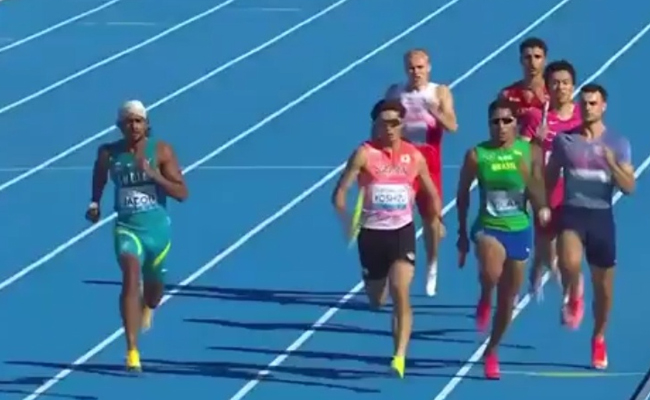
Gaborone (Botswana) (PTI): Amoj Jacob and Ragul Kumar got injured during the men's 4x400m and 4x100 races respectively as India ended their World Athletics Relays campaign in disappointment on the second day of competitions here on Sunday.
The Indian camp had high hopes of making the 2027 World Championships in the men's 4x400m relay but the team did not finish (DNF) the race as Jacob suffered cramps and pulled out of the race after taking the baton from the first leg runner Dharamveer Choudhary. Rajesh Ramesh and Vishal TK were to run in the third and fourth legs.
Those teams which could not qualify for the 2027 Beijing World Championships by reaching the final round of each of the six relay events on Saturday were given another chance in the second qualification round on Sunday.
The top two teams in each of the two heats (in all six relay events) booked the Beijing ticket on Sunday.
India will now have to try and qualify for the World Championships through the Top Lists of the World Athletics, which is a long and tedious process.
In the men's 4x100m race, third leg runner Ragul Kumar fell down the track after failing to hand over the baton inside the exchange zone to fourth leg runner Gurindervir Singh, which clearly showed the lack of coordination among the runners.
Harsh Santosh Raut and Animesh Kujur ran the first two legs.
The Indian quartet was disqualified and Kumar was seen being taken away from the Field of Play with the help of the volunteers.
It was a comedy of errors in the case of the women's 4x100m race, which saw the baton being dropped during an exchange between first leg runner Tamanna and second runner Nithya Gandhe, though the Indians finished the race in 53.09 seconds.
Gandhe started running quite a distance, but after realising that the baton was not in her hand, she turned and ran back to pick it up.
The only silver-lining for the Indian contingent was the national record time in the mixed 4x100m relay race, though the quartet of Ragul Kumar, Nithya Gandhe, Animesh Kujur and Sneha SS finished sixth in heat number two with a time of 41.35 seconds, bettering the previous national mark of 42.30 seconds set in March in Chandigarh.
The mixed 4x400m relay quartet of Theerthesh P Shetty, Kumari Saloni, Nihal William and Rashdeep Kaur ended at fifth in heat number one with a time of 3 minutes and 19.40 seconds.
On Saturday, all the five Indian relay teams had failed to make it to the respective final rounds and thus missed out on the 2027 World Championships berths.