Goa fire: Delhi court dismisses Luthra brothers' transit anticipatory bail pleas

New Delhi (PTI): A Delhi court on Thursday rejected the transit anticipatory bail pleas of Saurabh and Gaurav Luthra, owners of Birch by Romeo Lane nightclub in Goa where a massive fire last week killed 25 people.
On Wednesday, the accused sought four weeks of transit anticipatory bail so that they were not immediately arrested after their return to Delhi from Thailand.
Additional Sessions Judge Vandana dismissed the bail plea.
A detailed order is awaited.
ALSO READ: Goa nightclub fire: Owners Saurabh and Gaurav Luthra detained in Thailand
During the proceedings, counsel for the state of Goa opposed the pleas, saying, “They left, they concealed, and they are now seeking leniency.”
He said the Luthra brothers had left Goa immediately after the fire incident and had been “evading the legal process”.
The state counsel said the law does not aid those who refuse to submit to summons or warrants.
Referring to judicial observations, he said: “Once it is shown that a person is attempting to evade the process of law, the court should not come to his aid at all.”
He added that anticipatory bail is a discretionary relief and cannot be granted to those who have “created obstacles in the execution of warrants or concealed themselves”.
The counsel submitted that serious allegations were pending, including non-bailable warrants. “This is not a case for granting the privilege of anticipatory bail. The gravity of the offence and the conduct of the applicants disentitle them from any protection,” he argued.
Seeking the relief, one of the counsels for the applicants argued that they were willing to return immediately and face the investigation, and urged the court not to “punish them at the threshold”.
He said the brothers had approached the Delhi court at the earliest opportunity and undertook to join the probe without delay.
ALSO READ: Umar Khalid granted interim bail to attend sister’s wedding in Delhi riots conspiracy case
“If I land in India tonight and the investigating officer (IO) tells me to appear at midnight, I will be there,” he said.
The counsel said that transit bail was not a determination on merits but a limited protection to ensure safe access to the right court.
He cited a Supreme Court order permitting an accused abroad, against whom Blue and Red Corner notices were contemplated, to return to India with temporary protection.
“I only seek protection for a few days to reach the court safely. When a citizen is willing to submit to the law, the Court must extend a helping hand, not a fist,” he said.
Let the Truth be known. If you read VB and like VB, please be a VB Supporter and Help us deliver the Truth to one and all.
Bengaluru airport introduces AI-based system to enhance safety at vehicle-aircraft intersections
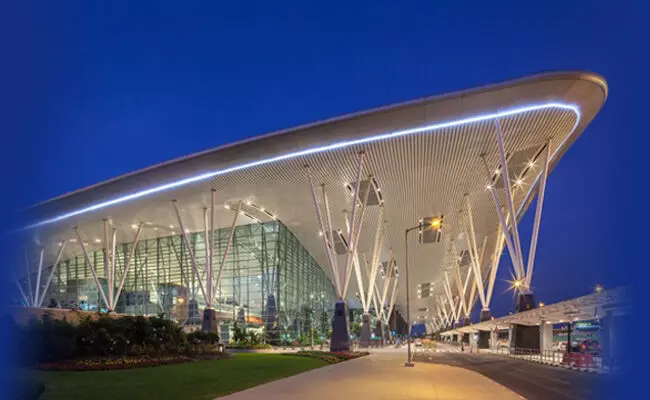
Bengaluru: Bangalore International Airport Limited (BIAL) has introduced an integrated smart airside safety system at Kempegowda International Airport to improve operational safety at key intersection zones.
According to The Hindu, the system has been designed to enhance safety at Cross Service Roads (CSRs), where aircraft and ground vehicle movements intersect.
According to BIAL, the system integrates AI-based computer vision, automation, and centralised monitoring to manage right-of-way movements and reduce the risk of human error.
“CRSs are among the most sensitive areas within airport operations, requiring precise and seamless coordination between aircraft and ground vehicles. Traditionally, right of way protection at these intersections relied on manual or semi-manual inset light activation, creating dependencies on human intervention, increasing the risk of delays and limiting operational visibility,” TH quoted BIAL as saying.
The new system uses real-time detection of vehicle movement, risk assessment, and automated signalling. AI-enabled cameras identify potential conflicts and trigger automated inset light signals to ensure aircraft priority. Normal operations resume once the area is confirmed clear.
“Based on these detections, the system triggers automated inset light activation to protect aircraft right‑of‑way and restores normal signalling once the intersection is confirmed clear. A centralised monitoring and analytics platform digitally logs all events, strengthening governance, compliance, and operational control,” BIAL said.
By embedding technology into operations, the system creates a data-driven separation layer between aircraft and ground vehicles, significantly reducing human error, especially during night and low-visibility conditions.
“Precision-led signal activation improves traffic flow, minimises unnecessary stoppage and enhances turnaround efficiency. It also establishes a scalable foundation for predictive safety analytics, enabling trend analysis, peak-hour optimisation, compliance mapping and risk forecasting to support continuous improvement and stronger airside governance,” BIAL said.