Goans to be banned from casinos from 2019: Parrikar
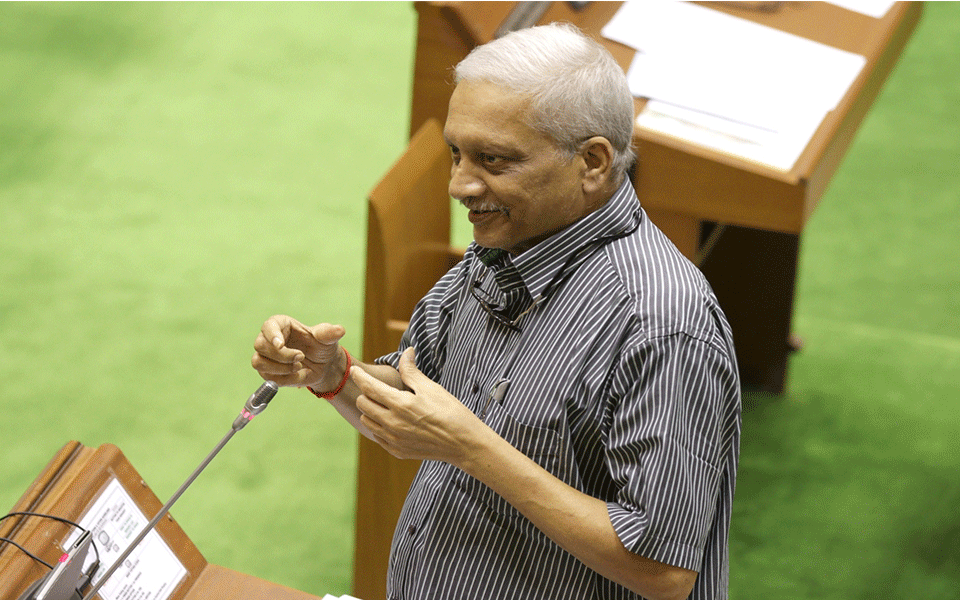
Panaji, Aug 3 : Native Goans would be banned from entering casinos from 2019, after the state government appoints a gaming commissioner to regulate the industry, Chief Minister Manohar Parrikar said on Friday.
The Chief Minister said a casino policy would be unveiled this month.
"As a policy, Goans will not be permitted to enter the casino playing areas. Only visiting tourists shall be allowed. A mechanism will be put in place once the gaming commissioner is appointed," the Chief Minister told the Assembly.
Parrikar said that offshore casinos operating in the Mandovi river off Panaji would be relocated to special designated zones which will be notified by the state government in the upcoming policy.
"The Government shall identify notified designated zones where present offshore casinos can be shifted. That means the government will notify zones... Licences for offshore casinos will be issued provided they grant their willingness within a year's time," Parrikar said.
"Licences for casino operations being granted in a designated zone can be considered for a tenure of 10 to 15 years taking into account the huge investment required for such projects," Parrikar said.
There are currently six offshore casinos operating from the Mandovi river, while there are nine onshore casinos which function in the numerous five star resorts which dot the state.
When in the Opposition (from 2007-2012), the BJP had vociferously opposed casino operations in Goa, most of the licences for which had been granted by Congress-led coalition governments.
Top BJP leaders, including Parrikar, on several occasions had promised to close down the offshore casino industry after coming to power.
When the BJP rode to power in 2012, the Congress accused the saffron party of being in cahoots with the casino lobby, especially after successive coalition governments headed by the BJP failed to shut offshore casino operations.
Let the Truth be known. If you read VB and like VB, please be a VB Supporter and Help us deliver the Truth to one and all.
Raghuvanshi, spinners fire KKR to seven-wicket win over SRH
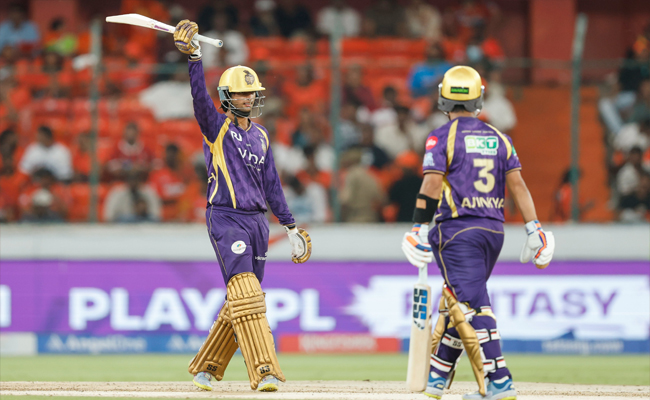
Hyderabad (PTI): The promising Angkrish Raghuvanshi (59) made a well-paced fifty as Kolkata Knight Riders defeated Sunrisers Hyderabad by seven wickets in their IPL match here on Sunday.
Skipper Ajinkya Rahane (43) and Raghuvanshi added 84 runs for the second wicket as KKR overhauled SRH’s under-par 165 all out with ease.
Finn Allen made an aggressive 29 off 13 balls upfront to give KKR a brisk start.
Earlier, Travis Head made a belligerent 61 off 28 balls but KKR's spinners bowled well to restrict SRH to 165.
Mystery spinners Varun Chakravarthy (3/36) and Sunil Narine (2/31) wrecked SRH middle-order with controlled spells.
Along the way of his two-wicket burst in his fourth-over, Narine also completed 200 IPL wickets.
The spinner was the third bowler to achieve the feat after Yuzvendra Chahal and Bhuvneshwar Kumar.
Ishan Kishan made 42 off 29 balls.
Brief Scores:
Sunrisers Hyderabad: 165 all out in 19 overs (Travis Head 61, Ishan Kishan 42; Varun Chakravarthy 3/36, Sunil Narine 2/31).
Kolkata Knight Riders: 169/3 in 18.2 overs (Angkrish Raghuvanshi 59, Ajinkya Rahane 43).