Government is trampling on judicial independence through appointment: Retd. SC Judge
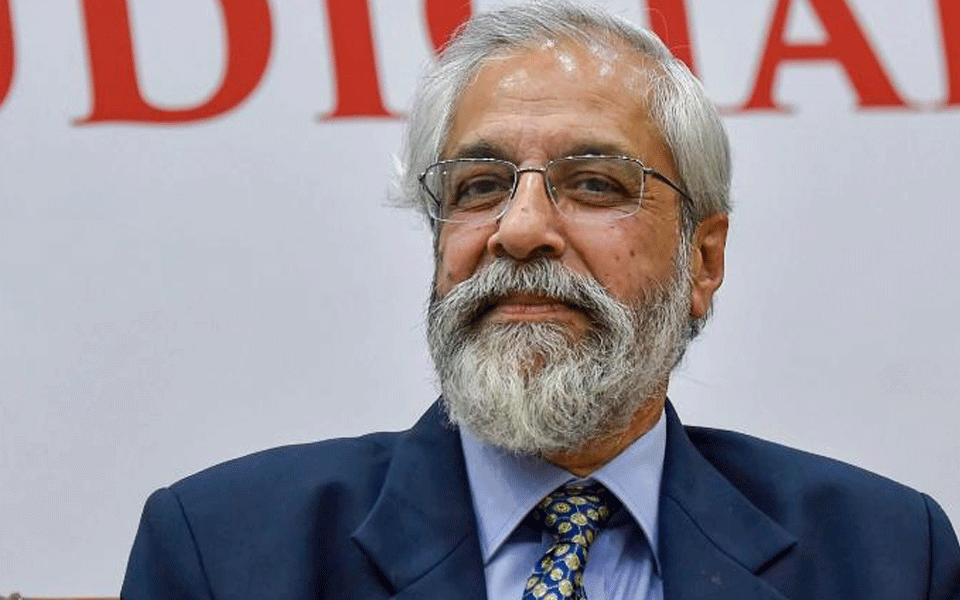
A retired Supreme Court judge has alleged that the government was trampling on judicial independence through appointments. In an op-ed article published on Wednesday in The Indian Express, Justice Madan Lokur said the National Judicial Appointments Commission, a proposed reform to give the government more control over picking judges that was struck down as unconstitutional, is effectively in place anyhow because of the Centre’s behaviour.
Lokur cited several cases in which the government rejected appointments made by the Supreme Court collegium, which makes appointments among the higher judiciary in India. In a number of these cases, appointments of judges to certain courts were rejected – with no explanation given – but they were then appointed elsewhere.
“The reasons indicated in the file are not known and it would certainly be in the interest of the institution if they are disclosed,” Lokur asked, in his piece. “If the judge was unfit or unsuitable for appointment as the chief justice of Andhra Pradesh, how did he become suitable for Gujarat?”
Lokur cited multiple instances where the government has overruled the Collegium.
“As recently as in late August, the Economic Times reported that the CJI had written to the law minister that 43 recommendations made by the collegium were pending with the government and the vacancies in the high courts were to the extent of about 37 per cent,” he wrote. “Also, the collegium could not consider the appointment of 10 persons since some information was awaited from the government for varying periods. Who is calling the shots — the government?”
The retired judge also brought up the manner in which the proposed transfer of Madras High Court chief Justice VK Tahilramani took place. The collegium transferred Tahilramani to the Meghalaya High Court, a move seen as being the equivalent of a demotion. Lokur said he wasn’t getting into the question of whether the transfer should have happened, but of the discourse around it.
In particular, he brought up reports in the press that quoted a profile of Tahilramani put together by the Intelligence Bureau. Lokur quoted a report from The Times of India, which said that Chief Justice of India Ranjan Gogoi told the Central Bureau of Investigation to “take further action as per law” after a report by the Intelligence Bureau flagged Tahilramani’s purchase of two flats in the outskirts of Chennai. The CBI will reportedly look into whether Tahilramani had declared the two properties in official documents. .
“Should the IB be blindly believed — there is a well-known incident of a teetotaller being called a “boozer” by the IB?” asked Lokur. “Was the CJI kept in the dark about her being kept under surveillance? How many other judges are being spied on? Isn’t it somewhat unusual and frightening that judges, expected to render judgment without fear or favour, are subject to surveillance by the IB? Can their independence be guaranteed under these circumstances?”
‘Frankenstein’s NJAC’
The NJAC, passed by the current government in 2015, was struck down by the Supreme Court the same year after it was found to be unconstitutional. Headed by the CJI, the NJAC was supposed to have the Union minister of law and justice an ex officio member and two eminent persons on the panel. They were to recommend appointment of judges of the Supreme Court and High Courts and the transfer of judges of the high courts. “Notwithstanding the declaration of unconstitutionality of the NJAC, I believe its core functions are now being performed by a body minus the two eminent persons,” said Lokur.
He also cited the example of Justice Vikram Nath who was in April recommended by the collegium as the chief justice of the Andhra Pradesh High Court. “Sometime later, the government referred back the recommendation for reconsideration,” he said. “On August 22, the collegium reconsidered the recommendation “for the reasons indicated in the file” and recommended his appointment as the chief justice of the Gujarat High Court. The reasons indicated in the file are not known and it would certainly be in the interest of the institution if they are disclosed. If the judge was unfit or unsuitable for appointment as the chief justice of Andhra Pradesh, how did he become suitable for Gujarat?”
Another example cited by Lokur was that of Justice Akil Kureshi, the senior-most judge of the Gujarat High Court, who was recommended to be the Chief Justice of the Madhya Pradesh High Court in May. “Guess what? The government sent two communications to the CJI on August 23 and 27 along with some material,” Lokur said. “On reconsideration of the communications and the material, the collegium modified its recommendation on September 5 and recommended his appointment as the Chief Justice of the Tripura High Court. Again, the contents of the communications and the accompanying material are not known. Is there something so terribly secret about them that it would not be in the interest of the institution to make a disclosure?”
Lokur said the unconstitutional NJAC was now the Frankenstein’s monster. “The advice of the two eminent persons postulated by the NJAC is no longer required. Actually, there is now no need to amend the Constitution to bring back the NJAC — it is already in existence with a vengeance. At the present moment, silence on crunch issues is not golden.”
Courtesy: scroll.in
Let the Truth be known. If you read VB and like VB, please be a VB Supporter and Help us deliver the Truth to one and all.
Shivakumar’s CM aspiration natural, high command will decide: Parameshwara
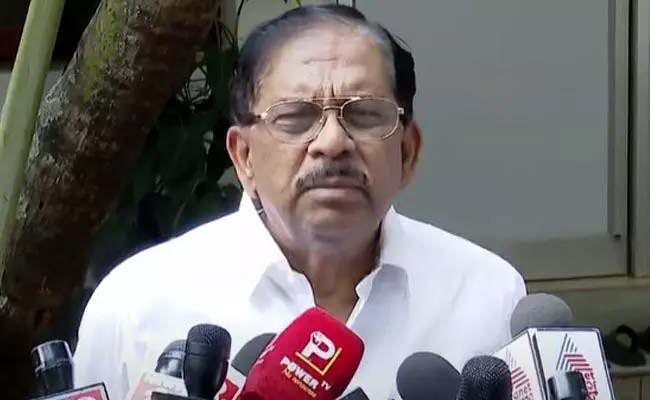
Bengaluru (PTI): Karnataka Home Minister G Parameshwara said on Saturday that Deputy CM D K Shivakumar, as the state Congress president, naturally aspires to become chief minister. However, he added that the final decision rests with the party's high command.
Amid ongoing speculation about a leadership change within the ruling Congress, he wished Shivakumar "good luck".
"I have always wished him so. There is nothing else; we are good friends. He is the PCC (Pradesh Congress Committee) president, and naturally, he has an aspiration to become the chief minister. Nobody can object to it. But it all depends on what the high command decides,” Parameshwara said in response to a question regarding Shivakumar’s aspiration for the CM post.
Speaking to reporters, he said, “Don’t always go back to the CM issue. Please understand there is nothing that I can tell you about it. If I were part of the decision-making body or inside the decision-making body, I could definitely provide information.”
Supporters of Shivakumar have been insisting on his elevation in line with a reported power-sharing agreement with chief minister Siddaramaiah when the party won the 2023 Assembly elections. Some have even claimed that "sweet news" is expected by May 15, which is Shivakumar’s birthday.
Speculation has been circulating within the Congress and political circles about a possible leadership change and cabinet reshuffle after May 4, once the results of the Assembly elections in four states and one union territory, along with bypolls to two Assembly segments in Karnataka, are announced.
However, AICC President Mallikarjun Kharge said on Thursday that there is no CM change in Karnataka "for now" and that the leadership issue in the state will be resolved soon.
On Friday, he said no date has been fixed yet to discuss a possible leadership change, while maintaining that any decision in this regard would be taken collectively by the party high command after due consultation.
Meanwhile, Parameshwara met senior Congress leader and MLC B K Hariprasad and Minister B Z Zameer Ahmed Khan over dinner on Friday. Hariprasad had met Siddaramaiah earlier in the day.
Responding to a question about discussions at the dinner, as his name is also being mentioned for the chief minister post amid calls for a "Dalit CM", the home minister said there was no discussion about the chief minister issue.
“Hariprasad told me that he met the CM, but he did not disclose what was discussed between them. Hariprasad, Zameer Ahmed Khan, and I met over dinner, and we discussed the elections held in four states and one union territory. We analysed the national-level political situation and naturally discussed the state’s political developments,” he said.
When asked if he would travel to New Delhi to meet the party high command, Parameshwara said, “I will definitely go to Delhi. Nobody can stop me from going there. I will go when it is required.”