Government to up printing of Rs 500 notes to tackle cash crunch: DEA Secretary
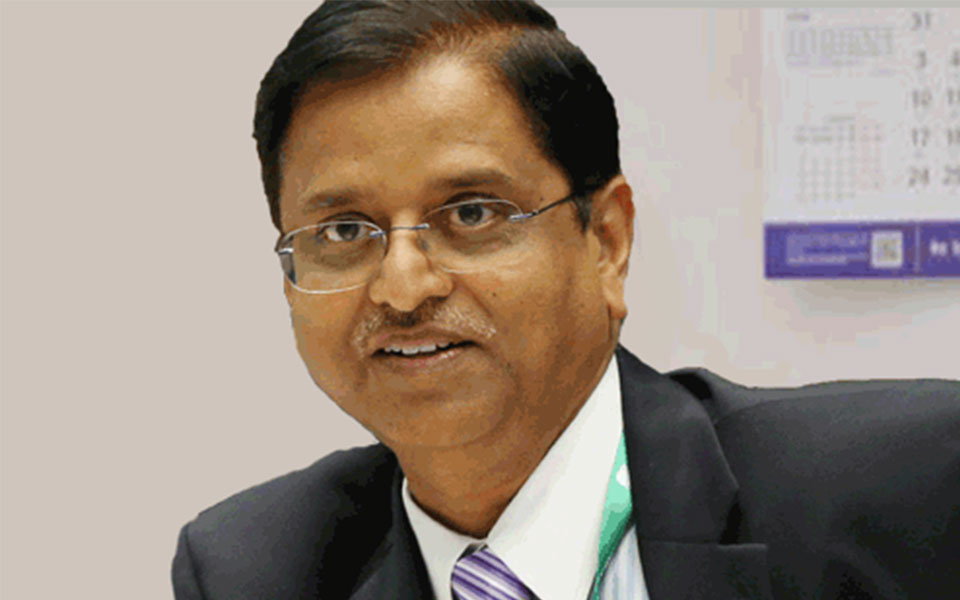
New Delhi, April 17: To meet the "unusual" currency demand in the country, the government has decided to increase printing of Rs 500 notes by five times, Economic Affairs Secretary Subhash Chandra Garg said here on Tuesday.
"We have taken steps to increase the supply of currency in case the demand were to go up further. To give you an example, Rs 500 notes -- we print about 500 crore of notes per day. We have taken steps to raise this production five times," Garg said at a press meet called to calm fears after reports of currency shortages emerged from several parts of the country.
"Very soon, in the next couple of days, we will have a supply of about Rs 2,500 crore worth of Rs 500 notes per day. In a month, supply would be about Rs 70,000-75,000 crore. These notes alone can more than meet the demand of any month," he said.
Garg asserted that there was no cash crunch in the country, pointing out that currently around Rs 18 lakh crore worth of currency was in circulation -- a little over what was in circulation at the time of demonetisation.
"We keep Rs 2.5-3 lakh crore more currency in stock for excess demand. In the last few days, we have pumped cash into the system to meet the demand. We still have a reserve of Rs 1.75 lakh crore."
He said there was "unusually high demand" for currency in the last couple of months. As opposed to an average demand of about Rs 20,000 crore a month, "in the first 13 days of April itself there was a demand of Rs 45,000 crore", he said.
Garg attributed this sudden cash demand to localised phenomenon.
"This unusual spurt in demand is seen more in some parts of the country like Andhra Pradesh, Telangana, Karnataka, Madhya Pradesh and Bihar," the Finance Ministry said in a statement on Tuesday.
"We have noted that this is coming more from some parts of the country. There might also be some sort of a feeling in some people that if the cash runs out, why not keep it in reserve so it may be safe... a kind of 'shortage mentality'. But believe us, there is no shortage, there is no cash crunch," he said.
"There is no shortage of notes in stock, there is no shortage of cash being printed... Therefore I would urge... every citizen not to hoard or stock cash -- it is not required. You are unnecessarily raising your risks. We have adequate cash, but the preferable mode of use is digitisation, so use it," Garg added.
Asked whether there was any hoarding of the Rs 2,000 notes, he said: "In this system, there are about 6.70 lakh crore worth of Rs 2,000 notes. They are more than adequate to meet the transaction demand of customers... But, off late, we have noted somewhat lesser inflow coming back from circulation.
"We have not got this investigated, but you can assume that this one note is most suitable for people to keep with themselves. There has been some tendency of some people using Rs 2,000 notes, but that does not affect the overall supply of the Rs 2,000 notes."
Justifying the higher currency circulation in the system compared to the pre-demonetisation period, Garg said: "At the time of demonetisation, the currency in circulation Rs 17.5 lakh crore. Currency in circulation now is about Rs 18 lakh crore. So it is in absolute numbers higher than at the time of demonetisation."
"But demonetisation is one-and-a-half years earlier... if we had taken that growth path, we would had still been much higher. If the currency had grown as it was growing before demonetisation, probably it would have been somewhere at the level of Rs 22-23 lakh crore. So, we are at a lower level."
Let the Truth be known. If you read VB and like VB, please be a VB Supporter and Help us deliver the Truth to one and all.
Omar thanks Home Minister Shah for reopening 14 tourist destinations in J-K
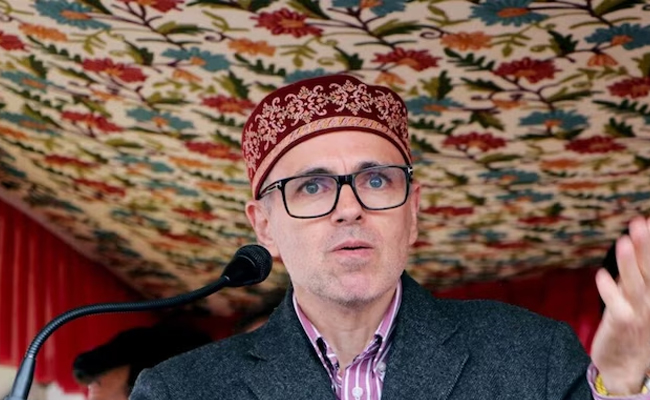
Srinagar (PTI): Jammu and Kashmir Chief Minister Omar Abdullah on Tuesday thanked Union Home Minister Amit Shah for reopening 14 tourist destinations in the Union Territory, which were closed in April last year following the Pahalgam terror attack.
"Recently, the Union home minister had come to Jammu and I had talks with him. Before that, I met him in Delhi as well. My request with regard to tourism was that the areas which have been closed should be reopened. There is no purpose served by keeping these destinations closed. We did not close these places even at the worst of times.
"I was assured by the home minister that these places will be reopened and orders for the same have now been issued. I am thankful to the home minister for that. The local people have borne losses (due to closure). Now, I hope people will visit these beautiful places," Abdullah told reporters on the sidelines of a function here.
The lieutenant governor, who heads the security apparatus in Jammu and Kashmir, on Monday ordered the reopening of 11 tourist destinations in Kashmir and three in the Jammu region. These destinations were among the 80-odd places which were shut down for visitors in the aftermath of the Pahalgam terror attack on April 22 last year that left 26 persons, mostly tourists, dead.
On the controversial remarks made by BJP MLA Vikram Randhawa, the chief minister said the truth has prevailed. "The truth did come out after that. The case was against him (Randhawa). If my information is correct, a case was filed against him for occupying government land," Abdullah said.
He alleged there is always a difference in the words and deeds of BJP leaders.
"It is a trait of the BJP that there is a difference in their words and deeds. They talk about Jammu and Kashmir and nominated a person to the Rajya Sabha from here. He spent 90 per cent of his (MPLAD) funds in Uttar Pradesh.
"He (Ghulam Ali Khatana) is from J-K. He has taken an official house here. Khatana sahib lives here and works from here but when it comes to CDF, he spends 90 per cent of it in UP," Abdullah alleged.
Asked about electricity supply during the month of Ramzan, the chief minister said he is scheduled to chair a meeting of officials where all aspects and arrangements will be reviewed.
"We would make all efforts to ensure that people face the least amount of difficulty during the holy fasting month," he added.
On the protests by daily wagers, Abdullah said there is no need for the street protests as the government has announced on the floor of the Assembly that they shall be regularised this year as per a scheduled process.
"It has been said on the floor of the Assembly that they will be regularised through a process under a time table. If somebody is provoking them for political benefits, they should not become tools in their hands.
"I will listen to you and do anything if you ask with love. Try intimidating me, then nothing will happen. If they have something to say, they should come and tell me. These street protests are not good for them or their future. We have said they will be regularised this year in a time-bound manner," he added.