Govt bans 9 Meitei extremist groups, their associate organisations
New Delhi, Nov 13: The government on Monday banned nine Meitei extremist groups and their associate organisations, which mostly operate in Manipur, for their anti-national activities, and launching fatal attacks on security forces.
According to a notification issued by the Ministry of Home Affairs, the groups that have been banned for five years, are: Peoples' Liberation Army generally known as PLA, and its political wing Revolutionary Peoples' Front (RPF), the United National Liberation Front (UNLF) and its armed wing Manipur Peoples' Army (MPA).
The Peoples' Revolutionary Party of Kangleipak (PREPAK) and its armed wing Red Army, the Kangleipak Communist Party (KCP) and its armed wing (also called the Red Army), the Kanglei Yaol Kanba Lup (KYKL), the Coordination Committee (CorCom) and the Alliance for Socialist Unity Kangleipak (ASUK) have also been banned.
The PLA, UNLF, PREPAK, KCP, KYKL were banned by the MHA under the Unlawful Activities (Prevention) Act, 1967 (37 of 1967) years ago and the latest action extends the ban by five years. The declaration as outlawed of the other organisations is fresh.
In its notification, the MHA said the Meitei extremist organisations have declared, as their professed aim, establishment of an independent nation by secession of Manipur from India through armed struggle and to incite indigenous people of Manipur for such secession.
The MHA said it is of the opinion that the Meitei extremist organisations have been engaging in activities prejudicial to the sovereignty and integrity of India, employing and engaging in armed means to achieve their aforesaid objectives, attacking and killing the security forces, the police and civilians in Manipur, indulging in acts of intimidation, extortion and looting of civilian population for collection of funds for their organisations.
They are making contacts with sources abroad for influencing public opinion and for securing their assistance by way of arms and training for the purpose of achieving their secessionist objective and maintaining camps in neighbouring countries for the purpose of sanctuaries, training and clandestine procurement of arms and ammunition, it said.
The MHA said if there is no immediate curb and control of the Meitei extremist organisations they will take the opportunity to mobilise their cadres for escalating their secessionist, subversive, terrorist and violent activities.
The groups will propagate anti-national activities in collusion with forces inimical to sovereignty and integrity of India, indulge in killings of civilians and targeting of the police and security force personnel, procure and induct illegal arms and ammunition from across the international border and extort and collect huge funds from public for their unlawful activities, the ministry said.
The activities of the Meitei extremist organisations are considered detrimental to the sovereignty and integrity of India and that they are unlawful associations, it said.
"The central government, having regard to the circumstances, is further of opinion that it is necessary to declare the Meitei extremist organisations... as 'unlawful associations' and accordingly, in exercise of the powers conferred by the proviso to sub-section (3) of section 3 of the said Act, the central government hereby directs that this notification shall, subject to any order that may be made under section 4 of the said Act, have effect from the 13th day of November, 2023, for a period of five years," it said.
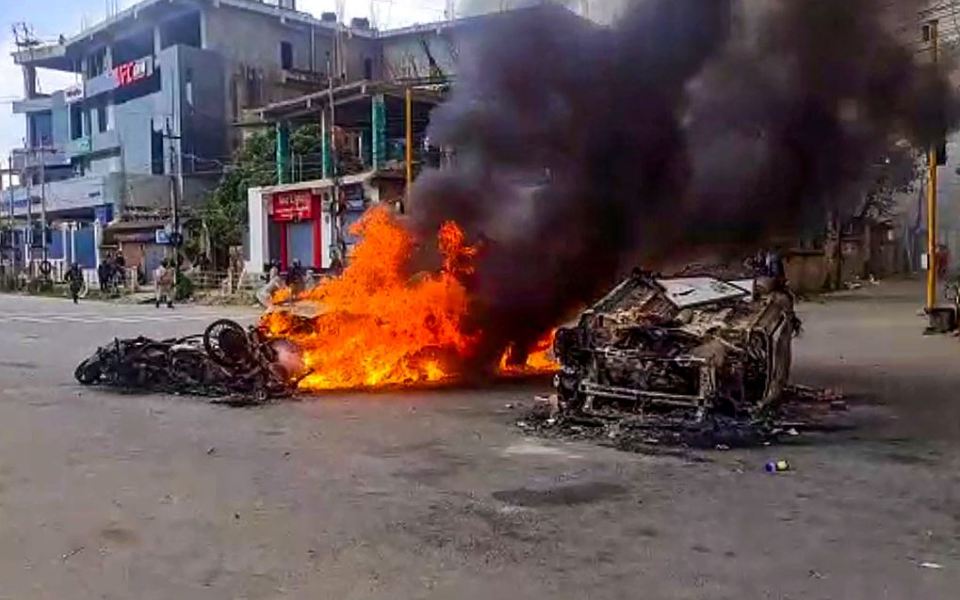
Manipur has seen bouts of violence since ethnic clashes first erupted in May. More than 180 people have been killed since then.
The clashes have occurred over a number of grievances that ethnic Meitei and Kuki communities have against the other. A major flashpoint has been a move to give the Meiteis the Scheduled Tribe status, which has since been rolled back.
Meiteis account for about 53 per cent of Manipur's population and live mostly in the Imphal Valley, while tribals, which include Nagas and Kukis, constitute 40 per cent and reside mainly in the hill districts.
Let the Truth be known. If you read VB and like VB, please be a VB Supporter and Help us deliver the Truth to one and all.
Several Gurugram schools receive hoax bomb threats

Gurugram (PTI): Several Gurugram schools received another hoax bomb threat emails on Wednesday morning, prompting police to launch searches on the premises.
Police said the email was sent by the 'Khalistan National Army', with threats issued to Haryana Chief Minister Nayab Singh Saini to declare April 29 as the "40th Khalistan Declaration Day". It also threatened to bomb the Red Fort in Delhi.
Police said it was a hoax as no suspicious items were found after an intensive search.
Several schools, including Shri Ram, Amity, and the HDFC school, received threatening emails at 8.33 am, when classes had already begun, police said.
The school administrations became aware of the threats around 9 am and immediately informed the police, a senior police officer said.
The schools immediately implemented emergency protocols, with many declaring a holiday and asking parents to take their children home safely, the officer said.
A large number of anxious parents gathered outside the schools, as police and bomb squad teams reached the spots and started checks.
"Around 10 schools have approached the police from morning until now over bomb threats. Police teams are alert, and searches are underway on all the premises", the officer said.
As soon as the information about this email was received, police in Gurugram and Delhi swung into action and started investigation.
Schools immediately implemented emergency protocols upon receiving the mail. Many schools declared a holiday and sent messages to parents, asking them to take their children home. Large crowds of parents gathered outside the schools.
The schools were sanitised by sending a bomb disposal squad as well as a dog squad.
A senior police officer said that police teams thoroughly searched the school premises, classrooms, buildings, and surrounding areas. No suspicious objects or explosive materials were found during the investigation.
"Police teams are seriously investigating the entire matter. Cyber experts are being consulted to determine the authenticity of the email, its source, and the identity of the sender", added the officer.
This is the third time since January that schools have received fake bomb threats.
In March, at least a dozen schools in the city received bomb threat emails, which later turned out to be hoaxes.
Similarly, on January 28, as many as 13 schools received hoax bomb threats via email, forcing authorities to evacuate campuses and suspend classes.
Last month, police arrested a Bangladeshi national whose email ID was allegedly used to make a bomb threat for some payment.