Govt 'fully committed' to protecting Aravallis, Cong spreading lies: Bhupender Yadav
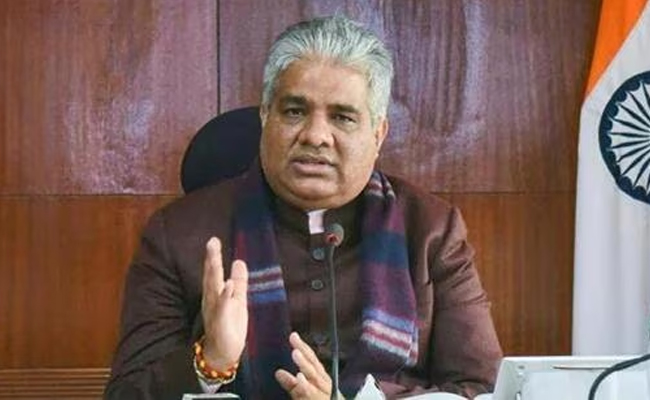
New Delhi (PTI): Union Environment Minister Bhupender Yadav on Monday accused the Congress of spreading "misinformation" and "lies" on the issue of the new definition of the Aravallis and stressed that mining can be carried out legally in only 0.19 per cent of the area covered by the mountain range.
At a press briefing, he said the Narendra Modi government remains "fully committed" to protecting and restoring the Aravallis.
"The Congress, which allowed rampant illegal mining in Rajasthan during its tenure, is spreading confusion, misinformation and lies about the issue," the minister alleged.
The new definition, approved by the Supreme Court on the recommendation of the Environment Ministry, "aims to curb illegal mining" and allow "sustainable mining legally", and that too only after a Management Plan for Sustainable Mining (MPSM) is prepared by the Indian Council of Forestry Research and Education (ICFRE), he said.
The ICFRE will identify areas where mining can be permitted only under exceptional and scientifically justified circumstances, sources said.
ALSO READ: Arnab Goswami’s Homecoming? Anchor tears into Modi Government over aviation chaos
The study will also determine ecologically sensitive, conservation-critical and restoration-priority areas within the Aravalli landscape where mining will be strictly prohibited.
Yadav said that legally approved mining currently covers only a very small fraction of the Aravalli region, amounting to about 0.19 per cent of the total geographical area of 37 Aravalli districts in Rajasthan, Haryana and Gujarat.
Delhi, which has five Aravalli districts, does not permit any mining.
According to the Supreme Court's directions, he said, no new mining leases will be granted in the Aravalli region until a Management Plan for Sustainable Mining is prepared for the entire landscape by the Indian Council of Forestry Research and Education.
Existing mines may continue operations only if they strictly comply with sustainable mining norms laid down by the committee.
In November 2025, the Supreme Court accepted a uniform legal definition of what constitutes the Aravalli Hills and Aravalli Range on the recommendation of a committee led by the Environment Ministry.
Under this definition, an "Aravalli Hill" is a landform with an elevation of at least 100 metres above its local surrounding terrain and an "Aravalli Range" is a cluster of two or more such hills within 500 metres of each other.
Critics, including environmentalists and some scientists, argue that many ecologically important parts of the Aravalli system do not meet the 100-metre threshold (e.g., low ridges, slopes, foothills and recharge areas), yet are important for groundwater recharge, biodiversity support, climate moderation and soil stability.
They warn that areas excluded under the new definition could be opened for mining, construction and commercial activities, weakening long-standing protections and ecological continuity across the range.
The redefinition has triggered protests, from Rajasthan to Haryana, and social media campaigns.
ALSO READ :‘Pay worker before sweat dries’: Madras HC invokes prophet’s teaching to settle lawyer’s dues
The Centre has rejected the charge that the new definition weakens environmental safeguards. It has said that most of the Aravalli region (over 90 per cent) remains protected and the new definition does not relax mining controls.
Yadav on Sunday said the Aravali range includes all landforms which exist within 500 metres of two adjoining hills of a height of 100 metres or more.
All landforms existing within this 500-metre zone, irrespective of their height and slopes, are excluded for the purposes of grant of mining leases, he said.
Let the Truth be known. If you read VB and like VB, please be a VB Supporter and Help us deliver the Truth to one and all.
Karnataka: Three held for murder of Tibetan man in Dharwad district

Dharwad (Karnataka) (PTI): Three people were arrested on Monday in connection with the murder of a Tibetan man in this district, police said on Monday.
Tashi Dhondup (39), a Buddhist monk and resident of Mundagod, was found dead near Haliyal Bridge on the Dharwad bypass on April 29, they said.
Police said the body bore injury marks on the face, indicating foul play.
Upon receiving information about an unidentified body within the limits of Dharwad Rural Police Station, a highway patrol team and emergency services rushed to the spot and alerted senior officials.
Following inspection and identification of the deceased, a case of murder was registered the same day based on visible injuries and findings from the scene of crime team, a senior police officer said.
Superintendent of Police Gunjan Arya said the motive appears to be “murder for gain”. The accused allegedly demanded money from the victim and assaulted him when he failed to comply, leading to his death.
Three accused, all from Kolhapur district in neighbouring Maharashtra, have been arrested, while efforts are on to nab two others involved in the crime.
Further investigation is underway.