Govt may consider introducing legal safeguards workers for healthcare workers: Panel

New Delhi (PTI): The government may consider introducing appropriate legal safeguards for healthcare workers, who at times face violence from relatives or attendants of patients, a parliamentary panel has said.
The Parliamentary Standing Committee on Home Affairs headed by BJP member Brij Lal, which examined the proposed three criminal laws, discussed a memoranda submitted by various medical associations requesting it to introduce provisions under Clause 115 of the Bharatiya Nyaya Sanhita (BNS) to penalise acts of violence against healthcare service personnel.
The committee, in its report, said it was submitted before the panel that unlike in any other professions, healthcare professionals are vulnerable to "violent attacks" by relatives of patients, in cases where patients die during treatment.
Such violent attacks against healthcare personnel are prevalent throughout the country and there is a need to provide some legal safeguards for the benefit of healthcare workers, the medical associations told the committee.
In its response, the Union Home Ministry said the general penal provisions are applicable to all and no distinction is made in the penal laws for any class of person.
Everyone is equal in the eyes of law, the home ministry stressed.
The state is duty bound to protect life all its citizens, including doctors and professionals like media persons, advocate, bankers, charted accountants, etc.
Making a special provision for doctors and other health care professionals may give rise to similar demands from other professionals like media persons, advocates, bankers, charted accountants, the home ministry observed.
The home ministry also informed the committee that the Ministry of Health and Family Welfare has a proposal to introduce a 'Medical Professionals Act' to provide safeguards to healthcare workers against violent attacks, and that the home ministry would take an update from the Ministry of Health and Family Welfare on the same.
"After considering the concerns of the healthcare personnel, the committee opines that the government may consider introducing appropriate legal safeguards for healthcare workers," the committee noted.
The Clause 115 of the BNS says: Whoever voluntarily causes hurt, if the hurt which he intends to cause or knows himself to be likely to cause is grievous hurt, and if the hurt which he causes is grievous hurt, shall be punished with imprisonment of either description for a term which may extend to seven years, and shall also be liable to fine.
The Bharatiya Nagarik Suraksha Sanhita (BNSS-2023) bill was introduced in the Lok Sabha on August 11 along with the Bharatiya Nyaya Sanhita (BNS-2023) and the Bharatiya Sakshya Adhiniyam (BSA-2023) bills.
The three proposed laws seek to replace the Code of Criminal Procedure Act, 1898, the Indian Penal Code, 1860, and the Indian Evidence Act, 1872, respectively.
Let the Truth be known. If you read VB and like VB, please be a VB Supporter and Help us deliver the Truth to one and all.
Karnataka School Edu Dept prohibits children from being made to dance to obscene songs
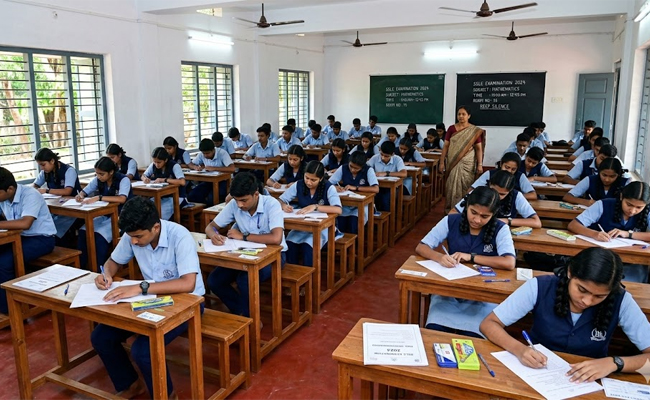
Bengaluru (PTI): The Karnataka School Education Department has issued a circular strictly prohibiting children from being made to dance to obscene songs in educational and cultural programmes.
It stated that such dances would negatively impact students' mental health and moral values. It will create indiscipline and harm the sanctity of education.
"All the Deputy Directors (Administration) of the state's School Education Department have been asked to take strict measures to prevent children or students from dancing to obscene songs in all government, aided and unaided schools in the state," the office of the commissioner of the School Education Department said in a recent circular.
"If it is found that children are being made to dance to obscene songs, appropriate action will be taken against the headmaster or management of such school," it added.
The department also listed certain measures in this regard, which include: strictly prohibiting children from being made to dance to obscene songs during educational and cultural programmes; selecting songs that are inspiring, positive, instilling national pride in children and reflecting the greatness, dignity, values, culture, and morality of the state.
Stating that the school headmaster and management are responsible for selecting songs and dances for cultural programmes, it said, they should also ensure that students wear decent clothes in dance or cultural programmes.