GST Council can look at hiking filing threshold beyond Rs 5 cr
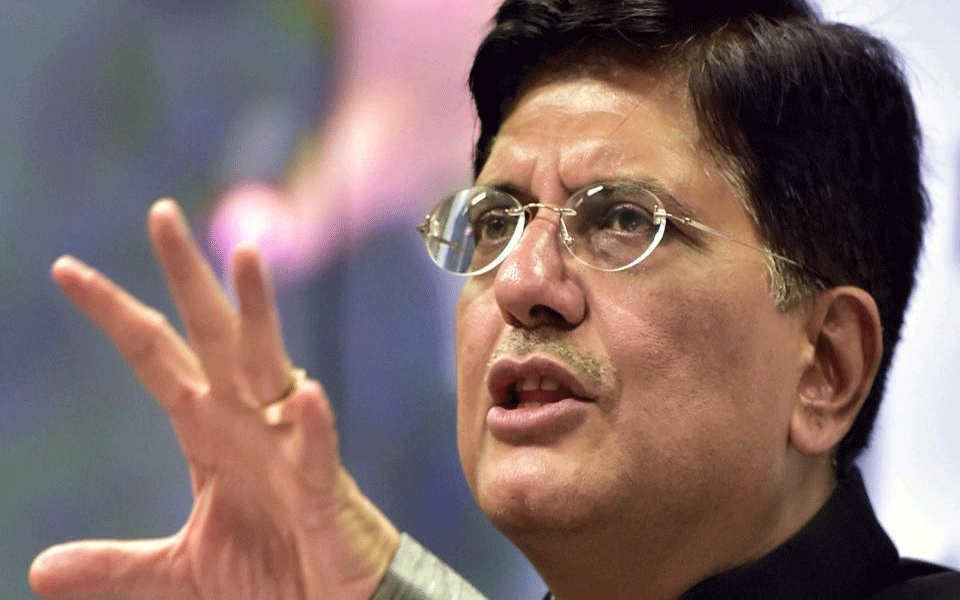
New Delhi, July 23 : The GST Council could consider raising the threshold for quarterly filing of returns and monthly tax payments to above the Rs 5 crore turnover decided last week in order to facilitate smaller businesses to grow, acting Finance Minister Piyush Goyal said on Monday.
Besides approving rate reductions for 88 consumer items, the Goods and Services Tax (GST) Council, at its 28th meeting here on Saturday, announced quarterly return-filing and monthly tax payments for businesses with annual turnover of up to Rs 5 crore as against the current threshold of Rs 1.5 crore.
This move will benefit 93 per cent of registered GST taxpayers, while only 7 per cent of them will be filing monthly returns, Goyal said at a convention here organised by the Confederation of All India Traders (CAIT).
"The GST Council decided to raise the threshold to Rs 5 crore so that businesses that go over Rs 1.5 crore turnover do not face taxation hassles," Goyal said.
"I want trade and business to grow and flourish. If their business goes above Rs 5 crore, we are prepared to raise the limit even further," he said.
He also said that the simplified return forms approved by the Council required the assessee to only file the sales data and the amount of tax and input tax credit would be automatically indicated by the system.
The implementation of the revamped return filing process would take some time as corresponding changes would have to be made in the GST Network (GSTN), the Minister added.
The GST rate reductions and clarifications by the Council on Saturday will come into effect from July 27.
Let the Truth be known. If you read VB and like VB, please be a VB Supporter and Help us deliver the Truth to one and all.
4 workers die after being buried under coal slurry in Jharkhand's Dhanbad

Dhanbad (Jharkhand) (PTI): At least four workers died after being buried under coal slurry in Jharkhand's Dhanbad district on Saturday, a police official said.
The incident took place at Moonidih coal washery in the command area of Bharat Coking Coal Limited (BCCL).
"Bodies of all four workers were dug out of debris during a rescue operation," Putki police station in-charge Waqar Hussain told PTI.
The incident took place when coal slurry was being loaded into trucks by workers, during which a large chunk of slurry fell and trapped several workers underneath, officials said.
The deceased have been identified as Manik Bauri, Dinesh Bauri, Deepak Bauri, and Hemlal Gope.
Meanwhile, the family members of the deceased and local villagers placed the bodies in front of the washery gate and began a protest.
They demanded compensation, jobs for dependents and action against those responsible for the incident.
Police and administration officials are trying to pacify the protesters, an official said.