Haryana polls 'stolen', EC colluded with BJP: Rahul claims 25 lakh fake entries in state poll list
_vb_42.jpeg)
New Delhi (PTI): Congress leader Rahul Gandhi on Wednesday cited electoral list data from Haryana to claim that 25 lakh entries were "fake" and the assembly polls last year were "stolen", as he accused the Election Commission of colluding with the BJP to make them win.
The Leader of Opposition in the Lok Sabha said he is questioning the Election Commission and the democratic process in the country and therefore, is doing so with 100 per cent proof.
Gandhi alleged that the Chief Election Commissioner (CEC) and the two election commissioners colluded with the BJP to ensure its victory in Haryana and claimed that "they are in partnership" with Prime Minister Narendra Modi.
'Operation Sarkar Chori' was launched to convert the landslide Congress victory into loss in Haryana, the former party president alleged.
He also alleged that CEC Gyanesh Kumar is "lying" to the people of India when he stated that house number zero is given to homeless people and that is the reality of zero number houses.
Addressing a press conference at the Indira Bhawan here, Gandhi cited the electoral list of Haryana to claim that 25,41,144 were fake voters with multiple examples of duplicate voters, invalid addresses and bulk voters.
"Why is the Election Commission not removing duplicates? It is because if it does so, it would result in fair elections and it doesn't want fair elections," Gandhi said.
"All polls pointed to a Congress victory in Haryana. The five top exit polls said Congress is sweeping. The other thing that was surprising was that for the first time in Haryana, the postal votes were different from the result. In postal ballots, Congress got 73 seats while the BJP got 17 seats," he said.
Gandhi claimed that thousands of people associated with the BJP voted both in UP and Haryana both.
During the presser, Gandhi showed a picture of a woman who appears on the voter list 22 times in 10 booths in the Rai assembly constituency, and said this shows that this was a 'centralised operation'.
He claimed that the picture of the woman used for multiple entries is from Brazil.
She is one of 25 lakh such records in Haryana which is proof of a centralised operation, Gandhi said.
He alleged that there were 25,41,144 'vote chori' entries on the list which are fake in Haryana.
"One in 8 voters in Haryana are fake and despite that the Congress loses by 22,779 votes which was the difference in eight seats," Gandhi said.
"I was in shock, I simply could not believe what we found. I asked the team to cross check multiple times. I want young people, Gen Z to understand this clearly as your future is being stolen," Gandhi said.
He claimed that a plan was in motion to convert a landslide victory of the Congress into a loss in Haryana.
Gandhi also played out a video of now Haryana Chief Minister Nayab Singh Saini, who two days before counting, stated that the BJP would win and "we have a system in place".
"We suspected, once we did Mahadevapura and Aland, that this is not happening in just one constituency but this is being done at the state and national level," Gandhi said
In September, Gandhi had accused CEC Kumar of protecting those who "destroyed democracy" and cited data from Karnataka Assembly constituency Aland to claim that votes of Congress supporters were being systematically deleted ahead of elections.
In August, Gandhi, citing data from the 2024 Lok Sabha polls, had claimed that over one lakh votes were "stolen" through manipulation in Mahadevapura assembly segment in Karnataka.
The Election Commission had, however, dubbed the charges as "incorrect and baseless" and asserted that no deletion of votes can happen without giving an opportunity of being heard to the affected person.
The BJP won 48 seats in the 2024 assembly polls. The Congress, which was predicted to win by many exit polls, won 37 seats. The INLD won two seats while independent candidates bagged three in the 90-member Assembly.
Let the Truth be known. If you read VB and like VB, please be a VB Supporter and Help us deliver the Truth to one and all.
VP, PM greet civil servants on Civil Services Day
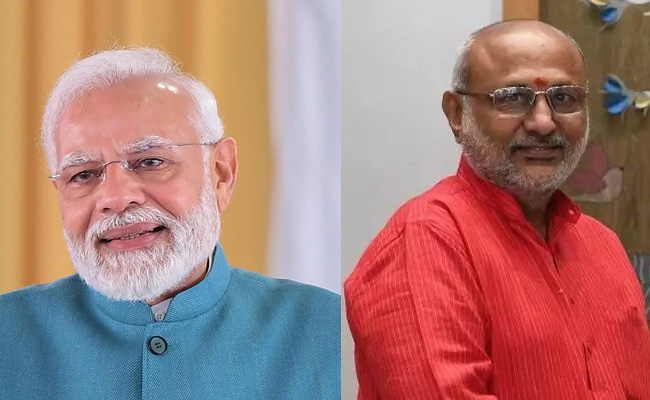
New Delhi (PTI): Vice President C P Radhakrishnan and Prime Minister Narendra Modi on Tuesday greeted civil servants on the occasion of Civil Services Day and said it is time to further strengthen the resolve to work towards good governance and nation building.
The Vice President said as the enduring pillar of India's administrative framework, the efforts of the civil servants in strengthening governance and delivering public services are of immense significance.
The prime minister said from the grassroots to policy-making, the efforts of civil servants touch countless lives and contribute to India's progress
"On the occasion of Civil Services Day, I extend my warm greetings to all civil servants and convey my sincere appreciation for your dedication and exemplary service to the nation," Radhakrishnan said in a post on X.
ALSO READ: 5.2-magnitude quake jolts Manipur
He said the theme for this year, "Viksit Bharat: Citizen-Centric Governance and Development at the Last Mile", aligns with the vision of Viksit Bharat 2047 and underscores the Government's commitment to transparent, accountable, and citizen-centric governance, with a strong emphasis on last-mile delivery and inclusive development.
"Let us all celebrate the day and continue to work collectively towards building an inclusive and developed India," he said.
The Vice President will deliver the keynote address at the Civil Services Day celebrations at Vigyan Bhawan here on Tuesday.
In his message, Modi greeted all civil servants on Civil Services Day and said this is an occasion to further strengthen the resolve to work towards good governance and nation building.
"May our civil servants continue to serve with excellence, compassion and innovation, upholding the highest standards of duty," he said.
The prime minister said service to the nation is the foundation of a 'Developed India'.
"On the glorious occasion of Civil Services Day, let us reaffirm our resolve to build a strong, prosperous, and sensitive India by bringing the person standing at the last line into the mainstream of development," he said.
The central government celebrates April 21 every year as 'Civil Services day' as an occasion for civil servants to rededicate themselves to the cause of citizen and renew their commitments to public service and excellence in work.
This date is chosen to commemorate the day when the first Home Minister of Independent India, Sardar Vallabhbhai Patel, addressed the probationers of Administrative Services Officers in 1947 in Delhi, and referred to civil servants as the 'steel frame of India'.