HC questions Maha's refusal to share documents with CBI for its probe against Anil Deshmukh
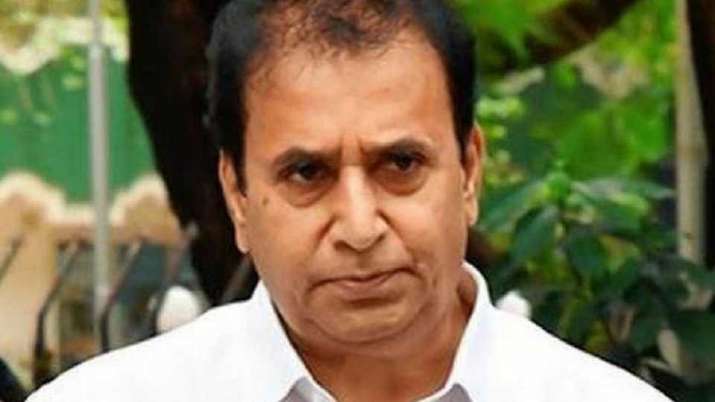
Mumbai: The Bombay High Court on Friday questioned the Maharashtra government's refusal to share certain documents with the CBI for its probe against former state home minister Anil Deshmukh, and said that unless the documents are seen how can the central agency decide if there was any nexus with him over alleged corruption in police transfers and postings.
The state government had earlier claimed that the documents sought by the Central Bureau of Investigation (CBI) did not have any relevance with the agency's corruption probe against Deshmukh.
A division bench of Justices S S Shinde and N J Jamadar was hearing an application filed by the CBI alleging that the government was not cooperating by refusing to hand over certain documents in connection with a probe against the NCP leader.
Additional Solicitor General Aman Lekhi, appearing for the CBI, on Friday said the government by refusing to hand over the documents was acting in contempt to a July order passed by the high court, which said that the agency had the power to inquire into corruption in police transfers and the reinstatement of police officer Sachin Waze.
The bench noted that earlier the state government had said that it was not averse to any investigation.
"Now why is the state government averse? We don't have any words. Why should the state government do this?" Justice Shinde said.
Senior counsel Rafiq Dada, appearing for the state government, argued that the HC had not said that the government was bound to give the documents and had in fact said that the CBI should investigate only those aspects that have a nexus with Deshmukh and his associates.
"Unless the CBI sees the documents, how will they (CBI) decide if there is any nexus or not. We only said that the CBI does not have unfettered authority to probe into other transfers. But the documents they are seeking pertain to a report submitted by Rashmi Shukla (IPS officer) on the issue of corruption in police transfers," the court said.
"These documents, we believe, you (government) cannot object to. Whatever period Anil Deshmukh was holding the portfolio of home minister, those documents may be needed," Justice Shinde said.
The court directed Dada to take instructions from the government on what documents it was willing to share with the CBI.
"Both are agencies of the state and the Centre. There are many occasions where information is shared. Tell us the list of documents you (state government) are willing to share. This will lead to a congenial and happy situation," the court said.
The bench posted the matter for further hearing on August 24.
The CBI, in its application filed last month, had said it had written a letter to the State Intelligence Department seeking details of a communication sent by senior IPS officer Rashmi Shukla on the issue of corruption in police transfers and postings, but the SID refused to provide them claiming it was part of an ongoing investigation.
The high court had on July 22 held that the CBI can inquire the allegations of corruption in transfers and postings of police personnel limited to its nexus with Deshmukh and had dismissed a petition filed by the Maharashtra government seeking that some parts of the central agency's FIR against the NCP leader be quashed.
The CBI had on April 21 lodged an FIR against Deshmukh on charges of corruption and misuse of official position. The FIR was lodged after the agency conducted a preliminary inquiry against the state's former home minister following an order from the HC on April 5.
Let the Truth be known. If you read VB and like VB, please be a VB Supporter and Help us deliver the Truth to one and all.
Tamil Nadu: Cong stages statewide protests against guv over govt formation
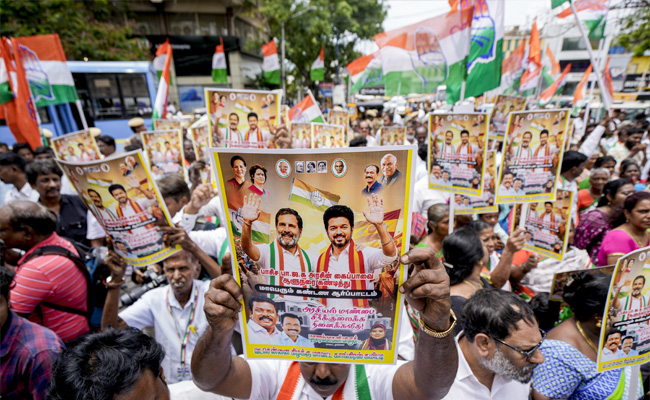
Chennai (PTI): TNCC on Friday launched a statewide protest against Governor Rajendra Vishwanath Arlekar for his refusal to invite the TVK to form the government despite it emerging as the single largest party in the recently concluded Assembly elections.
Leading a spirited demonstration at Anna Salai in Chennai, AICC in-charge for Tamil Nadu, Girish Chodankar, and TNCC President K Selvaperunthagai accused the Raj Bhavan of acting as a "puppet" of the BJP-led Centre and subverting democratic norms.
Speaking to reporters at the protest site, Chodankar launched a scathing attack on the Governor's delay in government formation.
"The Governor has a mission, but he is following (Union Home Minister) Amit Shah. That is his problem," Chodankar charged.
ALSO READ: UP govt sacks five doctors, orders action against 16 health officials for negligence
When asked about mounting speculation regarding a potential "outside support" arrangement between traditional rivals DMK and AIADMK to keep the TVK-Congress combine out of power, Chodankar said, "Let them come together. Let everyone get exposed before the people of Tamil Nadu.”
According to him, if that happens people will know who is really secular and who is ready to stand by them in this situation.
"I am confident that many secular parties are not ready to see BJP or RSS rule enter Tamil Nadu and will definitely oppose it," said Chodankar.
Addressing his party's recent exit from the DMK-led alliance to support actor-turned-politician Vijay's TVK, Chodankar dismissed allegations of "backstabbing" by his party's former ally.
"In a democracy, people are the masters. We have respected the people's mandate," he stated.
Selvaperunthagai demanded that the Governor immediately invite the single largest party to form the government.
"The Governor must implement the Constitution. That is our only demand, and that is why we are protesting today," Selvaperunthagai said.
The Congress, which recently snapped its long-standing ties with the DMK, has aligned itself with the TVK, which won 108 seats. The party cadres held demonstrations across all district headquarters, raising slogans against the Governor and the Union government, while demanding that the democratic mandate of the 2026 elections be respected without further delay.
The protests come amid a tense political climate in the state, as the DMK and AIADMK -- who both suffered significant losses to the TVK -- reportedly explore tactical manoeuvres to navigate the hung assembly.
TVK with 108 seats has the support of Congress' five MLAs but the party is still short of five legislators to form government.