Heavy rains disrupt normal life in Chennai and nearby districts
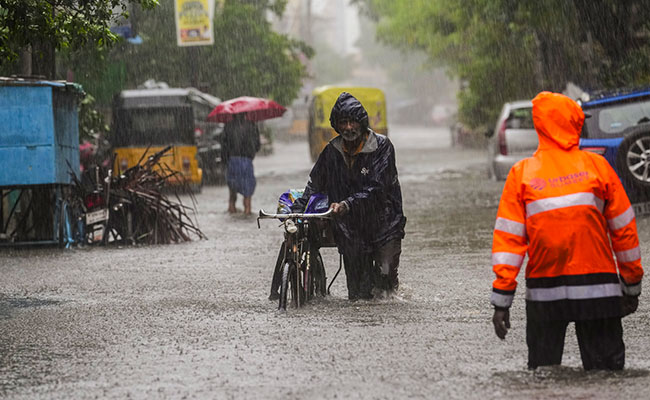
Chennai (PTI): Life was thrown out of gear in Chennai and its neighbouring districts on Monday as relentless rains pounded various parts leading to inundation, raising fears of a repeat of 2015 deluge.
People were seen scampering to buy and refill supplies and essential items with drinking water being on high demand. There was no let up in the downpour that led to power outages and internet disruption.
Cyclonic storm Michaung, which is likely to cross the coast in Andhra Pradesh on the forenoon of Tuesday lay near Chennai and Puducherry, bringing heavy rains.
The name 'Michaung' was suggested by Myanmar. It means strength or resilience.
Transport services took a severe hit as number of trains and flights were cancelled. Heavily inundated roads posed a challenge to road users who were few and far.
Many parts of the state capital and the adjoining districts of Kancheepuram, Chengalpet and Tiruvallur came under sheets of water even as the government machinery was deployed to clear the stagnant water and inundation.
In its latest update, the weather office said the rains were likely to continue in these districts till late on Monday.
"Cyclonic storm "MICHAUNG centered over the west central and adjoining southwest Bay of Bengal off south Andhra Pradesh and adjoining North Tamil Nadu coasts moved northwestwards at a speed of 8 KMPH, intensified into a Severe Cyclonic Storm over the same region on December 4. It is likely to move nearly northwards almost parallel and close to south Andhra Pradesh coast and and cross between Nellore and Machilipatnam (AP) during forenoon of December 5 as a Severe Cyclonic Storm," an update from the India Meteorological Department (IMD) said.
In Chennai, cabinet ministers Udhayanidhi Stalin and Ma Subramanian visited the affected areas and oversaw the relief activities.
The Chennai airport operations were suspended from 9.40 am to 11 pm. As many as 70 flights arriving to and departing from the airport were cancelled owing to non-stop rains. The runway and tarmac also remain shut due to waterlogging, the Airport Authority of India said.
Rail and air services suffered cancellation and delays.
"In view of water flowing above danger level, the bridge no.14 between Basin bridge and Vyasarpadi has been suspended on account of safety reasons," and six trains originating from the Dr.MGR Chennai Central to destinations including Coimbatore and Mysuru were cancelled on Monday morning, the Southern Railway said, adding full refund shall be granted to all passengers of the above trains.
According to airport officials, 12 domestic outbound services, including to destinations like Ahmedabad and Thiruvananthapuram were cancelled. Four international services, including to Dubai and Sri Lanka were cancelled by a private carrier.
Three arriving international services were diverted to Bengaluru.
As many as 14 subways in the city have been closed due to inundation, the city police said.
In 11 places, uprooted trees were removed.
Meanwhile, Additional Chief Secretary, Environment Climate Change and Forests, Tamil Nadu government, Supriya Sahu reacted to a viral video of a crocodile crossing a road in suburban Perungulathur area during heavy rains in Chennai.
In a post on X, she said, "Many are tweeting about this video. There are a few mugger crocodiles in several of the water bodies in Chennai. These are shy elusive animals and avoid human contact. This one has come out as the water has overflown due to massive rains under the impact of #CycloneMichuang please do not go close to water bodies."
"There is no possibility of harm to humans IF these animals are left alone & UNPROVOKED. No need to panic. Wildlife division has been alerted and they are on the job to avoid any untoward incident #cyclonemichaung #Cyclone #Michaung #ChennaiRains."
At Velachery in the city, a portion of land reportedly gave way, leading to a deep pit and some people were trapped.
Also, a building in the locality caved in trapping some workers. Two people have been rescued and admitted to the hospital, police said without sharing further details.
The Industries Department has set up a help desk for providing information and assistance to small and medium enterprises.
"SIPCOT is continuously monitoring and clearing hurdles within the industrial parks located in affected districts using patrol teams," an official said.
Let the Truth be known. If you read VB and like VB, please be a VB Supporter and Help us deliver the Truth to one and all.
4 held for sexually assaulting woman, girl on moving bus after social media alert in UP's Agra

Agra (UP) (PTI): Four people were arrested, after a prompt response by police following a social media alert, for allegedly sexually assaulting a woman and a girl inside a moving bus here, officials said on Tuesday.
According to an official police statement, at 12:27 am on April 27, information was received on the social media platform X about an incident of sexual assault on a bus travelling from Kanpur to Ahmedabad, which was approaching Namner crossing in Agra.
Acting under the direction of Police Commissioner Deepak Kumar, the Agra Police social media team immediately alerted the Rakabganj police station within minutes and coordinated with the victims to confirm the incident and obtain the exact location, it stated.
Police teams launched intensive checking at Namner crossing and intercepted the bus as it reached the spot. The four accused involved in the incident were apprehended on the spot, and legal action was initiated against them, the statement said.
The police said the swift response and coordination between the social media team and field units ensured timely action, bringing relief to the victims and other passengers, who expressed gratitude towards the police, it added.