Heinous crimes can't be quashed on basis of compromise: Supreme Court
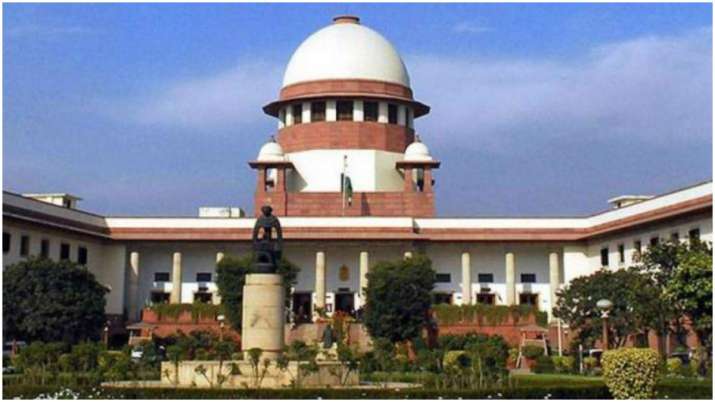
New Delhi, Jul 29: The Supreme Court on Friday said that heinous crimes, which are not private in nature and have a serious impact on society, cannot be quashed based on a compromise between the offender and the complainant or the victim.
The apex court said orders quashing FIRs or complaints relating to the grave and serious offences only based on an agreement with the complainant, would set a "dangerous precedent" where complaints would be lodged for oblique reasons to extract money from the accused.
"Furthermore, financially strong offenders would go scot-free, even in cases of grave and serious offences such as murder, rape, bride-burning, etc. by buying off informants/complainants and settling with them, a bench of Justices Indira Banerjee and V Ramasubramanian said in its judgement.
The top court set aside the Gujarat High Court orders, including the one which had quashed an FIR lodged in March 2020 for the alleged offence of abetment of suicide.
While referring to previous judgements of the apex court, the bench said before exercising its power under section 482 of the Code of Criminal Procedure (CrPC) to quash an FIR, criminal complaint, or criminal proceedings, the high court has to be circumspect and have due regard to the nature and gravity of the offence.
"Heinous or serious crimes, which are not private in nature and have a serious impact on society cannot be quashed on the basis of a compromise between the offender and the complainant and/or the victim," it said.
The apex court observed that crimes like murder, rape, burglary, dacoity, and even abetment to commit suicide are neither private nor civil and such crimes are against society.
"In no circumstances can prosecution be quashed on compromise, when the offence is serious and grave and falls within the ambit of crime against society," it said.
The bench said orders quashing FIRs or complaints relating to the grave and serious offences only based on an agreement with the complainant would render otiose the provisions, such as sections 306, 498-A, 304-B of the Indian Penal Code (IPC), which were incorporated as a deterrent with a specific social purpose.
While section 306 of the IPC deals with the abetment of suicide, section 498-A relates to the offence of a husband or relative of a husband of a woman subjecting her to cruelty. Section 304-B of the IPC deals with the offence of dowry death.
The apex court noted that the only question in the appeal before it is whether applications filed by the accused under section 482 of CrPC could have been allowed and an FIR under section 306 of the IPC could have been quashed based on a settlement between the complainant and the accused named in the FIR.
The bench observed that an FIR under section 306 of the IPC cannot even be quashed based on any financial settlement with the informant, surviving spouse, parents, children, guardians, caregivers, or anyone else.
It noted that the high court had erred in declining the prayer of the appellant for recalling its order, which was passed without hearing the wife of the deceased only because the original informant or complainant, a cousin brother, and an employee of the deceased had been heard.
"Hearing a cousin-cum-employee of the deceased cannot and does not dispense with the requirement to give the wife of the deceased a hearing," it said.
The bench noted that the wife of the deceased would have greater interest than cousins and employees in prosecuting accused persons charged with the offence of abetting the suicide of her husband.
It said the inherent power of the high court under section 482 of the CrPC to interfere with criminal proceedings is wide and such power has to be exercised with circumspection, in exceptional cases.
The top court noted that in exceptional cases, the high court might exercise its inherent powers under section 482 of the CrPC to quash criminal proceedings to prevent abuse of the process of the court.
It said offence under section 306 of the IPC of abetment to commit suicide is a grave and non-compoundable offence.
It said in criminal jurisprudence, the position of the complainant is only that of the informant and once an FIR or criminal complaint is lodged and a criminal case is started by the State, it becomes a matter between the state and the accused.
"The State has a duty to ensure that law and order are maintained in society. It is for the state to prosecute offenders," the bench said.
"In our considered opinion, the criminal proceeding cannot be nipped in the bud by the exercise of jurisdiction under section 482 of the CrPC only because there is a settlement, in this case, a monetary settlement, between the accused and the complainant and other relatives of the deceased to the exclusion of the hapless widow of the deceased," it said.
Let the Truth be known. If you read VB and like VB, please be a VB Supporter and Help us deliver the Truth to one and all.
Vijay unable to prove majority, not invited for CM oath ceremony: Sources
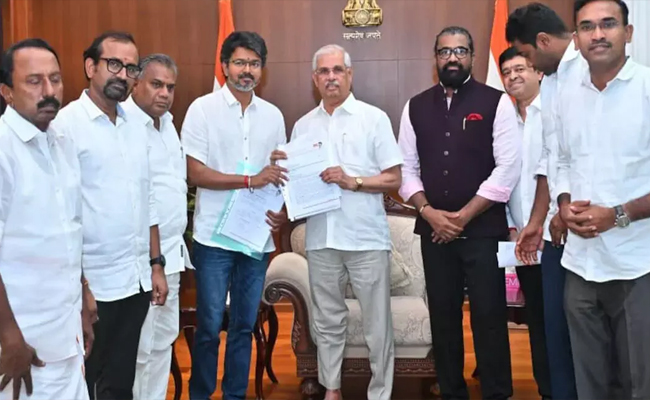
Chennai: Actor-politician Vijay has reportedly not been invited to take oath as Chief Minister of Tamil Nadu after failing to demonstrate support from the required number of MLAs, sources in Raj Bhavan said.
According to media reports that quoted sources in the office of R.N. Ravi Arlekar, Vijay could not prove the backing of 118 legislators, the majority mark in the 234-member Tamil Nadu Assembly.
Despite last-minute efforts to secure support from the Viduthalai Chiruthaigal Katchi (VCK), Amma Makkal Munnetra Kazagam (AMMK), and an IUML legislator, Vijay reportedly managed support from only 116 MLAs, falling short by two members.
Sources said Vijay failed to submit letters of support from the VCK and the Indian Union Muslim League (IUML).
Later, the IUML issued a statement clarifying that it was not part of the TVK-led alliance.
Meanwhile, AMMK leader T.T.V. Dhinakaran is also said to have informed the Governor that his party would support the All India Anna Dravida Munnetra Kazhagam (AIADMK) instead.
Earlier in the evening, Vijay had met Governor Arlekar and staked claim to form the government, stating that he enjoyed the support of 118 MLAs.