Hijab row: Personal info leak of six girl students figures in Rajya Sabha
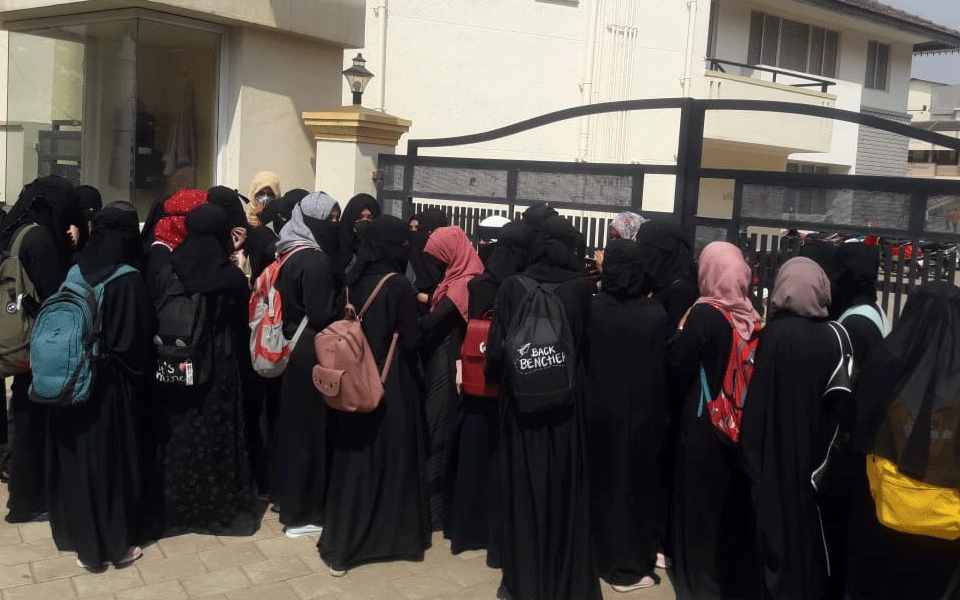
New Delhi(PTI): The online leakage of personal information of six girl students, most of them minors, from Karnataka's Udupi, where the first protests in connection with the hijab row were reported recently, figured in the Rajya Sabha on Friday with a member demanding protection of data rights.
Raising the issue through a Zero-Hour mention, Mausam Noor of the Trinamool Congress (TMC) said amidst the hijab ban controversy, personal data of at least six girl students was leaked and shared across social media platforms.
"Their personal information like names, addresses etc. have been shared by multiple people, thereby violating their privacy," she said.
The hijab row had erupted in Udupi in December last year when six students were prevented from attending classes because they wanted to cover their heads for religious reasons.
Stating that data leakage and violation are not uncommon these days, the TMC MP said personal information and pictures of multiple Muslim women were leaked and used against their will in the SulliDeal and BulliBai apps cases.
"In recent times, leaking of personal information has become a common way of violating women's rights and privacy and safety," she said, adding, "Leaking data and personal information is not just a threat to the safety of people, but also a violation of the basic fundamental rights such as the right to privacy."
Noor said the issue needs to be addressed and it should be ensured that the data rights of everyone, especially minor girls and women, are protected.
Sushil Kumar Modi of the Bharatiya Janata Party (BJP) demanded scrapping of the discretionary quota of MPs to recommend admission to Kendriya Vidyalayas, saying it goes against transparency and meritocracy, and breeds corruption.
Under the KVS Special Dispensation Admission Scheme (MP Quota), a Member of Parliament (MP) in both the Lok Sabha and the Rajya Sabha can recommend the names of a maximum of 10 students every academic year for admission in Kendriya Vidyalayas.
The admissions made under this quota not only skew the teacher-student ratio but also deprive several sections of the benefits of reservation as such recommendations do not follow the 50 per cent quota rule provided for SC, ST and OBC community students, he said.
Ram Gopal Yadav of the Samajwadi Party (SP) said the teachers of government-run primary schools should not be deployed on election duty and for other administrative jobs as it impacts the education of poor students.
A computer-literate clerk must be appointed at every government-run primary school for filing mandatory reports such as that of mid-day meals, which otherwise has to be done by a teacher by cutting into class time, he added.
Associating with the issue, Tiruchi Siva of the Dravida Munnetra Kazhagam (DMK) said the matter of low salaries of teachers should be addressed as well.
While Prashanta Nanda of the Biju Janata Dal (BJD) demanded immediate release of pensions for artisans, which have not been paid since April 2021, Shaktisinh Gohil of the Congress raised the issue of the Indian fishermen languishing in Pakistani prisons.
He said 580 Indian fishermen are lodged in jails in the neighbouring country for accidentally straying to Pakistani waters while fishing off the Gujarat coast.
Raising the issue of a 44-year-old fisherman who was caught by Pakistani Marines on December 9, 2018, Nanda said the punishment for trespassing into the Pakistani side of the International Maritime Boundary Line (IMBL) is three months' imprisonment.
Despite serving the sentence, the fisherman was not released and he died in a Pakistani prison on February 3 this year, he said, adding that it has been a month and a half but the body has not been handed over by the Pakistani authorities.
The BJD leader demanded that the government use diplomatic and other channels to secure the release of the Indian fishermen and ensure that the body of the deceased fisherman is brought back to India so that the family members could perform the last rites.
Let the Truth be known. If you read VB and like VB, please be a VB Supporter and Help us deliver the Truth to one and all.
Karnataka launches drug monitoring portal for NSQ detection, NDPS misuse
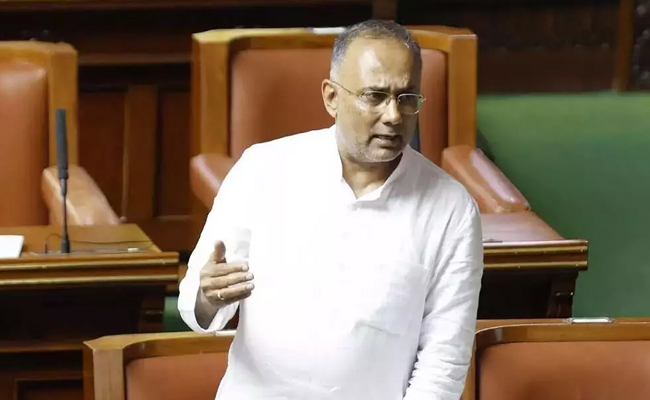
Bengaluru (PTI): Karnataka Health Minister Dinesh Gundu Rao on Thursday launched a monitoring portal for the detection of NSQ drugs and the prevention of misuse of NDPS, aimed at strengthening surveillance, transparency and accountability in public health.
To effectively monitor and control the movement of such drugs, the Food Safety and Drug Administration department has developed the portal to track Not of Standard Quality (NSQ) drug batches available with stockists and retailers, officials said.
Through this system, identified NSQ batches will be automatically locked, preventing any further sale or transaction of those products. The portal also provides real-time information to the department regarding available stock, stock-in-hand details and quantities returned to suppliers, ensuring better monitoring, transparency and public safety, they said.
Addressing a press conference here, the health minister said the main objective is that whenever any medicine is found to be not of proper quality or not up to standard, action needs to be taken.
He said that earlier, when samples were collected and tested, if a medicine was found to be substandard, it would already have reached the market - distributors, retailers, pharmacies and others.
"There was no system to recall those medicines. We could only try to stop future supplies, but we had no control over medicines that had already entered the market, even if we knew they were of poor quality. As a result, such medicines could still be purchased and sold to the public," Rao said.
Officials noted that the Food Safety and Drug Administration department has recalled medicines worth Rs 1.85 crore in the year 2025-26.
"Today, we are launching this portal... Whenever any drug is newly identified as substandard, we will immediately upload that information on the portal. The portal is integrated with databases of wholesalers and stockists," the minister said.
According to him, the moment a batch is declared substandard and uploaded, messages are instantly sent to all wholesalers and retailers. Wholesalers have been linked to this system. Once the information is updated, further sale of that batch will automatically stop.
"Whether it is in warehouses, distribution chains or stockists' inventories, the stock will be frozen automatically. They will not be able to sell those medicines further," he said.
Around 15,000 stockists and wholesalers are currently part of this system, the health minister said, adding that in the next stage, "We will bring in about 45,000 retailers and pharmacists into the database. For now, at the wholesale and stockist level, this system will completely block the sale of such medicines. Those batches will have to be returned, and the companies concerned will be held responsible. The recall process will happen in real time".
"Once testing and verification are completed and the drug is proven substandard, we can instantly alert the entire state. Every stock point holding that batch will be frozen immediately. Even if someone wishes to continue selling it, they will not be able to do so. The process will stop automatically," he said.
Stressing that this is a major reform and a very positive step, Rao said, "As far as I know, no other state in the country has introduced such a system. Karnataka is introducing it today." Apart from this, the minister said the portal will also help in monitoring narcotic and psychotropic drugs regulated under the Narcotic Drugs and Psychotropic Substances (NDPS) Act.
Earlier, when pharmacies sold such medicines, they only had to maintain physical records containing the patient's name, the doctor's details and the prescription. Irregularities would come to light only during inspections conducted at pharmacies.
Under the new system, Rao said that pharmacies selling narcotic or psychotropic drugs will have to upload all details onto the portal. "This means we will have data on where and how much is being sold, who is purchasing these medicines, whether excessive quantities are being sold under one person's name, or whether a particular doctor is prescribing unusually high amounts," he said.
Rao said the data can be analysed to identify suspicious patterns or unusual sales of such medicines.
"If certain doctors are issuing too many such prescriptions, we can monitor them closely. Likewise, if any pharmacy is selling unusually high quantities of these medicines, we can inspect them and take action," he added.