I was tortured, asked to name Narendra Modi in Malegaon blast case: Pragya Singh Thakur
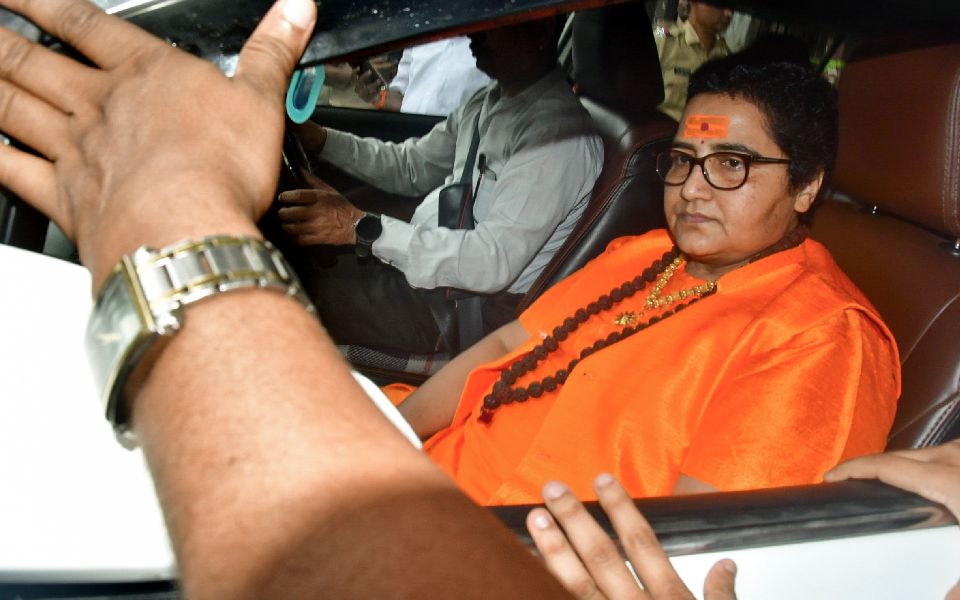
Mumbai, Aug 2 (PTI): Former BJP MP Pragya Singh Thakur, acquitted in the September 2008 Malegaon blast case, on Saturday alleged that she was tortured by the investigating officers who asked her to name several persons including Prime Minister Narendra Modi.
This is the first time Thakur has made this sensational claim which finds no mention in the 1036-page judgment of the special NIA court acquitting all seven accused in the case.
Thakur appeared before the sessions court here on Saturday to complete her surety formalities. Speaking to reporters outside, she claimed that she was tortured during her interrogation.
Notably, special judge A K Lahoti in his judgment has dismissed Thakur's claims of torture and ill-treatment.
"They (officers) told me to take PM Modi's name, as at the time I was staying in Surat (Gujarat). There are several names like Bhagwat (apparent reference to RSS chief Mohan Bhagwat) and so on, but I did not take anyone's name as I did not want to lie," Thakur told reporters.
She had put all this in writing, she claimed.
"Their objective was to torture me. They said if I did not take the names, then they will torture me. The names include Uttar Pradesh Chief Minister Yogi Adityanath, Sudarshan ji, Indresh ji, Ram ji Madhav, and many more, which I can't recall at the moment," Thakur said.
The former BJP MP alleged that she was detained illegally even in the hospital where she had fainted and her lungs had collapsed.
"I am writing my story in which I will mention all this. The truth will come out. This is a victory of religion, victory of Sanatan dharma, and victory of Hindutva...this is a Sanatani Rashtra, and it is always victorious. They tried very hard by torturing me and bringing all devotees of the country in this....we will try so that they are punished," she said.
The court in its judgment said while Thakur had alleged ill-treatment, no evidence was presented to support her claims.
It also referred to a Supreme Court order of 2011 in which it rejected her claims of illegal custody, torture and detention. The trial court further said that Thakur had not made any complaint before the court in Nashik when she was produced for remand after her arrest.
"There is no evidence (of torture and ill-treatment) brought to my notice and hence, I am not inclined to accept the submission," judge Lahoti said.
Thakur, meanwhile, said the whole case against her was baseless.
She described Param Bir Singh, then assistant commissioner of police with the Maharashtra Anti-Terrorism Squad (ATS), as a "wicked person".
"Singh, (then ATS chief) Hemant Karkare and Sukhwinder Singh tortured me and wanted me to tell lies. But I refused," she alleged.
Six people were killed and 101 were injured in a blast at Malegaon in Maharashtra's Nashik district on September 29, 2008.
The special court on July 31 acquitted Thakur, Lt Col Prasad Purohit and five others in the case noting that the prosecution had not adduced cogent and reliable evidence to warrant conviction and to prove the case beyond reasonable doubt.
Let the Truth be known. If you read VB and like VB, please be a VB Supporter and Help us deliver the Truth to one and all.
Hospital wall collapse: CM orders suspension of executive engineer; kin of victims get solatium
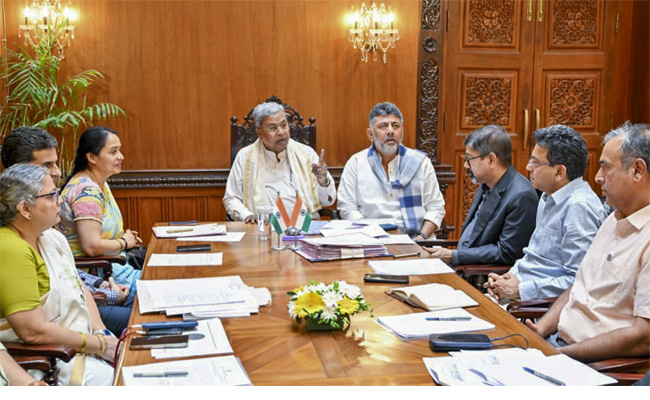
Bengaluru (PTI): Karnataka Chief Minister Siddaramaiah on Thursday ordered the immediate suspension of an executive engineer for the Bowring and Lady Curzon Hospital wall collapse that claimed the lives of seven people, during a high-level review meeting at Vidhana Soudha.
A compensation of Rs 5 lakh, as announced by the CM Siddaramaiah, was distributed to the families of seven victims who lost their lives in the tragedy on Wednesday evening, which occurred due to heavy downpour with gusty winds and hailstorm.
The meeting of municipal commissioners of the five corporations, chaired by the chief minister and attended by Deputy Chief Minister D K Shivakumar, focused on fixing accountability and examining lapses that led to the tragedy.
"Why was soil dumped in a way that damaged the wall? Why did you not monitor this?" Siddaramaiah asked, pulling up hospital authorities during the meeting.
A statement from the chief minister's office said that the CM ordered the immediate suspension of the executive engineer of the Karnataka Health Systems Development Project (KHSDP).
ALSO READ: Three arrested for running fake Aadhaar racket in UP's Badaun
He also questioned the hospital authorities, asking why they failed to monitor the dumping of soil that weakened the structure.
The chief minister directed that a notice be issued to the head of the Hospital.
During the meeting, Siddaramaiah said the rains had caused extensive damage in the city, with over 250 trees uprooted.
The Chief Minister instructed officials to take necessary measures before the onset of the monsoon to avoid untoward incidents.
Commissioners of all five municipal zones in Bengaluru have been asked to take precautionary steps, including trimming dry and dangerous tree branches, the CMO said.
Siddaramaiah also directed them to get the silt cleared from stormwater drains to prevent flooding, and that immediate action be taken to remove debris and fallen branches from roads.
Further, he instructed that barricades be placed at underpasses where water stagnates and restricts public movement.
The Greater Bengaluru Authority (GBA) Chief Commissioner M Maheshwar Rao said in a statement that Shivajinagar MLA Rizwan Arshad distributed compensation cheques of Rs 5 lakh each to the families of the deceased on Thursday.
Seven people, including a six-year-old girl, were killed and seven others injured when the compound wall collapsed amid heavy rain, strong winds and a hailstorm on Wednesday evening.
Police said the victims, comprising three from Bengaluru, two from Kerala on a study tour and one each from Uttar Pradesh and Assam, had taken shelter near the wall when it suddenly gave way, trapping them under the debris.
The chief minister questioned officials over the dumping of soil near the wall despite knowing it could weaken the structure, and directed that a notice be issued to the head of Bowring Hospital.
Siddaramaiah, who had visited the spot soon after the incident along with senior officials, reviewed the situation and ordered a detailed probe into the collapse.