'If bigger countries violate international law without any consequences...': PM Trudeau
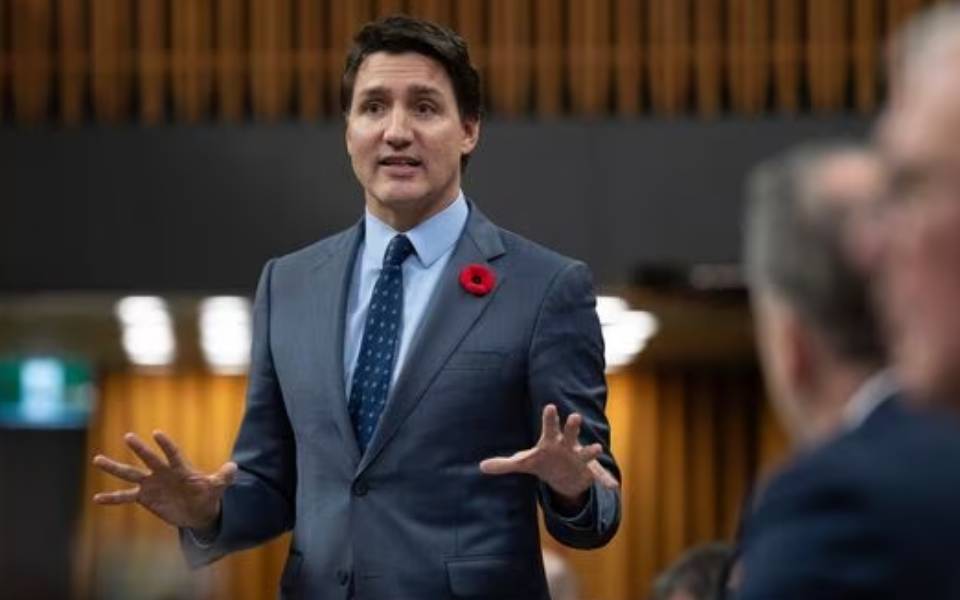
Ottawa, Nov 12: Prime Minister Justin Trudeau has underlined that a "fight" with India was not something Canada wanted to be having right now but reiterated his allegations and said Ottawa wants to "work constructively" with New Delhi on this "very serious matter".
Addressing the media on Friday, Trudeau also alleged that India violated the Vienna Convention as over 40 Canadian diplomats were shifted from India after New Delhi threatened to strip them of their diplomatic immunity.
The ties between India and Canada came under severe strain following Trudeau's allegations in September of a "potential" involvement of Indian agents in the killing of Khalistani separatist Hardeep Singh Nijjar on June 18 in British Columbia. India had designated Nijjar as a terrorist in 2020.
India rejected Trudeau's allegations as "absurd" and "motivated".
In his fresh remarks, Prime Minister Trudeau said that his government reached out to India to ask them to work together in getting to the bottom of this matter.
"From the very beginning when we learned of credible allegations that agents of the Indian govt were involved in the killing of a Canadian citizen on Canadian soil, we reached out to India to ask them to work with us in getting to the bottom of this matter," he said while addressing the media.
He said Canada also reached out to its friends and allies like the United States and others to work on "this really serious violation of international law and of the sovereignty of a democracy" and added that this is something that we are taking "very seriously".
"We will continue to work with all partners as law enforcement and investigative agencies continue to do their work. Canada is a country that will always stand up for the rule of law because if might starts to make right again, if bigger countries can violate international law without consequences, then the whole world gets more dangerous for everyone," he added.
Prime Minister Trudeau said that Canada wants to "work constructively" with India on this "very serious matter".
"From the very beginning, we shared the real allegations that we are deeply concerned about but we have reached out to the Indian govt and to partners around the world to get to the bottom of this, to take it seriously. That's why we were so disappointed when India violated the Vienna Convention and arbitrarily revoked the diplomatic immunity of over 40 Canadian diplomats in India," he said.
He reiterated that there were "serious reasons to believe that agents of the government of India could have been involved in the killing" of Nijjar.
"India's response is to kick out a whole bunch of Canadian diplomats by violating their rights under the Vienna Convention. That is of concern to countries around the world because if a given country can just decide that their diplomats of another country are no longer protected, that makes international relations more dangerous and more serious," he added.
"But every step of the way, we have tried to work constructively and positively with India, and we will continue to and that means continuing to work with Indian government diplomats. This is not a fight we want to be having right now but we will unequivocally always stand up for the rule of law," he added.
His remarks came after US Secretary of State Antony Blinken in New Delhi on Friday urged India to cooperate with an investigation by Canada into the killing of Nijjar.
Last week, Foreign Secretary Vinay Kwatra said New Delhi conveyed to the US side its serious concerns over increasing activities of pro-Khalistani elements in Canada.
"Insofar as Canada is concerned, we have been having very consistent conversations with all our friends and partners. Our position on this matter has been enunciated and explained in full detail on multiple occasions," Kwatra said.
Days after Trudeau's allegations in September, India temporarily suspended the issuance of visas to Canadian citizens and asked Ottawa to downsize its diplomatic presence in the country to ensure parity.
India resumed some visa services in Canada last month, more than a month after they were suspended.
Let the Truth be known. If you read VB and like VB, please be a VB Supporter and Help us deliver the Truth to one and all.
Bengaluru Police bust major drug network; 16 arrested, narcotics worth Rs 36.67 crore seized

Bengaluru: In a major crackdown on drug trafficking and illegal narcotics trade, Bengaluru City Police have arrested 16 accused persons and seized narcotic substances worth Rs 36.67 crore.
According to Bengaluru City Police Commissioner Seemanth Kumar Singh, those arrested include four foreign nationals, eight persons from other states and four locals. Police said the network had interstate as well as international links.
Police recovered 9 kg 64 grams of MDMA, 5 kg 195 grams of hydro ganja, 19,755 LSD strips, 156 grams of heroin, 618 grams of charas, 332 grams of cocaine, 315 grams of drug-mixed gummies and 11 kg 470 grams of ganja from the accused.
The Commissioner said the action was carried out as part of a major anti-drug operation in the city. The network was busted with the support of the CCB Narcotics Control Squad and police stations of Bagaluru, Adugodi, Chikkajala, HSR Layout, Yeshwanthpur, Jalahalli and Jnanabharathi.
Cases were registered in CCB, East Division and West Division police stations based on specific intelligence received on different dates, following which raids were conducted.
Preliminary investigation revealed that the accused were procuring drugs at lower prices from foreign, interstate and local sources and selling them in Bengaluru at higher rates.
Police said college students and working professionals were among the main targets of the accused.