Imposing practices like 'surya namaskar' on students of other religions against Constitution: Jamiat

New Delhi, Jul 5: Prominent Muslim organisation Jamiat Ulema-e-Hind on Friday denounced any attempt to "saffronise the education system" and said forcing of customs of one religion on students from other religions in schools such as the practice of "surya namaskar" was against the Constitution.
At its two-day governing council meeting that concluded on Friday, the Jamiat deliberated upon a range of issues, including Islamophobia, mob lynching, Muslim reservation, targeting of madrasas, uniform civil code (UCC) and the Israel-Palestine conflict.
The organisation vehemently denounced attempts to "saffronise the educational system, enforce a uniform civil code, and target Islamic madrasas", according to a statement.
The Jamiat fiercely opposed forcing one's religious customs and practices on students from other religions in schools, it said.
Jamiat chief Maulana Mahmood Madani, who presided over the meeting, emphasised that love and unity, not animosity, are needed for the country to prosper.
He denounced the rise in anti-Muslim propaganda and mob lynchings, the statement issued by the organisation said.
"In recent years, madrasas have been targeted under one pretext or another. The recent adverse actions and false statements made against madrasas and their Islamic scholars by certain BJP chief ministers and the NCPCR chief were observed with great concern at the meeting," the statement said.
In the resolution for "Necessary Measures for Protection and Safeguard of Islamic Madarsas", the governing council demanded that the government and authorities concerned act immediately to stop the "ongoing misinformation campaign against madrasas".
The meeting also urged madrasas to concentrate on internal reform and ensure the implementation of the suggestions made by the standing committee for the "protection of madrasas".
The statement said a resolution passed in the meeting denounced the "attempt by the Union and state governments to impose religiously incompatible practices on pupils and saffronise the education system".
Islam is based on the concept of monotheism, and no Muslim is allowed to accept the worship of deities other than Allah or take part in any actions that are symbolic of other faiths, the Jamiat said.
"Every citizen of this country is free to uphold their own religious practices and beliefs under the provisions of the Constitution. Therefore, it is an infringement on religious freedom and a violation of the Constitution when the government imposes mandatory directives on schoolchildren to conduct 'Surya Namaskar', 'Saraswati Puja', sing Hindu songs, ashlokas, or wear tilak," it said.
The Jamiat urged the government to desist from any such provocative actions, the statement said.
The governing council expressed concerns over attempts to implement the UCC, saying it was a front for "a larger plot to restrict people's freedom of religion and fundamental rights", it said.
On the issue of Muslim reservations, the resolution clarified that Article 16(4) of the Constitution mandates reservations for under-represented and marginalised groups.
It must be made clear that the country has never benefited from the use of religion as a justification for discriminating against anyone, the statement said.
Within the framework of the Constitution, special reservations for Muslims have been introduced in a number of states through proactive affirmative measures meant to lessen social and economic inequalities, the Jamiat said.
The governing council also warned that any attempt to repeal the Waqf Act would be seen as a plot to jeopardise both the rights of the Muslim minority and the country's well-being.
The resolution also denounced the war crimes committed by Israel in Gaza as well as its "aggression" against the Palestinian people.
Let the Truth be known. If you read VB and like VB, please be a VB Supporter and Help us deliver the Truth to one and all.
MP boat tragedy: Death toll rises to 10 with recovery of one more body; 3 tourists still missing
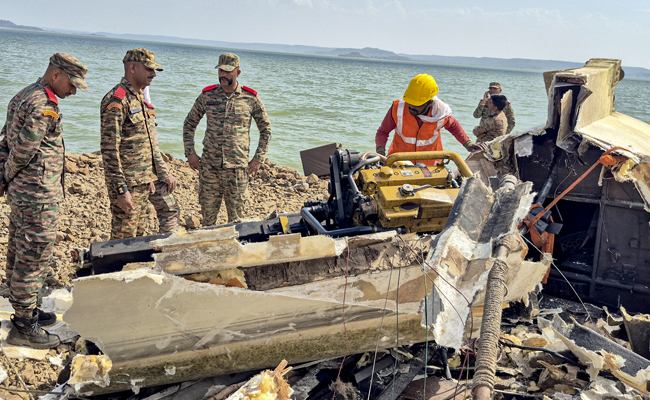
Jabalpur (PTI): The body of a child was retrieved on Saturday evening from Bargi Dam in Jabalpur district of Madhya Pradesh, raising the death toll in the cruise boat tragedy that took place two days ago to ten, while search continued for three missing tourists.
The boat, operated by the state tourism department, capsized during a storm on Thursday evening with some of the survivors alleging negligence and safety lapses such as life jackets not being distributed in time.
The body recovered on Saturday evening was possibly that of six-year-old Viraj Soni, said Sub-Divisional Officer of Police (SDOP) Anjul Ayank Mishra.
"The identity will be confirmed after family members identify the body," he told PTI.
Kamraj, an employee of the Ordnance Factory at Khamaria, his five-year-old son Tamil, and another child Mayuram (5) who had come from southern India were still missing.
Authorities have arranged equipment to search deep waters of the dam and are getting a generator to facilitate diving operations, Mishra added.
Divers and disaster response teams have expanded the search radius to five km, he said.
Of the 41 identified passengers on board the ill-fated vessel, 28 were rescued, police said.
More than 200 rescuers, including around 20 Army divers airlifted from Agra, joined the search operation that resumed at 5 on Saturday morning. The operation, involving the National Disaster Response Force, State Disaster Response Force and local divers, was briefly affected at around 9 am due to strong winds, officials said.
Post-mortem examinations of nine deceased persons have been completed, Mishra said.
"Our priority is to search for the missing persons. We will also register a First Information Report in the case soon," he said.
Police said CCTV footage near the boarding point showed 43 people heading towards the boat while the identities of 41 passengers have been confirmed so far.
The state government on Friday ordered a probe into the tragedy and dismissed three crew members. It also banned operation of similar vessels in the state.