India backs dialogue, prioritises safety of Indians amid West Asia conflict: Jaishankar
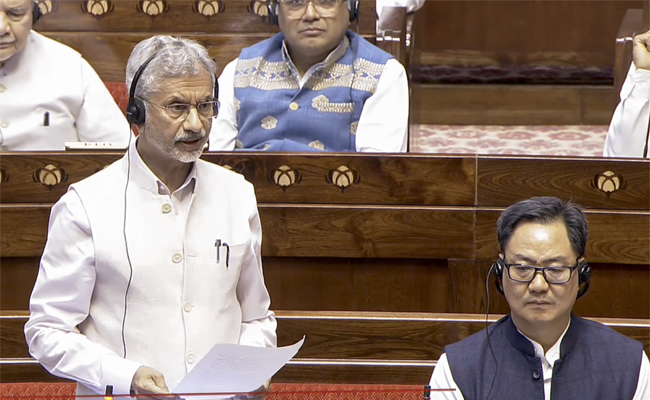
New Delhi (PTI): India advocates de-escalation and return to dialogue and diplomacy, External Affairs Minister S Jaishankar said on Monday on the widening West Asia conflict, while stressing on respect for sovereignty and territorial integrity of all states in the region.
Making a suo moto statement on the crisis that broke out on February 28 when the US and Israel launched military strikes on Iran and Tehran retaliated with attacks of US positions in the region as well as Israel, Subrahmanyam Jaishankar said safety of Indian nationals as well as national interests such as energy security and trade remain top most priority for the government.
"India is in favour of peace and urges a return to dialogue and diplomacy. We advocate de-escalation, restraint, and ensuring the safety of civilians," he said. "The wellbeing and security of the Indian community in the region is our priority. And our national interests, including energy security and trade, will always remain paramount."
India, Jaishankar said, expressed deep concern at the outset and urged all sides to exercise restraint, avoid escalation and prioritise civilian safety, stressing that dialogue and diplomacy remain the only viable path to resolve the crisis while respecting the sovereignty and territorial integrity of all states in the region.
Amid opposition MPs staging a walkout of the House after they vociferously put across their demand for a discussion on the issue, the minister said the government is closely monitoring the escalating conflict and has taken multiple steps to ensure the safety of Indian nationals in the region and safeguard the country's strategic interests, he said.
The latest round of hostilities that began on February 28 has seen fighting between Israel and the United States on one side and Iran on the other, along with attacks on several Gulf countries and significant casualties, including among Iran's leadership.
Jaishankar said the Cabinet Committee on Security met on March 1 under the chairmanship of Prime Minister Narendra Modi and reviewed the situation, including implications for regional security, economic activity and the safety of the large Indian community in the Gulf.
He noted that nearly one crore Indians live and work in Gulf countries, while few thousand are in Iran for study or employment, making regional stability critical for India. The Gulf is also central to India's energy security and trade, accounting for nearly USD 200 billion in commerce, he said.
The minister said attacks on merchant shipping have affected Indian seafarers, with casualties reported and one Indian mariner still missing.
Jaishankar said the government had issued a series of travel advisories since January, urging Indian nationals to avoid non-essential travel to Iran and advising those already there to remain in contact with the Indian embassy and follow safety precautions.
He said Indian diplomatic missions have assisted citizens with relocation and evacuation efforts, including helping some Indian nationals travel to neighbouring countries such as Armenia for onward return to India.
According to the minister, nearly 67,000 Indian nationals have returned from the region so far as the government facilitated additional commercial flights and other travel arrangements amid partial airspace openings.
The Ministry of External Affairs has also set up a dedicated control room to monitor the situation and respond to requests from Indian nationals, while the Directorate General of Shipping has created a quick response team to assist Indian seafarers.
Jaishankar said the Indian government has remained in close contact with regional leaders, with Prime Minister Modi speaking to the leaders of the UAE, Qatar, Saudi Arabia, Kuwait, Bahrain, Oman, Jordan, and Israel, all of whom assured the safety of the Indian community.
He added that India has also maintained diplomatic contact with the US and Iran, and he himself spoke with Iranian Foreign Minister Abbas Araghchi on February 28 and March 5.
"While attempts have been made, contacts with Iran at the leadership level are obviously difficult at this time. I have, however, spoken to (Iranian) Foreign Minister Araqi on 28th February and 5 March 2026. We will continue these high-level conversations in the coming days," he said.
The minister also informed the House that an Iranian vessel, IRIS Lavan, was docked at Kochi on March 4 after India granted permission for humanitarian reasons.
Jaishankar said the government remains committed to protecting India's energy security and economic interests amid the volatile situation.
Suo Motu Statement by EAM Dr S Jaishankar in Rajya Sabha on “The Situation in West Asia” (March 09, 2026) | Read full statement here: pic.twitter.com/oHekP766tz
— Press Trust of India (@PTI_News) March 9, 2026
Let the Truth be known. If you read VB and like VB, please be a VB Supporter and Help us deliver the Truth to one and all.
Bypoll results will decide the future of Congress in Karnataka: BJP leader Ashoka
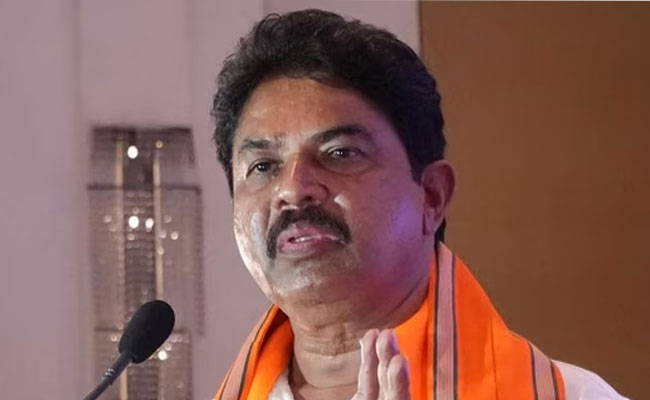
Bengaluru (PTI): Leader of Opposition BJP in the Karnataka Assembly R Ashoka said the results of the bypolls in Davanagere South and Bagalkote assembly constituencies will decide the future of the ruling Congress in the state.
The bypolls were necessitated following the demise of sitting Congress MLAs Shamanur Shivashankarappa and H Y Meti, who represented Davanagere South and Bagalkote constituencies respectively.
The ruling Congress has fielded Shamanur Shivashankarappa’s grandson and Karnataka Minister S S Mallikarjun’s son Samarth Shamanur in Davanagere South and Umesh Meti in Bagalkote, who are locked in a direct contest with BJP candidates T Dasakariyappa and Veerabhadrayya Charantimath.
According to Ashoka, there is a contest between the poor and the rich in the upcoming bypolls, scheduled on April 9.
"The Congress will lose this election, and the future of the state will be decided. Since Chief Minister Siddaramaiah has said ‘Make the poor win’, the BJP has fielded poor candidates,” the BJP leader said in a press conference.
In Davanagere, the BJP has given a ticket to an ordinary person, whereas Congress has given tickets to powerful and influential people. In Bagalkote, there is a very good opinion about the BJP candidate, he claimed.
According to him, the Congress has given space to dynastic politics in both places. Therefore, the BJP has a strong chance of winning in both constituencies.
The LoP said if the Congress candidate wins in Davanagere, it is understood that Muslims will not get opportunities in the future, and therefore, Muslims are opposing the Congress party.
He also charged that Chief Minister Siddaramaiah, who talks about uniting backward classes, has not given a ticket to backward class candidates.