India could face productivity loss equivalent to 34 million jobs in 2030 due to global warming: UN

United Nations: India is projected to lose 5.8 per cent of working hours in 2030, a productivity loss equivalent to 34 million full-time jobs, due to global warming, particularly impacting agriculture and construction sectors, a report by the UN labour agency said.
The International Labour Organization (ILO) released its report 'Working on a Warmer Planet - The Impact of Heat Stress on Labour Productivity and Decent Work' which said that by 2030, the equivalent of more than two per cent of total working hours worldwide is projected to be lost every year, either because it is too hot to work or because workers have to work at a slower pace.
"Projections based on a global temperature rise of 1.5 C by the end of the twenty-first century, and also on labour force trends, suggest that, in 2030, 2.2 per cent of total working hours worldwide will be lost to high temperatures - a productivity loss equivalent to 80 million full-time job," the report said.
It said that the accumulated global financial loss due to heat stress is expected to reach USD 2,400 billion by 2030.
"If nothing is done now to mitigate climate change, these costs will be much higher as global temperatures increase even further towards the end of the century," the report said.
Countries in Southern Asia are the most affected by heat stress in the Asia and the Pacific region and by 2030, the impact of heat stress on labour productivity is expected to be even more pronounced.
In particular, up to 5.3 per cent of total working hours (the equivalent of 43 million full-time jobs) are projected to be lost, with two-thirds of Southern Asian countries facing losses of at least two per cent.
In a dire warning, the report said that the country most affected by heat stress is India, which lost 4.3 per cent of working hours in 1995 and is projected to lose 5.8 per cent of working hours in 2030.
Because of its large population, India is in absolute terms expected to lose the equivalent of 34 million full-time jobs in 2030 in productivity as a result of heat stress.
"Although most of the impact in India will be felt in the agricultural sector, more and more working hours are expected to be lost in the construction sector, where heat stress affects both male and female workers," it said.
National-level GDP losses are projected to be substantial in 2030, with reductions in GDP of more than five per cent expected to occur in Thailand, Cambodia, India and Pakistan due to heat stress.
Heat stress is defined as generally occurring at above 35 degrees Celsius, in places where there is high humidity. Heat stress affects, above all, outdoor workers such as those engaged in agriculture and on construction sites. Excess heat at work is an occupational health risk and in extreme cases can lead to heatstroke, which can be fatal, the UN agency said.
The report also noted that the western Indian city of Ahmedabad incorporated a cool roofs initiative into its 2017 Heat Action Plan, notably by providing access to affordable cool roofs for the city's slum residents and urban poor, ie those who are most vulnerable to the health effects of extreme heat.
The initiative aims to turn the roofs of at least 500 slum dwellings into cool roofs, improve the reflectivity of roofs on government buildings and schools, and raise public awareness.
"The impact of heat stress on labour productivity is a serious consequence of climate change," said Catherine Saget, Chief of Unit in the ILO's Research department and one of the main authors of the report.
"We can expect to see more inequality between low and high-income countries and worsening working conditions for the most vulnerable."
With some 940 million people active in agriculture around the world, farmers are set to be worst hit by rising temperatures, according to the ILO data, which indicates that the sector will be responsible for 60 per cent of global working hours lost from heat stress, by 2030.
Construction will also be "severely impacted", with an estimated 19 per cent of global working hours lost at the end of the next decade, ILO says.
Other at-risk sectors include refuse collection, emergency services, transport, tourism and sports, with southern Asian and western African States suffering the biggest productivity losses, equivalent to approximately five per cent of working hours by 2030.
The report noted that a labour market challenge pertains to the high rates of informality in the region, particularly in Southern Asia and South-East Asia.
As many as 90 per cent of all workers in India, Bangladesh, Cambodia and Nepal work informally. Although the prevalence of informality can to a great extent be explained by the high share of employment in agriculture, informality is also pervasive in other sectors, including construction, wholesale and retail trade, and the accommodation and food service industries.
"Temperatures exceeding 39 C can kill. But even where there are no fatalities, such temperatures can leave many people unable to work or able to work only at a reduced rate. Some groups of workers are more vulnerable than others because they suffer the effects of heat stress at lower temperatures," the report said.
Older workers, in particular, have lower physiological resistance to high levels of heat and represent an increasing share of workers - a natural consequence of population ageing.
Let the Truth be known. If you read VB and like VB, please be a VB Supporter and Help us deliver the Truth to one and all.
Time of renewed hope: PM Modi greets people on Gudi Padwa
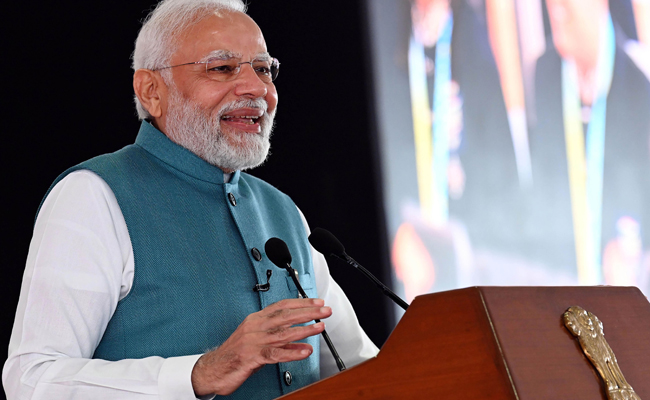
New Delhi (PTI): Prime Minister Narendra Modi on Thursday greeted the people of Maharashtra and Goa on the occasion of Gudi Padwa and said it symbolises the triumph of righteousness over adversity.
In identical letters to the people of the two western states, Modi said that as India continues its journey towards progress and self-reliance, the essence of Gudi Padwa becomes even more relevant.
"On the auspicious occasion of Gudi Padwa, I extend my heartfelt greetings to you and your family. This sacred festival, marking the beginning of the New Year, is a time of renewed hope and the promise of new beginnings," he said.
The prime minister said the 'gudi' (a symbolic flag hoisted at the entrance of households) stands as a symbol of victory, prosperity and optimism.
Gudi Padwa holds deep cultural and historical significance, he said.
"It symbolises the triumph of righteousness over adversity. It is also associated with the onset of spring, the season of rejuvenation," he added.
"Today, as India continues its journey towards progress and self-reliance, the essence of Gudi Padwa becomes even more relevant," Modi said.
The values Gudi Padwa embodies are the very values that guide everyone.
"In a rapidly changing world, these traditions anchor us, reminding us of our roots and what we stand for.
"Let us carry forward the spirit of Gudi Padwa throughout the year with renewed determination and a sense of purpose. May this New Year bring happiness, good health and prosperity to all," the PM said.