India expels Canadian diplomat in tit-for-tat move
New Delhi (PTI): India on Tuesday announced expulsion of a senior Canadian diplomat, in a tit-for-tat to Canada expelling an Indian official after alleging a "potential" Indian link to the killing of a Khalistani separatist leader in June.
Canadian High Commissioner to India Cameron MacKay was summoned to the Ministry of External Affairs (MEA) and informed about the decision to expel the senior Canadian diplomat.
The actions marked a further deterioration in India-Canada ties as they came days after both sides decided to pause their negotiations for a bilateral free trade agreement.
The relations between the two countries have been under strain over increasing activities of pro-Khalistani elements in Canada.
The MEA said the decision to expel the Canadian diplomat reflects India's growing concern at the "interference of Canadian diplomats in our internal matters and their involvement in anti-India activities"
"The concerned diplomat has been asked to leave India within the next five days," it said in a statement.
Earlier in the day, India outrightly rejected as "baseless" Canadian Prime Minister Justin Trudeau's claim of a "potential link" between Indian government agents and the killing of Khalistani separatist leader Hardeep Singh Nijjar in June
After Trudeau made the comments in Parliament, Canadian Foreign Minister
M lanie Joly announced that a "top Indian diplomat" has been expelled from Canada.
Joly's office said that the diplomat is Pavan Kumar Rai, the head of the Research and Analysis Wing (RAW), according to Canadian broadcaster CBC news.
In a statement in Parliament, Trudeau claimed that there were "credible allegations of a potential link" between Indian government agents and the killing of Khalistani leader Hardeep Singh Nijjar in June.
In strong reaction, the MEA said the allegations of the Government of India's involvement in any act of violence in Canada are "absurd and motivated".
"We have seen and reject the statement of the Canadian prime minister in their Parliament, as also the statement by their foreign minister," it said.
It said "such unsubstantiated allegations seek to shift the focus from Khalistani terrorists and extremists, who have been provided shelter in Canada and continue to threaten India's sovereignty and territorial integrity."
"The inaction of the Canadian Government on this matter has been a long-standing and continuing concern," the MEA said.
The MEA said similar allegations were made by the Canadian Prime Minister to Prime Minister Narendra Modi, and were completely rejected," it said.
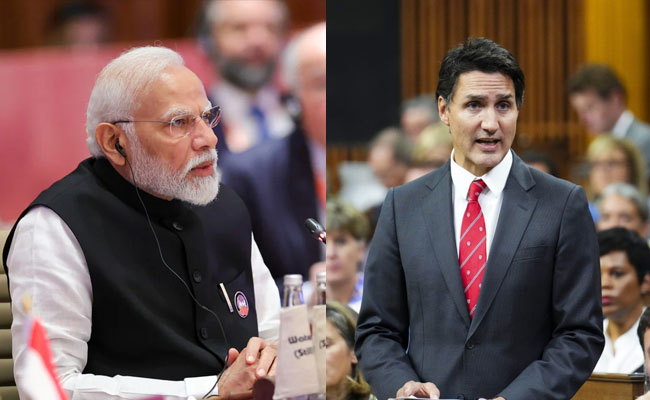
Prime Minister Modi and Trudeau had a bilateral meeting on September 10 on the sidelines of the G20 Summit in Delhi.
"We are a democratic polity with a strong commitment to rule of law," the MEA said.
It said Canadian political figures have "openly expressed sympathy" for such elements and that remains a matter of deep concern.
"The space given in Canada to a range of illegal activities including murders, human trafficking and organised crime is not new," the MEA said.
"We reject any attempts to connect Government of India to such developments," it said.
"We urge the Government of Canada to take prompt and effective legal action against all anti-India elements operating from their soil," it added.
In a statement in the House of Commons on Monday, Trudeau said Canadian security agencies have been "actively pursuing credible allegations of a potential link between agents of the Government of India and the killing of a Canadian citizen, Hardeep Singh Nijjar."
"Any involvement of a foreign government in the killing of a Canadian citizen on Canadian soil is an unacceptable violation of our sovereignty," he said.
In his talks with Trudeau' on September 10, Modi conveyed India's strong concerns about continuing anti-India activities of extremist elements in Canada as they are promoting secessionism and inciting violence against Indian diplomats and threatening the Indian community there.
Let the Truth be known. If you read VB and like VB, please be a VB Supporter and Help us deliver the Truth to one and all.
26-year-old youth from Andhra dies by suicide in US
Kurnool (Andhra Pradesh) (PTI): A 26-year-old youth from this district has died allegedly by suicide in Chicago, US, recently, due to distress over debt, sources said on Saturday.
The family members of the deceased have requested that the identity of their relative be withheld, noting that his parents are senior citizens suffering from medical conditions.
Reacting to the incident, Andhra Pradesh IT Minister Nara Lokesh expressed condolences and assured assistance for the repatriation of the mortal remains of the deceased.
"My heartfelt condolences to the bereaved family. I request Union Aviation Minister K Ram Mohan Naidu to ensure smooth and hassle-free transport of the mortal remains," Lokesh said in a post on X.
An NRI community member from the US posted on social media that one of their members from Kurnool on Optional Practical Training (OPT) passed away in Chicago a few days ago.
He said Telugu Association of North America (TANA) had completed all necessary documentation and formalities to send the mortal remains to India for final rites.
He further requested assistance in expediting the cargo pickup, currently scheduled for Sunday, seeking an earlier arrangement considering the urgency.
(Assistance for overcoming suicidal thoughts is available on the state’s health helpline 104, Tele-MANAS 14416.)