Canada expels Indian diplomat as it investigates India's possible link to Sikh activist's slaying
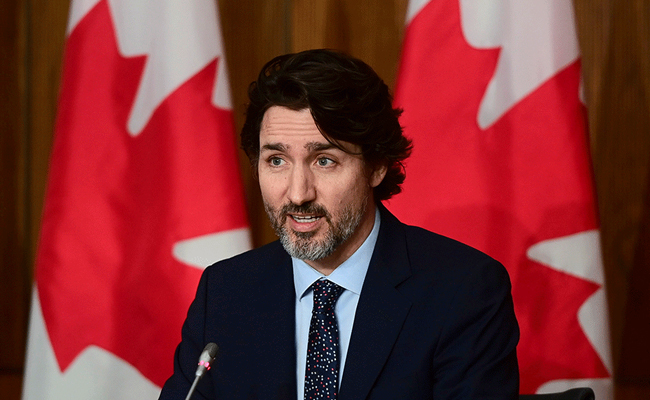
Toronto (AP): Canada said it was expelling a top Indian diplomat Monday as it investigates what Prime Minister Justin Trudeau called credible allegations that India's government may have had links to the assassination in Canada of a Sikh activist.
Trudeau said in Parliament that Canadian intelligence agencies have been looking into the allegations after Sikh leader Hardeep Singh Nijjar, a strong supporter of an independent Sikh homeland known as Khalistan, was gunned down on June 18 outside a Sikh cultural centre in Surrey, British Columbia.
Trudeau told Parliament that he brought up the slaying with Indian Prime Minister Narendra Modi at the G-20 last week, that he told Modi that any Indian government involvement would be unacceptable and that he asked for cooperation in the investigation.
Canadian Foreign Minister M lanie Joly said the head of Indian intelligence in Canada has been expelled as a consequence. "If proven true this would be a great violation of our sovereignty and of the most basic rule of how countries deal with each other," Joly said. "As a consequence we have expelled a top Indian diplomat."
The Indian Embassy in Ottawa did not immediately answer phone calls from The Associated Press seeking comment.
"Over the past number of weeks Canadian security agencies have been actively pursuing credible allegations of a potential link between agents of the government of India and the killing of a Canadian citizen, Hardeep Singh Nijjar," Trudeau said.
Trudeau said Canada has declared its deep concerns to the Indian government.
"Last week at the G-20 I brought them personally and directly to Prime Minister Modi in no uncertain terms," Trudeau said. "Any involvement of a foreign government in the killing of a Canadian citizen on Canadian soil is an unacceptable violation of our sovereignty."
Trudeau said his government has been working closely and coordinating with Canada's allies on the case.
"In the strongest possible terms I continue to urge the government of India to cooperate with Canada to get to the bottom of this matter," he said.
Trudeau said he knows there are some members of the Indo-Canadian community who feel angry or frightened, and he called for calm.
Opposition Conservative leader Pierre Poilievre said if the allegations are true they represent "an outrageous affront to our sovereignty."
The Khalistan movement is banned in India, where officials see it and affiliated groups as a national security threat. But the movement still has some support in northern India, as well as beyond, in countries like Canada and the United Kingdom which are home to a sizable Sikh diaspora.
Let the Truth be known. If you read VB and like VB, please be a VB Supporter and Help us deliver the Truth to one and all.
MP boat tragedy: Death toll rises to 10 with recovery of one more body; 3 tourists still missing
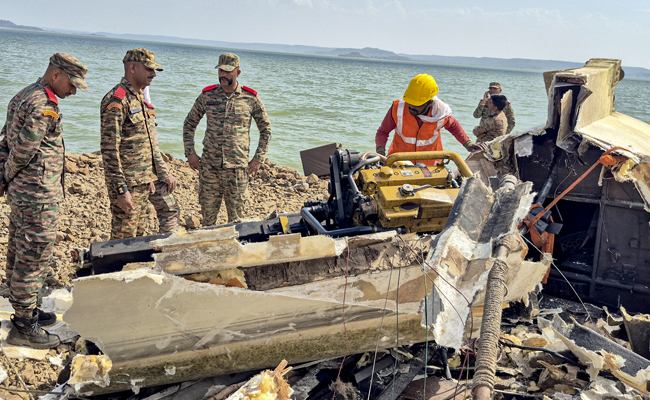
Jabalpur (PTI): The body of a child was retrieved on Saturday evening from Bargi Dam in Jabalpur district of Madhya Pradesh, raising the death toll in the cruise boat tragedy that took place two days ago to ten, while search continued for three missing tourists.
The boat, operated by the state tourism department, capsized during a storm on Thursday evening with some of the survivors alleging negligence and safety lapses such as life jackets not being distributed in time.
The body recovered on Saturday evening was possibly that of six-year-old Viraj Soni, said Sub-Divisional Officer of Police (SDOP) Anjul Ayank Mishra.
"The identity will be confirmed after family members identify the body," he told PTI.
Kamraj, an employee of the Ordnance Factory at Khamaria, his five-year-old son Tamil, and another child Mayuram (5) who had come from southern India were still missing.
Authorities have arranged equipment to search deep waters of the dam and are getting a generator to facilitate diving operations, Mishra added.
Divers and disaster response teams have expanded the search radius to five km, he said.
Of the 41 identified passengers on board the ill-fated vessel, 28 were rescued, police said.
More than 200 rescuers, including around 20 Army divers airlifted from Agra, joined the search operation that resumed at 5 on Saturday morning. The operation, involving the National Disaster Response Force, State Disaster Response Force and local divers, was briefly affected at around 9 am due to strong winds, officials said.
Post-mortem examinations of nine deceased persons have been completed, Mishra said.
"Our priority is to search for the missing persons. We will also register a First Information Report in the case soon," he said.
Police said CCTV footage near the boarding point showed 43 people heading towards the boat while the identities of 41 passengers have been confirmed so far.
The state government on Friday ordered a probe into the tragedy and dismissed three crew members. It also banned operation of similar vessels in the state.