India has efficiently managed situation arising out of Gulf war, Cong trying to spread panic: PM
Gandhinagar/Sanand/Tharad (PTI): As the West Asia war rages, India has successfully kept the situation under control with its strong foreign policy and collective strength of citizens, Prime Minister Narendra Modi said on Tuesday and accused the Congress of attempting to exploit the
conflict for domestic political gains.
Like "Rajneeti ke gidh" (vultures of politics), the Congress is attempting to exploit the West Asia conflict by triggering panic among people for political gains though India has managed the situation arising out of the more than month-long war effectively, he asserted.
During his day-long visit to Gujarat, the PM travelled to Gandhinagar, Sanand and Vav Tharad district and inaugurated a semiconductor plant, museum and addressed gatherings. He inaugurated and laid foundation stones for development projects totalling Rs 19,806.9 crore during the visit.
Addressing a large gathering at Nani village in the newly created Vav Tharad district, Modi accused Congress of indulging in rumour-mongering and trying to instigate people to queue up at fuel pumps and spread public disorder.
"Today, when the nation requires unity and solidarity, Congress leaders are actively engaged in divisive politics. When the nation needs reassurance, the Congress is busy spreading fear and rumours. When the nation calls for restraint, the Congress wants to incite people," Modi stated.
Referring to the global situation, Modi said while many countries are engulfed in war, unrest and instability, India has demonstrated resilience and unity.
"India has always possessed a unique strength. No matter how difficult the times may be, our nation stands united," he said.
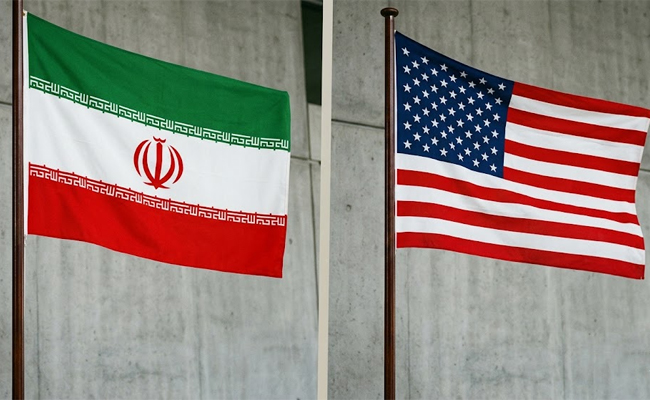
Referring to the West Asia situation triggered by the joint US-Israel attacks on Iran on February 28, , Modi noted the conflict has widespread global repercussions, especially on energy supplies.
"Difficulties regarding energy requirements, especially diesel, petrol and gas, have intensified globally. Yet, even amidst such a crisis, India has successfully kept the situation under control with its strong foreign policy and collective strength of its citizens," the Prime Minister added.
He said attempts by some political parties to score political points during a global crisis were unfortunate, and at the forefront of this political conspiracy is the Congress party.
Modi pointed out that while fuel prices have surged by 10 to 25 per cent in many countries, India has ensured that its people are protected from the impact of rising crude rates.
During his visit to Sanand in Ahmedabad district, Modi inaugurated Kaynes Semicon's outsourced semiconductor plant, and said India is strengthening its role as a reliable chip supplier in the global market.
He noted the 21st Century has brought several challenges and global supply chains have been affected due to conflicts, emphasising that his government is laying a strong foundation for technology and energy security in the coming decades.
Addressing a gathering at Sanand, Modi emphasised India is actively building a robust semiconductor ecosystem and simultaneously making significant efforts to establish a resilient supply chain for raw materials.
"India is actively building a robust semiconductor ecosystem and simultaneously making significant efforts to establish a resilient supply chain for raw materials. India's participation in Pax Silica is a testament to this very endeavour. Working in tandem with our global partners, we aim to ensure a secure supply chain," Modi added.
India recently joined Pax Silica, a US-led strategic coalition launched in December 2025 to secure critical technology supply chains, with a special focus on semiconductors, AI, and rare earth elements.
"Furthermore, to achieve self-reliance in critical minerals, India has launched the National Critical Minerals Mission," Modi stated.
The PM referred to the announcement of a 'rare earth corridor' in this year's Budget, encompassing coastal states such as Odisha, Andhra Pradesh, Tamil Nadu, and Keralam.
"This corridor will serve as an integrated network, forging a robust value chain spanning mining, refining, and manufacturing. Our objective is to establish a national reserve of critical minerals within the country," he maintained.
Observing that India is leading the world in terms of AI adoption, Modi stated that Indians explore technology, and that the success of Digital India and the excellent work being done in Fintech shows Indians' trust in technology.
"India's AI ecosystem stands to benefit significantly from the emergence of our semiconductor ecosystem. The India of the 21st century is moving forward not merely as a witness to change, but with a firm resolve to lead that change. Our policies and decisions are laying a strong foundation for the technology and energy security of the coming decades," he said.
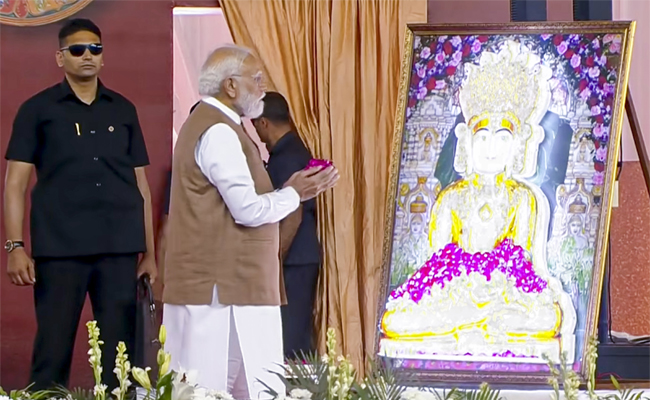
Earlier in the day, the PM inaugurated the Samrat Samprati Museum, located on Shri Mahavir Jain Aradhana Kendra campus at Koba village near Gandhinagar, on the occasion of Mahavir Jayanti.
Speaking on the occasion, Modi noted the newly built museum sends a strong message of peace and non-violence at a time when the world is "engulfed in the flames of instability and unrest".
Referring to the current global situation, Modi said the legacy and message of the museum are significant not just for India but for entire humanity.
"Given the current global scenario - the way the world is being scorched in the fires of instability and unrest - the legacy and message of this museum hold immense significance," he said.
The museum reflects India's core strength of diversity and unity, bringing together traditions such as the Vedas, Puranas, Ayurveda, Yoga and other philosophical streams, the PM noted.
Let the Truth be known. If you read VB and like VB, please be a VB Supporter and Help us deliver the Truth to one and all.
Min. Priyank Kharge to expresses concern over implementation of VB-G Ram G
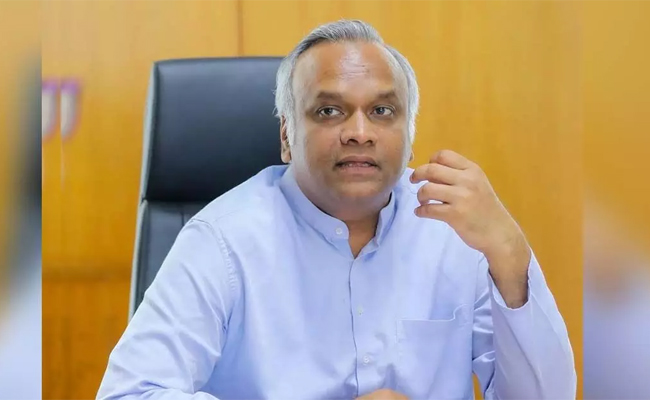
Bengaluru: Rural Development and Panchayati Raj Minister Priyank Kharge has expressed concern over the uncertainty surrounding the implementation of the proposed VB-G Ram G scheme, stating that the MNREGA programme, which has been a lifeline for rural India for nearly two decades, appears to be facing an uncertain future.
Speaking to media, Kharge said that as March 31 draws to a close, there is no clarity on the rollout of the new scheme from April 1. He pointed out that the central government has not yet issued the necessary guidelines for implementing the scheme for rural workers and villages.
He criticised the Centre for its lack of preparedness, stating that there is no clarity on fund allocation, no final parameters for classifying gram panchayats, and key processes such as social audits have not been defined.
Kharge said the situation comes at a critical time, as summer marks a peak period for rural employment demand, when many people depend heavily on wage employment for their livelihood.
He added that reports have emerged of delays in approvals and families not receiving work despite demand.
He further alleged that the Centre’s move to shift from a statutory employment guarantee to a rule-based allocation system is already showing negative consequences.
Kharge also raised concerns over provisions such as a mandatory 60-day halt during agricultural seasons, which he said would further limit employment opportunities for rural workers.
The BJP-led central government had claimed that the new scheme would transform rural India, but in reality it is turning out to be detrimental to people’s livelihoods, he said.
“The crisis in rural India due to the stalling of MNREGA is beginning to unfold. Given the Centre’s past record in handling such situations, there is growing concern over the impact on rural livelihoods,” Kharge said.