India most attractive destination for global investors: Rajnath
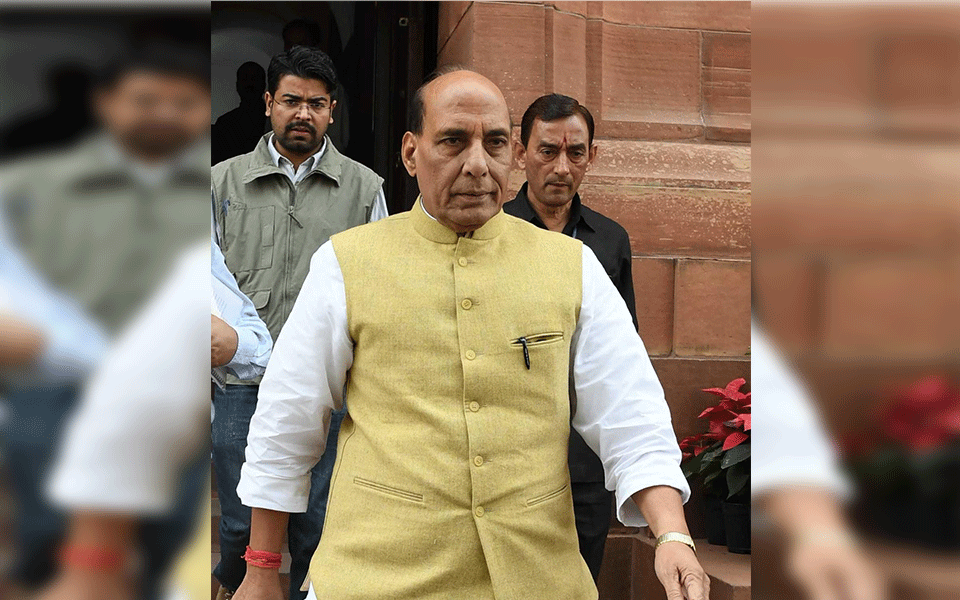
New Delhi, July 23 : India has become the most attractive destination for global investors and its GDP growth has moved much ahead of the inflation rate, Union Home Minister Rajnath Singh said on Monday.
Speaking at a meeting of the Confederation of All India Traders (CAIT) here, he admitted that there were some problems with demonetisation and the implementation of the Goods and Services Tax (GST) but issues have now been sorted out and people are aware of the benefits of the two moves.
"India's GDP (Gross Domestic Product) had been half of the inflation rate four years ago. But it has gone up rapidly in the last four years. The GDP rate now has moved much ahead of the current inflation rate. There has not been a single moment in the last four years when the GDP growth was lower than the inflation rate.
"This is a big difference you can see now," he said.
Asserting that India has now become the most attractive destination for world's investors, he said: "India has received more than $150 billion FDI (Foreign Direct Investment) in last four years. There was a time four years ago when only two mobile factories were running in India. Now, the number of these factories has reached to 120."
This is an indication that the whole world has belief and confidence in India's economy, said the senior BJP leader, adding India has gained a new height in the ease of doing business and it jumped from 142 to 100th place.
Citing a survey by a reputed consultancy, the Minister said India was ranked 9th among the world's top 10 economies in 2014 and had raced ahead of France to emerge as the top six.
"I am confident, as economists predict, in the next two-three years India's economy will be among the top five. With this pace of GDP growth, by 2030 we will break into the world's top three economies."
In four years of our government, there has been drastic financial inclusion as the people living in huts have been the part of economy because of opening of their bank accounts. "Fifty-five per cent of the total bank accounts opened across the world are in India only."
Describing the benefits of government's digitisation scheme, Rajnath Singh said subsidies of 431 government-run schemes amounting to over Rs 365,000 crore have been transferred to the bank accounts of beneficiaries through Digital Payment Direct Transfer policy so that mediators could not do any wrong doings.
Stating that the GST rates have recently been slashed on several items and that many have been brought under zero and 5 per cent slabs, Rajnath Sigh said the government is open to further review of the slabs.
"Out of 6.5 crore retail traders, around 1.25 crore have registered under the GST. As per the Economic Survey, more than 1.15 crore returns have been filed during November 2016-2017. GST is a major taxation reform in the country where only 6.10 crore people are under the taxation regime out of over 130 crore population," he said.
Underlining traders as strong pillars in the country's economy, the Minister sought the cooperation of the trading community to realise the Prime Minister's dream of doubling India's economy by 2022 and urged them to unite with the farmers so that no political party could avoid them.
Taking a veiled dig at former Prime Minister Manmohan Singh, Rajnath Singh said economic growth was dependent on a realistic, not economist, Prime Minister.
"There is no lack of economic potential in India. This potential was observed by our former Prime Minister Atal Bihari Vajpayee. Our incumbent Prime Minister Narendra Modi also observed it and has been trying his best to do in that direction. Neither Atalji was economist nor Modiji is. There is no need to be an economist to give country's economy a new height. It is necessary to be realistic," Rajnath Singh said.
"In my view, no matter if Prime Minister and the people sitting in the government are not economists, they should be realistic. The country can grow fast if they are realistic," he said.
Let the Truth be known. If you read VB and like VB, please be a VB Supporter and Help us deliver the Truth to one and all.
4 workers die after being buried under coal slurry in Jharkhand's Dhanbad

Dhanbad (Jharkhand) (PTI): At least four workers died after being buried under coal slurry in Jharkhand's Dhanbad district on Saturday, a police official said.
The incident took place at Moonidih coal washery in the command area of Bharat Coking Coal Limited (BCCL).
"Bodies of all four workers were dug out of debris during a rescue operation," Putki police station in-charge Waqar Hussain told PTI.
The incident took place when coal slurry was being loaded into trucks by workers, during which a large chunk of slurry fell and trapped several workers underneath, officials said.
The deceased have been identified as Manik Bauri, Dinesh Bauri, Deepak Bauri, and Hemlal Gope.
Meanwhile, the family members of the deceased and local villagers placed the bodies in front of the washery gate and began a protest.
They demanded compensation, jobs for dependents and action against those responsible for the incident.
Police and administration officials are trying to pacify the protesters, an official said.