India safe as long as its brave soldiers stand guard at borders: Modi to security forces on Diwali
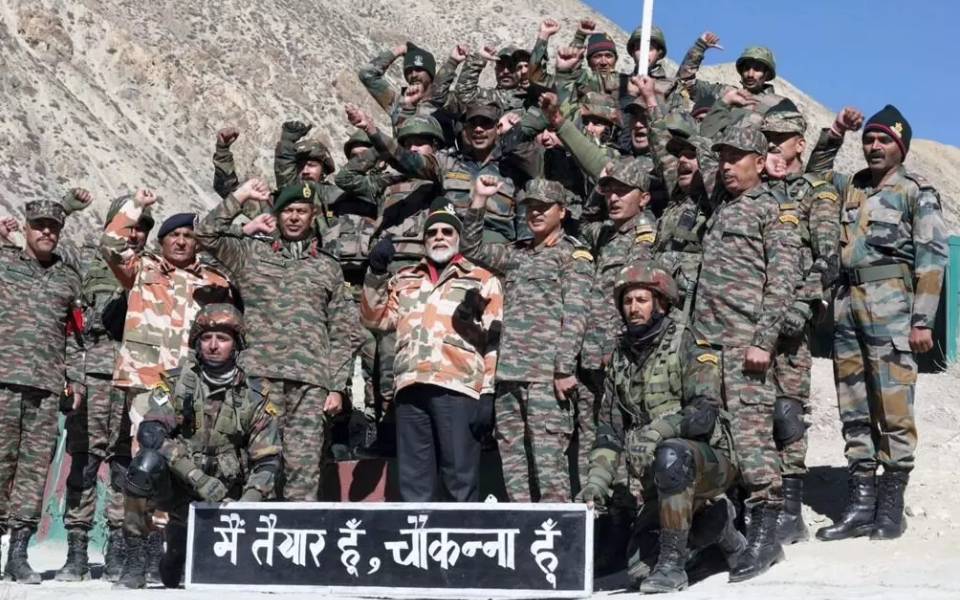
Lepcha (HP), Nov 12: Prime Minister Narendra Modi on Sunday said security forces have a big role in maintaining peace and keeping India's borders safe at a time of rising global expectations from the country, as he flew to Lepcha in Himachal Pradesh to spend his Diwali with soldiers.
Keeping with his annual practice of spending time with personnel of the armed forces on Diwali, Modi also asserted that India is fast emerging as a big global player in the defence sector and the capabilities of its security forces are constantly rising.
Global circumstances are such that the expectations from India are also constantly rising, the prime minister said.
"At such an important time, it is necessary that India's borders are protected and there is an environment of peace in the country, and you have a big role in this," Modi, dressed in Indo-Tibetan Border Police (ITBP) fatigues, said.
"India is protected till the time my bravehearts are standing on the borders, unflinching as the Himalayas," the prime minister said. He added that after independence, "these bravehearts (Army personnel) fought so many wars and won the country's heart...Our jawans have snatched victory in the face of challenges".
"It is said that 'parv' is where the 'parivaar' is. On festivals, being away from the family and deployed on the borders exemplifies the commitment to duty. The country is indebted to you," Modi told soldiers.
"Therefore, on Diwali, one 'diya' is for your safety, and in every prayer, people wish for your safety," the prime minister said, noting that for 30-35 years he has been travelling to border areas on Diwali to celebrate the festival with soldiers.
Modi noted that he has been doing it since long before he was either prime minister or chief minister. "The place where jawans are posted is no less than any temple for me. Wherever you are, my festival is there," he said.
India's soldiers have always walked ahead, risking their lives, and have always proven that they are the "strongest wall" at the borders, he said.
"For me, a place where our security forces are deployed is no less than a temple," Modi said.
The prime minister also hailed the role played by the armed forces in evacuations from violence-hit areas, and saving lives in earthquake-hit areas and during other calamities.
"When we had to pull out people from Sudan, India's bravehearts completed the mission with courage. When there was an earthquake in Turkiye, they risked their lives to save people," Modi said.
Wherever Indians are in danger, security forces are always committed to ensuring their safety, he asserted. "We are proud of our forces and soldiers," Modi added.
The prime minister also listed the achievements in the last one year since the last Diwali and mentioned the Chandrayaan landing, Aditya L1, test related to Gaganyaan, indigenous aircraft carrier INS Vikrant, Tumkur helicopter factory, Vibrant Village campaign and sporting achievements.
Highlighting global and democratic gains India made in the last one year, Modi also listed the inauguration of the new Parliament building, passage of the Narishakti Vandan Adhiniyam (women's reservation bill), organising the G20, biofuel alliance, preeminence in real-time payment in the world, crossing USD 400 billion in exports, becoming the fifth biggest economy of the world and strides in 5G roll out.
"The past year is a milestone year in nation building," Modi said.
He also pointed out that India made great strides in infrastructure development and became the country with the world's second largest road network and longest river cruise service.
The prime minister also highlighted the India-Middle East-Europe Corridor decision, two world-class convention centres in Delhi - Bharat Mandapam and Yashobhoomi being opened and India becoming the country with the highest number of universities.
Noting that India has created possibilities from its struggles, Modi said that the nation has now stepped on the path of Atmanirbhar Bharat.
He highlighted India's unprecedented growth in the defence sector and its emergence as a global player, and said that the strength of India's armies and security forces is continuously increasing.
He recalled how the nation was dependent on others for the smallest needs earlier, while it is meeting the needs of friendly nations today.
Modi said India's defence exports have increased more than eight times since his visit to the region in 2016 to celebrate Diwali with soldiers.
"Defence production worth more than Rs 1 lakh crore is taking place in the country today. This is a record in itself," he added.
"Today, indigenous resources and top-class border infrastructure are also becoming our strength. And, I am happy that Narishakti is also playing a big role in this," Prime Minister Modi said.
He pointed out the commissioning of 500 women officers during the past year, women pilots flying Rafale fighter jets and the posting of women officers on warships.
The prime minister also said that every step by the armed forces determines the direction of history. He expressed confidence that the armed forces will continue to serve Mother India with the same determination.
"With your support, the nation will continue to touch new heights of development. Together we will fulfil every resolution of the country," he said.
"I wish the people of the country from the last village, which I call the first, where I am celebrating Diwali with security forces. The greetings on Diwali from here are special," the prime minister said.
The prime minister arrived in Lepcha in the morning to celebrate Diwali with security forces. He shared photographs of his interaction with soldiers. Modi was seen offering them sweets.
In his post on X, Modi said, "Spending Diwali with our brave security forces in Lepcha, Himachal Pradesh, has been an experience filled with deep emotion and pride."
"Away from their families, these guardians of our nation illuminate our lives with their dedication," he said.
"The courage of our security forces is unwavering. Stationed in the toughest terrains, away from their loved ones, their sacrifice and dedication keep us safe and secure," the prime minister added.
India will always be grateful to these heroes who are the perfect embodiment of bravery and resilience, Modi said in another post.
Since coming to power in 2014, Modi has been visiting military facilities to celebrate Diwali.
In 2014, the prime minister celebrated the festival of lights with soldiers at the Siachen Glacier. In the following year, on the 50th anniversary of the 1965 war with Pakistan, Modi visited three memorials in Punjab where the Indian armed forces had fought pitched battles that proved to be key to the country's victory.
In 2016, the prime minister travelled to Himachal Pradesh to meet the personnel of the Indo-Tibetan Border Police, the Dogra Scouts and the Army at Sumdoh near the China border. In 2017, Modi was in the Gurez sector in north Kashmir, while in 2018, he celebrated Diwali in Harsil, Uttarakhand, which was followed by a visit to Kedarnath.
After being re-elected to the high office in 2019, Modi celebrated Diwali in Rajouri in Jammu and Kashmir. In 2020, he was at a border post of Longewala on Diwali and in 2021, he celebrated the festival with soldiers in Nowshera. The prime minister celebrated Diwali with the armed forces in Kargil last year.
Let the Truth be known. If you read VB and like VB, please be a VB Supporter and Help us deliver the Truth to one and all.
Bengaluru Police bust major drug network; 16 arrested, narcotics worth Rs 36.67 crore seized

Bengaluru: In a major crackdown on drug trafficking and illegal narcotics trade, Bengaluru City Police have arrested 16 accused persons and seized narcotic substances worth Rs 36.67 crore.
According to Bengaluru City Police Commissioner Seemanth Kumar Singh, those arrested include four foreign nationals, eight persons from other states and four locals. Police said the network had interstate as well as international links.
Police recovered 9 kg 64 grams of MDMA, 5 kg 195 grams of hydro ganja, 19,755 LSD strips, 156 grams of heroin, 618 grams of charas, 332 grams of cocaine, 315 grams of drug-mixed gummies and 11 kg 470 grams of ganja from the accused.
The Commissioner said the action was carried out as part of a major anti-drug operation in the city. The network was busted with the support of the CCB Narcotics Control Squad and police stations of Bagaluru, Adugodi, Chikkajala, HSR Layout, Yeshwanthpur, Jalahalli and Jnanabharathi.
Cases were registered in CCB, East Division and West Division police stations based on specific intelligence received on different dates, following which raids were conducted.
Preliminary investigation revealed that the accused were procuring drugs at lower prices from foreign, interstate and local sources and selling them in Bengaluru at higher rates.
Police said college students and working professionals were among the main targets of the accused.