India's first privately built rocket set for November 15 launch
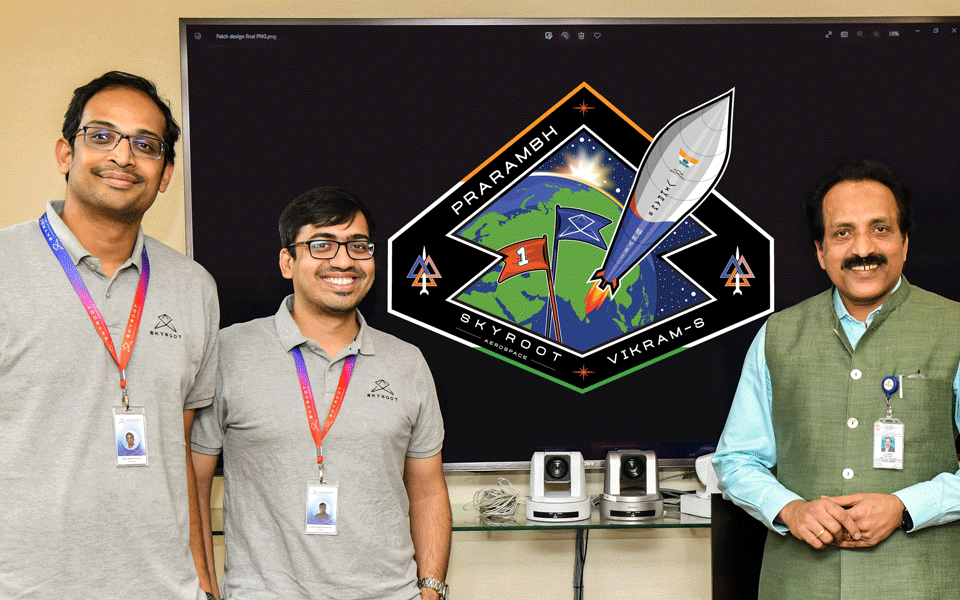
New Delhi (PTI): India's first privately developed rocket -- Vikram-S -- is set for a November 15 launch on a sub-orbital mission with three payloads, Hyderabad-based space startup Skyroot Aerospace has announced.
The maiden mission of Skyroot Aerospace, named 'Prarambh' (the beginning), will carry payloads of two Indian and one foreign customers and is set for launch from the Indian Space Research Organisation's launchpad at Sriharikota.
"Heartbeats quicken. All gazes are up to the sky. The earth is listening. It all points to 15 Nov 2022 for launch," Skyspace Aerospace said on Friday.
The launch is scheduled for 11:30 am, Skyroot Aerospace CEO and co-founder Pawan Kumar Chandana had told PTI.
Spacekidz, a Chennai-based aerospace startup, will fly 'Fun-Sat', a 2.5 kg payload developed by students from India, the US, Singapore and Indonesia on the sub-orbital flight on board Vikram-S.
With this mission, Skyroot is set to become the first private space company in India to launch a rocket into space, heralding a new era for the space sector which was opened up in 2020 to facilitate private sector participation.
Skyroot's launch vehicles are named 'Vikram' as a tribute to the founder of the Indian space programme and renowned scientist Vikram Sarabhai.
Based in Hyderabad, Skyroot was the first startup to sign a memorandum of understanding with ISRO for launching its rockets.
It aims to disrupt entry barriers to cost-efficient satellite launch services and space-flight by advancing its mission to make spaceflights affordable, reliable and regular for all, the statement said.
Set up in 2018, Skyroot has successfully built and tested India's first privately developed cryogenic, hypergolic-liquid, and solid fuel-based rocket engines using advanced composite and 3D-printing technologies.
Skyroot Aerospace successfully raised USD 51 million through a Series-B financing round, in September this year. It had raised USD 11 million in Series-A capital raise in July last year.
Let the Truth be known. If you read VB and like VB, please be a VB Supporter and Help us deliver the Truth to one and all.
EAM Jaishankar meets Jamaican PM, gifts over 10 BHISHM Cubes
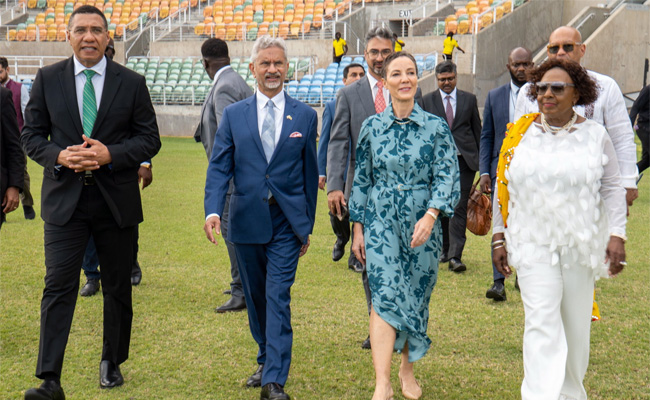
Kingston (PTI): External Affairs Minister S Jaishankar on Monday met Jamaican Prime Minister Andrew Holness and discussed ways to further deepen "political, economic and people-to-people cooperation."
Jaishankar also conveyed greetings from Prime Minister Narendra Modi to Holness.
"Pleased to call on Prime Minister @AndrewHolnessJM in Kingston. Conveyed the greetings of PM @narendramodi," Jaishankar posted on X.
"Discussed deepening our political, economic and people-to-people cooperation. Value his commitment towards further strengthening India-Jamaica relations," the post further read.
Also, the external affairs minister handed over 10 BHISHM (Bharat Health Initiative for Sahyog Hita & Maitri) Cubes as a gift to Jamaica.
"Formally handed over 10 BHISHM Cubes as a gift from India to Jamaica, in the presence of PM @AndrewHolnessJM, Health Minister @christufton and FM @kaminajsmith," Jaishankar posted on X.
"The BHISHM Cube mobile hospital system, designed for rapid deployment, will help Jamaica during disasters and emergencies. The gift of these cubes is a statement of friendship, a commitment to disaster preparedness, and an outcome of innovation," the post said.
Jaishankar arrived in Kingston on Saturday evening, marking the first leg of his nine-day tour of Jamaica, Suriname, and Trinidad and Tobago, aimed at further strengthening India's strategic and cultural ties with the Caribbean nations.
Earlier in the day, he interacted with the Indian diaspora and discussed India's ongoing transformation in infrastructure, human development and technology-driven governance and entrepreneurship with them.
He also highlighted the cricket bond between both countries as India gifted a scoreboard to Jamaica.
A scoreboard was dedicated at Sabina Park in Kingston. It is the home of the Jamaica cricket team and is the only Test cricket ground in the Caribbean island nation.
The minister expressed hope that the new scoreboard would witness many memorable innings, including those symbolising the enduring friendship between the two countries.
Cricket has long been a strong cultural bridge between India and Jamaica, which is part of the West Indies cricket team.
Jamaican players, including Chris Gayle, Courtney Walsh and Michael Holding, have played a major role in shaping the legacy of West Indies cricket in the international arena, contributing to its dominance in earlier decades and its continued global appeal.