India's hospitality industry icon PRS Oberoi no more
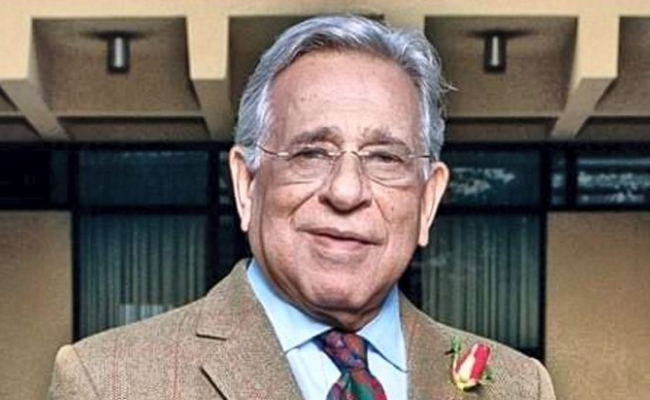
New Delhi (PTI): Prithvi Raj Singh Oberoi, the 94-year-old veteran corporate hotelier who redefined India's hospitality industry, passed away on Tuesday.
The Chairman Emeritus of The Oberoi Group, popularly known as 'Biki', built a sprawling chain comprising 32 hotels during his lifetime. EIH owns the eponymous Oberoi and Trident hotel chains.
Son of late Rai Bahadur MS Oberoi, the founder of The Oberoi Group, PRS Oberoi had also been instrumental in developing the Trident chain of hotels. His father, the man who started it all in 1934, passed away in 2002 and Tilak Raj, his older son, reportedly died prematurely in 1984.
Since then, PRS Oberoi steered the hospitality chain through its ups and downs. A hotel magnate who embodied fine living, his death brings to an end two generations of the family that built the Oberoi empire into an Indian hospitality powerhouse.
"It is with deep sadness that we inform the peaceful passing of PRS Oberoi, Chairman Emeritus of The Oberoi Group, earlier today. A luminary in the hospitality industry, Oberoi's legacy transcends borders, leaving an indelible mark on the global landscape," a statement said.
PRS Oberoi was born in New Delhi on February 3, 1929. He served as chairman of the company since 1988 until he stepped down in May last year due to ill health.
"PRS Oberoi has decided to relinquish his position as chairman and director of the EIH Associated Hotels Ltd effective May 2, 2022 due to his deteriorating health," a press release had said that time.
Under his leadership, the company expanded from its first hotel, 'The Trident Chennai', that opened in 1988, to become one of India's most reputable hotel companies.
He is reportedly survived by three children, son Vikramjit Singh Oberoi -Managing Director and Chief Executive Officer of EIH Hotels, and daughters Natasha and Anastasia.
In 2014, it was reported that PRS Oberoi decided not to choose his successor to run EIH Ltd, after years of intense speculation over who he would choose as successor, son Vikramjit or nephew Arjun, who currently serves as Executive Chairman of EIH Ltd. Arjun is the son of PRS Oberoi's late elder brother, Tilak Raj.
A recipient of India's second highest civilian honour -- Padma Vibhushan -- in 2008, PRS Oberoi was also awarded the 'Corporate Hotelier of the World' by HOTELS magazine in 2010.
PRS Oberoi was educated in India, the UK and Switzerland. In addition to providing leadership for the management of luxury hotels in several countries, he had been instrumental in pioneering the development of Oberoi Hotels and Resorts.
The Oberoi brand has come to represent fine luxury hotels. Business India magazine adjudged PRS Oberoi the Businessman of the Year 2008. He received this award for building a world-class premium hospitality brand. In November 2008, he was conferred the Lifetime Achievement Award at the Ernst & Young Entrepreneur of the Year Awards for redefining design standards in luxury hotels.
In October 2005, the Hotel Investment Conference Asia Pacific (HICAP), which is the preeminent gathering of hotel investors, investment bankers and leading industry professionals in the region, honoured him with the Lifetime Achievement Award at its annual conference in Hong Kong.
This award was given in recognition of his contribution to the hospitality industry and his pioneering leadership in making The Oberoi Group a global brand by taking the concept of luxury to a new paradigm.
In February 2013, PRS Oberoi was honoured with the Lifetime Achievement Award for Management by The All India Management Association.
Let the Truth be known. If you read VB and like VB, please be a VB Supporter and Help us deliver the Truth to one and all.
Several Gurugram schools receive hoax bomb threats

Gurugram (PTI): Several Gurugram schools received another hoax bomb threat emails on Wednesday morning, prompting police to launch searches on the premises.
Police said the email was sent by the 'Khalistan National Army', with threats issued to Haryana Chief Minister Nayab Singh Saini to declare April 29 as the "40th Khalistan Declaration Day". It also threatened to bomb the Red Fort in Delhi.
Police said it was a hoax as no suspicious items were found after an intensive search.
Several schools, including Shri Ram, Amity, and the HDFC school, received threatening emails at 8.33 am, when classes had already begun, police said.
The school administrations became aware of the threats around 9 am and immediately informed the police, a senior police officer said.
The schools immediately implemented emergency protocols, with many declaring a holiday and asking parents to take their children home safely, the officer said.
A large number of anxious parents gathered outside the schools, as police and bomb squad teams reached the spots and started checks.
"Around 10 schools have approached the police from morning until now over bomb threats. Police teams are alert, and searches are underway on all the premises", the officer said.
As soon as the information about this email was received, police in Gurugram and Delhi swung into action and started investigation.
Schools immediately implemented emergency protocols upon receiving the mail. Many schools declared a holiday and sent messages to parents, asking them to take their children home. Large crowds of parents gathered outside the schools.
The schools were sanitised by sending a bomb disposal squad as well as a dog squad.
A senior police officer said that police teams thoroughly searched the school premises, classrooms, buildings, and surrounding areas. No suspicious objects or explosive materials were found during the investigation.
"Police teams are seriously investigating the entire matter. Cyber experts are being consulted to determine the authenticity of the email, its source, and the identity of the sender", added the officer.
This is the third time since January that schools have received fake bomb threats.
In March, at least a dozen schools in the city received bomb threat emails, which later turned out to be hoaxes.
Similarly, on January 28, as many as 13 schools received hoax bomb threats via email, forcing authorities to evacuate campuses and suspend classes.
Last month, police arrested a Bangladeshi national whose email ID was allegedly used to make a bomb threat for some payment.