IndiGo cancels over 200 flights from Delhi, Mumbai on Saturday
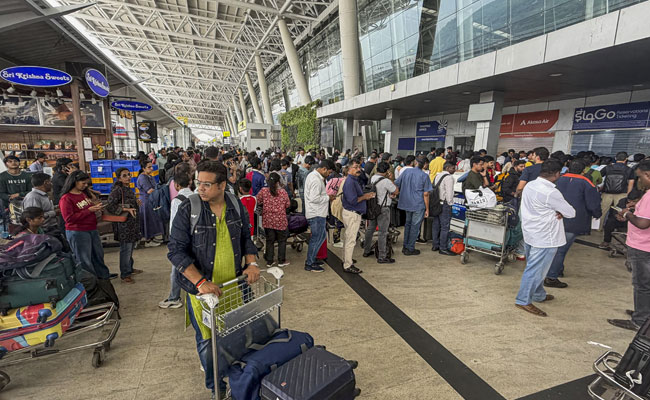
Mumbai (PTI): Domestic carrier IndiGo has cancelled over 200 flights from Delhi and Mumbai on Saturday, a day after managing to temporarily secure major relaxations in the second phase of the court-mandated new flight duty and rest period norms for cockpit crew, sources said.
Of these cancelled flights, 109 IndiGo flights were cancelled at Mumbai airport, 51 arrivals and 58 departures, and 106 flights at Delhi airport, which included 54 departures and 52 arrivals, they said.
On Friday, when IndiGo cancelled over 1,000 flights from across airports, IndiGo CEO Pieter Elbers, after maintaining a stoic silence over the grave crisis for three days, apologised in a video message for the major inconvenience caused to passengers due to the disruptions.
ALSO READ: Indigo fiasco: B'luru airport suffers disruptions; over 102 services cancelled, KIAL issues advisory
In the one-way video communication, Elbers also said that the airline was expecting fewer than 1,000 flights on Saturday.
It may be mentioned here that on Friday, DGCA provided temporary relief to IndiGo, which is partially owned by Rahul Bhatia, by way of rolling back the night duty definition to 12 am-5 am from 12 am-6 am earlier, and allowing its pilots to do six night-landings from two earlier, besides other relaxations.
Meanwhile, the pilots' body, Airlines' Pilots Association (ALPA) India, has taken a "strong" objection to the DGCA's "selective and unsafe" relief to IndiGo, saying that the relaxations have not just "destroyed regulatory parity but also placed millions of passengers at "heightened risk".
Following the meeting convened by the Ministry of Civil Aviation with ALPA India and other pilot associations on December 5, the Ministry announced that it has decided to place the implementation of the revised FDTL CAR in abeyance.
"ALPA India expresses its deep concern that this step directly contradicts the Court's directions, which mandate the enforcement of fatigue-mitigation standards rooted in aviation science," the Association said in a statement late Friday.
It stated that keeping the FDTL in abeyance not only undermines judicial authority but also heightens the risk to pilots and passengers by delaying essential fatigue protections.
"We urge the (Civil Aviation) Ministry and the regulator to uphold the Court's order in both letter and spirit and to prioritise the safety of the pilots and travelling public above all commercial considerations," ALPA India said.
ALSO READ: IndiGo cancels over 1,000 flights on Friday; expects situation to normalise by Dec 10-15: CEO
It is worth noting that IndiGo was the first carrier to oppose the new FDTL norms for pilots when they were introduced in January 2024, with a March implementation timeline.
It had been argued that the airlines require more time to put in place due to additional crew requirements. The latest FDTL norms, which entail increased weekly rest periods to 48 hours, extended night hours, and limiting the number of night landings to only two, as against six earlier, were initially also opposed by domestic airlines, including IndiGo and Tata Group-owned Air India.
But they were subsequently rolled out by the DGCA following the Delhi High Court's directives, albeit with a delay of over one year, in a phased manner, and with certain variations for airlines like IndiGo and Air India.
While the first phase of these FDTL norms came into force in July, the second phase, which reduced the number of night landings from six to two earlier, was implemented from November 1.
The norms were originally to be put in place in March 2024.
Let the Truth be known. If you read VB and like VB, please be a VB Supporter and Help us deliver the Truth to one and all.
CM Siddaramaiah alleges ‘criminal conspiracy’ in Sringeri recount, vows legal action
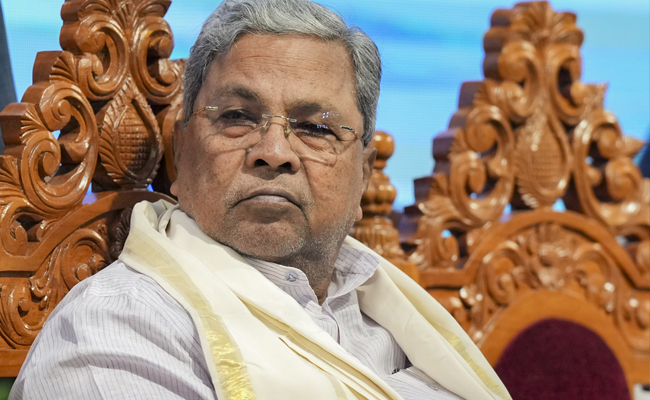
Bengaluru (PTI): Alleging a “criminal conspiracy” by BJP candidate D N Jeevaraj in the Sringeri Assembly poll recounting, Karnataka CM Siddaramaiah on Tuesday said the outcome was manipulated after valid postal ballot votes in favour of Congress leader T D Raje Gowda were tampered with during the recounting process.
Following a Karnataka High Court order on an election petition filed by Jeevaraj, challenging Raje Gowda’s election, the reverification and recounting were conducted on Saturday.
After the reverification and recount of postal ballots for the Sringeri Assembly constituency, votes polled in favour of Raje Gowda were reduced by 255, the returning officer said.
A report on the matter has been submitted to the Election Commission of India for further action, the officer added.
Congress leader Raje Gowda had won the 2023 Assembly polls from Sringeri by 201 votes, defeating his nearest rival Jeevaraj.
Addressing a press conference in Bengaluru, Siddaramaiah said the High Court had directed the recounting of postal ballots and that irregularities were noticed during the exercise conducted on May 2.
“This is a clear case of criminal conspiracy,” Siddaramaiah said, alleging that valid votes cast in favour of Raje Gowda were altered after being accepted by counting agents of all parties, including Congress, BJP, and JD(S).
He claimed that during the recounting of postal ballots, 255 votes were initially accepted as valid by all agents but were later tampered with by subordinate officials.
“There is a second mark on the votes polled in favour of Raje Gowda. They had accepted these as valid votes. Subsequently, another mark was made by officials. This is a clear case of criminal conspiracy,” he said.
When asked who was behind the alleged conspiracy, the CM replied, “It was hatched by Jeevaraj and others. It is planned.”
Siddaramaiah further alleged that the returning officer acted improperly by declaring the result despite the presence of an Election Commission observer during the recounting.
“Immediately after the counting, the returning officer announced the result. He should not have done so; this is against the law,” he said.
He pointed out that Raje Gowda had originally won by 201 votes, but after the recounting, the BJP candidate was declared the winner by 52 votes.
“The BJP has committed a criminal act of conspiracy. This is not vote chori but vote dacoity,” he alleged.
The CM said a police complaint had already been filed by Raje Gowda’s election agent, Sudhir Kumar, and emphasised the need for electoral integrity.
“We want transparency and free and fair elections. That is what our Constitution mandates,” he added.
Stating that the government would pursue legal remedies, Siddaramaiah said, “We are preparing an appeal challenging the returning officer’s announcement in a court of law.”
Responding to a separate query on elections in other states, the CM said there appeared to be an anti-incumbency factor in West Bengal, while results in Tamil Nadu were “surprising,” adding that Vijay’s party was emerging as the largest there.
Following the victory of party candidates in Bagalkote and Davanagere South, Siddaramaiah expressed confidence about future electoral prospects in Karnataka.
“Even in 2028, we will win the Assembly elections. We will come back,” the CM said.
Siddaramaiah added that he would order a forensic examination into the alleged tampering of postal ballots.