IndiGo crisis enters day 7; 127 flights cancelled from Bengaluru
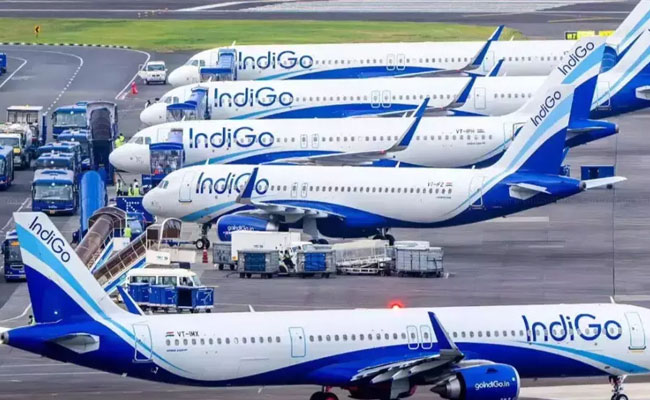
Mumbai (PTI): Flight disruptions at IndiGo entered the seventh day as the crisis-hit carrier cancelled 127 flights from Bengaluru Airport on Monday, a source said.
In another development, aviation safety regulator DGCA in an order on Sunday late evening extended the time by Monday 6 pm for IndiGo CEO Pieter Elbers and Chief Operating Officer and Accountable Manager Isidro Porqueras to submit reply to its show cause notice over the ongoing disruptions in the airline’s operations.
In the notices issued to Elbers and Porqueras on Saturday, the regulator said the large-scale operational failures pointed to significant lapses in planning, oversight, and resource management, and asked them to submit their replies within 24 hours.
IndiGo has cancelled 127 flights, including 65 arrivals and 62 departures from Bengaluru Airport, the source said.
ALSO READ: IndiGo cancels over 650 flights on Sun; ops slowly stabilise
The Gurugram-based airline, partially-owned by Rahul Bhatia, has been facing heat from both the government and the passengers for cancelling hundreds of flights since December 2, citing regulatory changes in the pilots' new flight duty and regulations norms, which resulted in lakhs of passengers getting stuck at airports pan-India.
For the first three days the airline failed to acknowledge the huge number of cancellations and it was only Friday when it cancelled 1,600 flights (Friday), a record in Indian aviation history that CEO Elbers released a video apologising for the major inconvenience caused to passengers due to the disruptions.
In the message, he admitted that the airline was cancelling a large number of flights, but did not mention that it would cancel 1,600 flights on that particular day.
The new norms, applicable for all domestic carriers, have come into force in two phases - July 1 and November 1 this year.
IndiGo has already temporarily secured major relaxations in the second phase norms till February 10.
The latest FDTL norms, which entail increased weekly rest periods to 48 hours, extended night hours, and limiting the number of night landings to only two, as against six earlier, were initially opposed by domestic airlines, including IndiGo and Tata Group-owned Air India.
But they were subsequently rolled out by the DGCA following the Delhi High Court's directives, albeit with a delay of over one year, in a phased manner, and with certain variations for airlines like IndiGo and Air India.
The norms were originally to be put in place from March 2024, but airlines, including IndiGo, sought a step-by-step implementation, citing additional crew requirements.
Let the Truth be known. If you read VB and like VB, please be a VB Supporter and Help us deliver the Truth to one and all.
Thumbay Group begins work on Sharjah’s first private integrated psychiatric, rehabilitation hospital
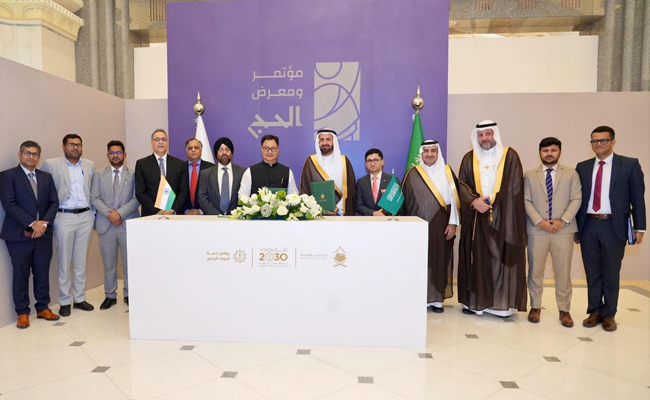
Sharjah: Thumbay Group has laid the foundation stone for the Thumbay Psychiatric and Rehabilitation Hospital at Sharjah Healthcare City, a 120-bed facility that the company says will be the region’s first private, fully integrated hospital dedicated to psychiatric care, neuro-rehabilitation and addiction recovery.
The groundbreaking ceremony was led by Dr. Abdelaziz Saeed Al Mheiri, who is also a member of the Sharjah Executive Council, in the presence of Dr. Thumbay Moideen.
Spread across 110,000 square feet, the hospital is being developed to address growing demand for specialised mental health and rehabilitation services in the UAE and the wider Gulf region.
The facility will include inpatient and outpatient services in psychiatry, neuro-rehabilitation, addiction treatment, child and adolescent mental health, and care for mood and anxiety disorders. It will also feature VIP inpatient villas designed to provide privacy and support long-term recovery.
A mosque, named the Thumbay Masjid, will be constructed within the campus and will be open to the public.
The hospital is being designed to meet standards for Commission on Accreditation of Rehabilitation Facilities (CARF), an internationally recognised accreditation system for rehabilitation facilities.
Speaking at the event, Dr. Abdelaziz Saeed Al Mheiri said the project reflects Sharjah’s commitment to strengthening healthcare infrastructure in all aspects of wellbeing.
“Mental health and rehabilitation have long needed dedicated infrastructure, and we are proud to support a private partner whose vision matches the ambition of this Emirate,” he said.
Dr. Thumbay Moideen said the project was a response to a growing need for specialised mental healthcare services in the region.
“We have spent over three decades building healthcare in this region, and the one conversation that has grown louder every year is mental health. Families have been carrying this quietly for too long. This hospital is our answer. It is purpose-built, not retrofitted, and it has been designed around dignity, recovery, and outcomes that families can trust,” he said.
Construction is scheduled to begin in June 2026, and the hospital is expected to become operational by mid-2027.
Once completed, the facility will become part of Thumbay Group’s network of healthcare, education and diagnostic institutions across the UAE.