Iran-Israel War: India ramps up oil imports from Russia, US in June
New Delhi (PTI): India has ramped up purchases of Russian oil in June, importing more than the combined volumes from Middle Eastern suppliers such as Saudi Arabia and Iraq, amid market volatility triggered by Israel's dramatic attack on Iran.
The US military struck three sites in Iran early Sunday, directly joining Israel which first struck Iranian nuclear sites on June 13.
Indian refiners are likely to import 2-2.2 million barrels per day of Russian crude oil in June - the highest in the last two years and more than the total volumes bought from Iraq, Saudi Arabia, the UAE and Kuwait, preliminary data by global trade analytics firm Kpler showed.
India's oil imports from Russia were 1.96 million barrels per day (bpd) in May.
Imports from the United States also rose to 439,000 bpd in June, a big jump from 280,000 bpd purchased in the previous month.
Full-month projections for imports from the Middle East stand at around 2 million bpd, lower than the previous month's buying, according to Kpler.
India, the world's third-largest oil-importing and consuming nation, bought from abroad around 5.1 million barrels of crude oil, which is converted into fuels like petrol and diesel in refineries.
India, which has traditionally sourced its oil from the Middle East, began importing a large volume of oil from Russia soon after the invasion of Ukraine in February 2022. This was primarily because Russian oil was available at a significant discount to other international benchmarks due to Western sanctions and some European countries shunning purchases.
This led to India's imports of Russian oil seeing a dramatic rise, growing from less than 1 per cent of its total crude oil imports to a staggering 40-44 per cent in a short period.
The conflict in the Middle East has so far not impacted oil supplies.
"While supplies remain unaffected so far, vessel activity suggests a decline in crude loadings from the Middle East in the coming days," Sumit Ritolia, Lead Research Analyst, Refining & Modeling at Kpler, told PTI.
"Shipowners are hesitant to send empty tankers (ballasters) into the Gulf, with the number of such vessels dropping from 69 to just 40, and (Middle East and Gulf) MEG-bound signals from the Gulf of Oman halving."
This suggests that current MEG supplies are likely to tighten in the near term, potentially triggering future adjustments in India's sourcing strategy, he said.
The Strait of Hormuz, which lies between Iran to the north and Oman and the United Arab Emirates to the south, serves as the main route for oil exports from Saudi Arabia, Iran, Iraq, Kuwait, and the UAE. Many liquefied natural gas (LNG) shipments, especially from Qatar, also pass through the strait.
As the military conflict between Israel and Iran escalates, Tehran has threatened to close the Strait of Hormuz, through which a fifth of the world's oil and a major LNG export transit. India imports about 40 per cent of all its oil and about half of its gas through the narrow Strait.
According to Kpler, concerns over a potential closure of the Strait of Hormuz have intensified following Israel's pre-emptive strikes on Iranian military and nuclear infrastructure. Iranian hardliners have threatened closure, and state media have warned of oil spiking to USD 400 per barrel.
"Yet, Kpler analysis assigns a very low probability to a full blockade, citing strong disincentives for Iran," Ritolia said.
This is because China, Iran's largest oil customer (which imports 47 per cent of its seaborne crude from the Middle East Gulf), would be directly impacted. Also, Iran's reliance on Hormuz for oil exports via Kharg Island (handles 96 per cent of its exports) makes self-blockade counterproductive.
Additionally, Tehran has made deliberate efforts over the past two years to rebuild ties with key regional actors, including Saudi Arabia and the UAE, both of which rely heavily on the Strait for exports and have publicly condemned Israel's actions. Sabotaging their flows would risk unraveling those diplomatic gains.
A closure would also provoke international military retaliation. Any Iranian naval build-up would be detectable in advance, likely triggering a preemptive US and allied response. At most, isolated sabotage efforts could disrupt flows for 24-48 hours, the estimated time required for US forces to neutralise Iran's conventional naval assets, according to Kpler.
Any such move would provoke military retaliation and diplomatic fallout with Oman, undermining Iran's own backchannels with the US.
Ritolia said India's import strategy has evolved significantly over the past two years.
Russian oil (Urals, ESPO, Sokol) is logistically detached from Hormuz, flowing via the Suez Canal, Cape of Good Hope, or Pacific Ocean.
Indian refiners have built refining and payment flexibility, while optimizing runs for a wider crude slate. Even US, West African, and Latin American flows - though costlier - are increasingly viable backup options.
"India's June volumes from Russia and the US confirm this resilience-oriented mix," he said. "If conflict deepens or there is any short-term disruption in Hormuz, Russian barrels will rise in share, offering both physical availability and pricing relief. India may pivot harder toward the US, Nigeria, Angola, and Brazil, albeit at higher freight costs.
Also, India may tap its strategic reserves (covering 9-10 days of imports) to bridge any shortfall.
Let the Truth be known. If you read VB and like VB, please be a VB Supporter and Help us deliver the Truth to one and all.
4 workers die after being buried under coal slurry in Jharkhand's Dhanbad
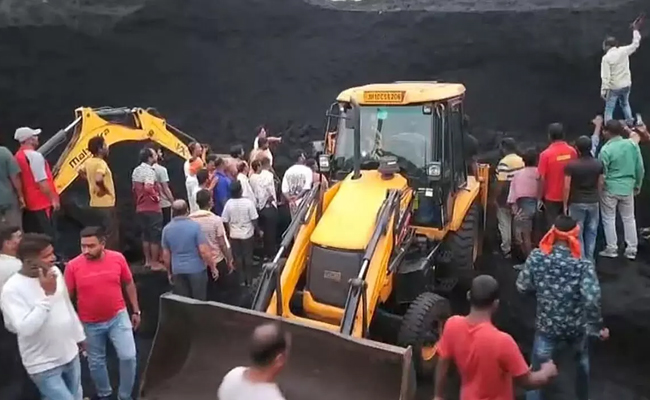
Dhanbad (Jharkhand) (PTI): At least four workers died after being buried under coal slurry in Jharkhand's Dhanbad district on Saturday, a police official said.
The incident took place at Moonidih coal washery in the command area of Bharat Coking Coal Limited (BCCL).
"Bodies of all four workers were dug out of debris during a rescue operation," Putki police station in-charge Waqar Hussain told PTI.
The incident took place when coal slurry was being loaded into trucks by workers, during which a large chunk of slurry fell and trapped several workers underneath, officials said.
The deceased have been identified as Manik Bauri, Dinesh Bauri, Deepak Bauri, and Hemlal Gope.
Meanwhile, the family members of the deceased and local villagers placed the bodies in front of the washery gate and began a protest.
They demanded compensation, jobs for dependents and action against those responsible for the incident.
Police and administration officials are trying to pacify the protesters, an official said.