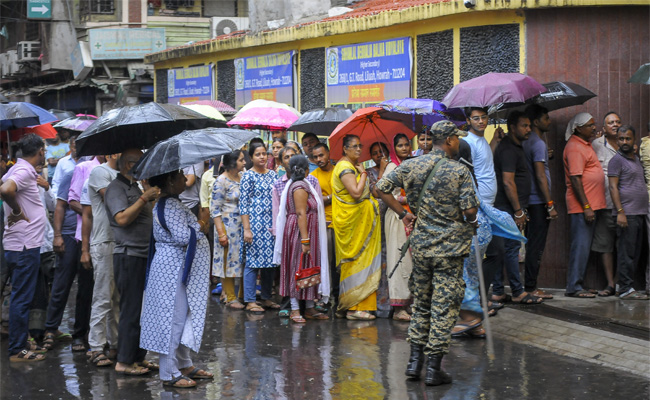
J&K cloudburst: 60 dead, 69 missing, over 100 hurt; PM Modi promises all assistance
_vb_34.jpeg)
New Delhi/Kishtwar (PTI): Prime Minister Narendra Modi spoke with Jammu and Kashmir Chief Minister Omar Abdullah and Lieutenant Governor Manoj Sinha on Friday and assured them of all help in the wake of a cloudburst in Kishtwar district that has killed at least 60 people and injured more than 100, officials said.
A massive flash flood triggered by the cloudburst struck the remote mountain village of Chisoti in Kishtwar on Thursday. Authorities have so far identified 30 of the bodies retrieved, the officials said on Friday.
Modi spoke with Abdullah and Sinha and took stock of the situation.
In a post on X, the prime minister said, "Spoke to Jammu and Kashmir LG, Shri Manoj Sinha Ji and CM Shri Omar Abdullah Ji regarding the situation in the wake of the cloudburst and flooding in Kishtwar."
"Authorities are working on the ground to assist those affected," he added.
Earlier, addressing an Independence-Day function at Srinagar's Bakshi Stadium, Abdullah said at least 60 people have been killed and more than 100 injured in the tragic incident.
There were two Central Industrial Security Force (CISF) personnel among the deceased.
To identify the deceased, the authorities shared their pictures through a WhatsApp group with the affected families, resulting in the identification of 30 of them.
More than 160 people have so far been rescued and the condition of 38 of them is said to be serious.
The officials said the death toll could go up as more people are believed to be trapped.
The Union Territory administration has set up a control room-cum-help desk in Paddar, about 15 km from Chositi, to assist people and pilgrims.
Five officials have been put on duty at the control room. The numbers provided are -- 9858223125, 6006701934, 9797504078, 8492886895, 8493801381, and 7006463710.
Since the tragedy struck, the help desk has received scores of distress calls, the officials said, adding that the authorities are trying to trace 69 people reported missing by their families at the help desk.
"We have shared the pictures of the bodies with them," an official said.
There are two villages ahead of the cloudburst-hit belt -- Machail and Hamori -- where hundreds of people are stranded, the officials said, adding that their mobile phone batteries have been exhausted due to the snapping of the power supply to the belt following the disaster.
Once contact is established, authorities will get to know the exact whereabouts of these people, they said.
Fresh search operations will also dig out more victims from the debris and mud in the area, the officials said.
The villagers said they had seen 10 bodies floating in the Chenab river.
Chisoti, a base camp for the annual Machail Mata Yatra, was bustling with pilgrims when the disaster struck between 12 noon and 1 pm on Thursday.
A large number of people had gathered there for the pilgrimage that began on July 25 and was scheduled to end on September 5. The 8.5-km trek to the 9,500-foot shrine begins from Chisoti, which is located about 90 km from Kishtwar town. The yatra remained suspended for the second day on Friday.
The floods, accompanied by mudslides and debris flows, buried houses, shops and vehicles.
At least 16 residential houses and government buildings, three temples, four water mills and a 30-metre span bridge, besides more than a dozen vehicles, were damaged in the flash floods in Chisoti and downstream, the officials said.
The flash floods also swept away a security camp and several vehicles parked at the bus stand. A temple in the middle of the flooded area miraculously survived.
A langar (community kitchen) set up for the devotees bore the brunt of the cloudburst, which caused flash floods and washed away several structures, including shops and a security outpost.
Many vehicles at the bus stand, the starting point for the foot journey to the Himalayan temple of Machail Mata, were severely damaged by floodwaters and mud.
A National Disaster Response Force (NDRF) team reached Chisoti on Friday.
"The NDRF team is joining the operation currently underway in the village. They reached Gulabgarh late in the night," Kishtwar Deputy Commissioner Pankaj Sharma told PTI.
Sharma, who is supervising the operation, said choppers could not be operated due to bad weather, so the NDRF team came by road from Udhampur.
Two more teams are on their way and will be joining the operation, the officials said.
The Army has also inducted one more column to intensify the search-and-rescue operations, they said. Rashtriya Rifles troops have joined the operation.
Five columns of 60 personnel each, totalling 300 troops, along with medical detachments of the White Knight Corps, are on the ground, working tirelessly in coordination with police, the State Disaster Response Force (SDRF) and civilian agencies to save lives and assist those in need.
Volunteer teams of Ababeel, with nine ambulances, reached the village and joined the operation on Thursday, said Adil, one of the members.
Another group, Hilal Volunteers, also joined in the rescue operation and ferried the injured to hospitals.
Despite rains, the rescue-and-relief operations resumed early on Friday after a night-long pause to look for survivors feared trapped under rubble and mud.
Several earth-movers requisitioned by the district administration joined the operation to move giant boulders, uprooted trees and electricity poles to speed up the rescue-and-relief operation, the officials said.
Videos showed torrents of muddy water, silt and rubble tearing through the steep slopes, destroying everything on the way. Houses folded over like a pack of cards, rocks came tumbling down, blocking roads and rescue paths.
The deputy commissioner, along with Senior Superintendent of Police, Kishtwar, Naresh Singh, is camping in the area to oversee the multi-agency operation on the ground.
The Jammu and Kashmir health and medical education department has reinforced critical infrastructure to ensure optimal patient care in the wake of the tragedy.
A health department official said a team of specialist doctors from PGI-Chandigarh is slated to reach the Government Medical College (GMC) in Jammu to assist in medical care and bolster critical-care capabilities.
According to the official, critical health infrastructure has been reinforced at a sub-district hospital close to the cloudburst site, with an additional deployment of 13 doctors and 31 paramedics.
Senior officers of the department are stationed at Padder, overseeing rescue and medical operations, he said, adding that the district hospital at Kishtwar has been prepped up with the additional deployment of general and orthopaedic surgeons, and anaesthetists from the GMC in Doda.
Tertiary-care institutions have been put in a state of full readiness, the officials said, adding that a team comprising specialists has been readied at the GMC-Doda to manage the patients being referred from the Kishtwar district hospital.
The GMC-Jammu is in full operational readiness with 50 dedicated disaster beds, 20 ventilator beds and five operating theatres, another official said.
He said specialist medical teams, comprising orthopaedic surgeons, neurosurgeons, critical-care anaesthetists and maxillofacial consultants, are on standby. The GMC-Jammu blood bank has kept more than 200 units for any exigency.
Immediately following the incident, 65 ambulances from the health department, NHPC, Army, CRPF and 108 Emergency Service of the Jammu and Kashmir health and medical education department were deployed for rescue and patient transfer, the official said.
Let the Truth be known. If you read VB and like VB, please be a VB Supporter and Help us deliver the Truth to one and all.
Rickelton's ton in vain as SRH beat MI by 6 wickets
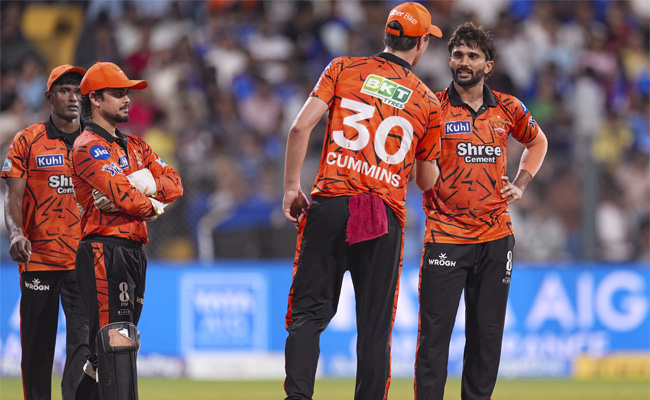
Mumbai (PTI): Ryan Rickelton's whirlwind unbeaten ton was overshadowed by Heinrich Klaasen's unbeaten 65 as Sunrisers Hyderabad defeated Mumbai Indians by six wickets in an IPL match here on Wednesday.
Chasing an imposing 244-run target, Travis Head (76 off 30) and Abhishek Sharma (45 off 24) shared 129 runs for the opening wicket to set the platform for SRH.
Klaasen (65 not out off 30 balls) then displayed his all-round hitting abilities to guide SRH home with the help of Nitish Kumar Reddy (21) and Salil Arora (30 not out off 10) in 18.4 overs.
Earlier, Rickelton's knock powered MI to 243 for five.
MI rode on a 93-run stand between Rickelton (123 not out off 55 balls) and Will Jacks (46 off 22) in 7.1 overs for the opening stand to power the side.
MI skipper Hardik Pandya scored a valuable 31 off 15 balls before being dismissed.
Praful Hinge (2/54), Eshan Malinga (1/29), Sakib Hasan (1/39) and Nitish Kumar Reddy (1/31) were the wicket-takers for SRH.
Brief Scores:
Mumbai Indian: 243 for 5 in 20 overs (Ryan Rickelton 123 not out; Praful Hinge 2/54).
Sunrisers Hyderabad: 249 for 4 in 18.4 overs (Travis Head 76, Heinrich Klaasen 65 not out; AM Ghazanfar 2/51).